All species › Passerines › Thrushes and allies › Clay-colored Thrush
Position in the tree Birds Aves › Birds with a flexible palate Neognathae › All other modern birds Neoaves › Landbirds Telluraves › Falcons, parrots and passerines Australaves › Falcons and passerines Eufalconimorphae › Parrots and passerines Psittacopasserae
Clay-colored Thrush | Turdus grayi
Grays lijster | Mirlo pardo
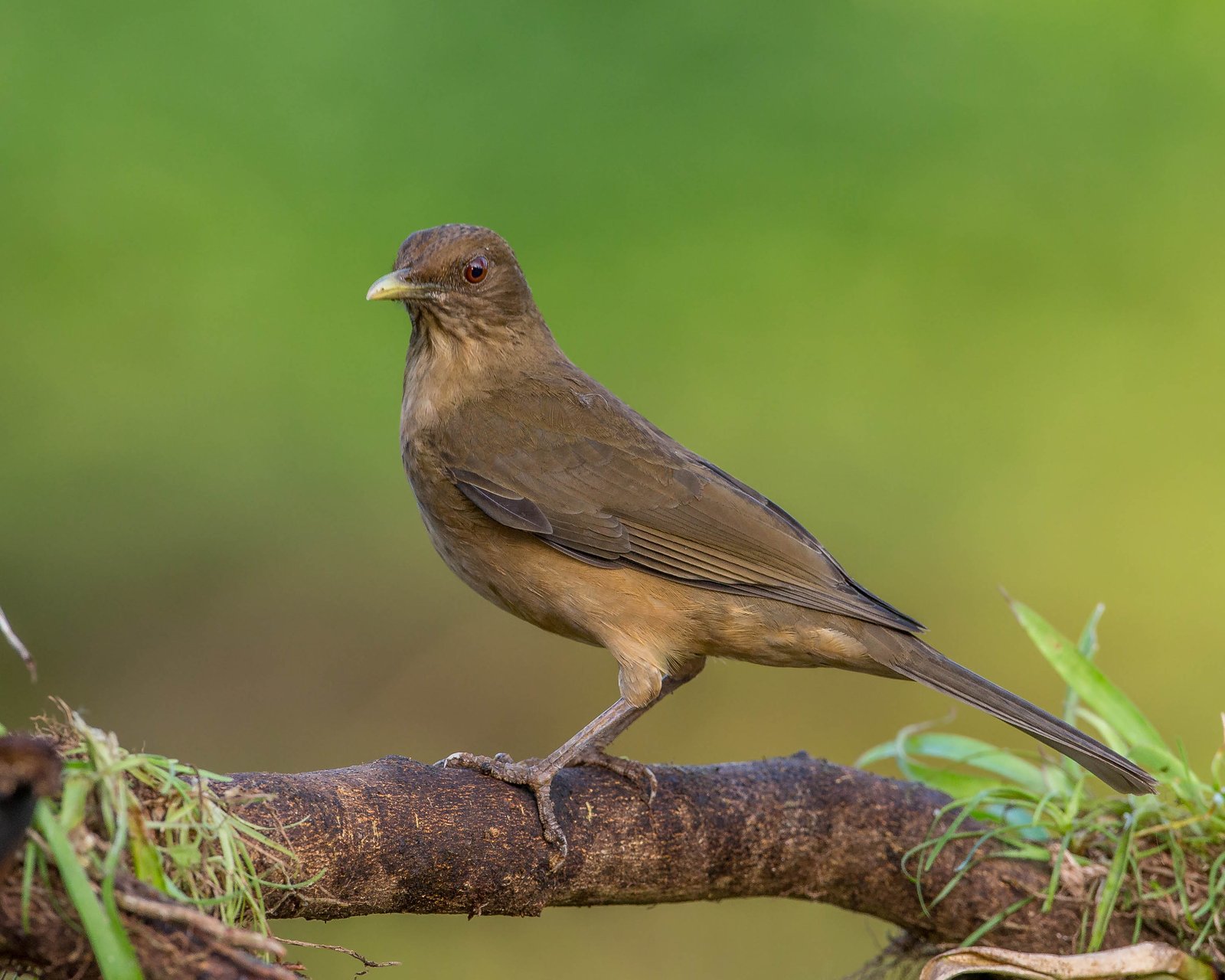
The Clay-colored Thrush is a plain buffy-brown thrush that is common in gardens, parks, plantations and forest edges from eastern Mexico to Panama. It is often the most visible thrush in villages and towns and sings mainly towards the end of the dry season. In Costa Rica, as the yigüirro, it is the national bird.
Voice
The song is a long, unhurried series of clear, whistled and flowing phrases, often from dawn until well into the morning. Calls include a drawn-out, nasal, mewing keeyah and a dry tock.
Recording: Leander Khil — CC BY-NC-SA 4.0 · converted to mono · xeno-canto
Identification
23–27 cm. Upperparts uniform olive-brown to buffy brown. Underparts paler, warm sandy to ochre-buff. Throat dull white with fine brown streaks. Bill yellowish olive to yellow, legs pinkish to greyish brown, iris reddish brown. No distinct eye-ring. The sexes are alike; juveniles have pale spots above and dark spots on the breast.
Confusion species
White-throated Thrush Turdus assimilis is greyer brown, has a white crescent below the heavily streaked throat and a yellow eye-ring, and lives in forest. Pale-vented Thrush Turdus obsoletus is darker, warmer brown, with a clean white lower belly and a dark bill. Mountain Thrush Turdus plebejus is greyer olive-brown with a blackish bill and lives in montane forest.
Habitat
Semi-open country with trees: forest edges, secondary forest, riparian woodland, shade coffee, cacao and other plantations, pastures with trees, villages, parks and gardens; from sea level to about 2400 m. It searches lawns and bare ground for earthworms and insects and eats much fruit.
Where the bird is most at home, classified by the vegetation units of Mexico and Central America.






Range and movements
On the Gulf slope of Mexico from southern Tamaulipas and San Luis Potosí, on the Yucatán Peninsula and on the Pacific slope from southern Mexico, through all of Central America to Panama. Outside the guide area in northern Colombia; increasing in the far south of Texas.
- Resident
- dark = core range, pale = thinly spread
How and when to look
In much of Central America seen in city parks and gardens, for example in the Central Valley of Costa Rica. It often feeds on lawns and sings most towards the end of the dry season.
Conservation status
Not threatened (LC). Very common and benefits from deforestation and the spread of gardens, plantations and semi-open farmland.
Scientific name
Turdus grayi | Bonaparte, 1838
Bonaparte described the species in 1838 and placed it straight away in the genus where it still stands. The genus Turdus was introduced in 1758 by Linnaeus. Turdus is the ordinary Latin word for 'thrush'. grayi honours the British zoologist George Robert Gray (1808–1872), curator of birds at the British Museum. The specimen the first description was based on came from Alta Verapaz, Guatemala.