All species › Passerines › Munias, parrotfinches, waxbills and allies › Scaly-breasted Munia
Position in the tree Birds Aves › Birds with a flexible palate Neognathae › All other modern birds Neoaves › Landbirds Telluraves › Falcons, parrots and passerines Australaves › Falcons and passerines Eufalconimorphae › Parrots and passerines Psittacopasserae
Scaly-breasted Munia | Lonchura punctulata
Muskaatvink | Capuchino punteado
The Scaly-breasted Munia is a small estrildid finch from South and South-East Asia that has spread around the world as a cage bird. In the guide area it has become established in a few places: north-western Baja California, the Yucatán Peninsula and around Tegucigalpa in Honduras. It lives in flocks in gardens, parks and weedy grassland.
Voice
A soft, plaintive kee-tee or tee-tee, often given in chorus by the flock. The song is a soft, barely audible series of whistles and clicks.
Recording: Bo Shunqi 薄顺奇 — CC BY-NC-SA 4.0 · converted to mono · xeno-canto
Identification
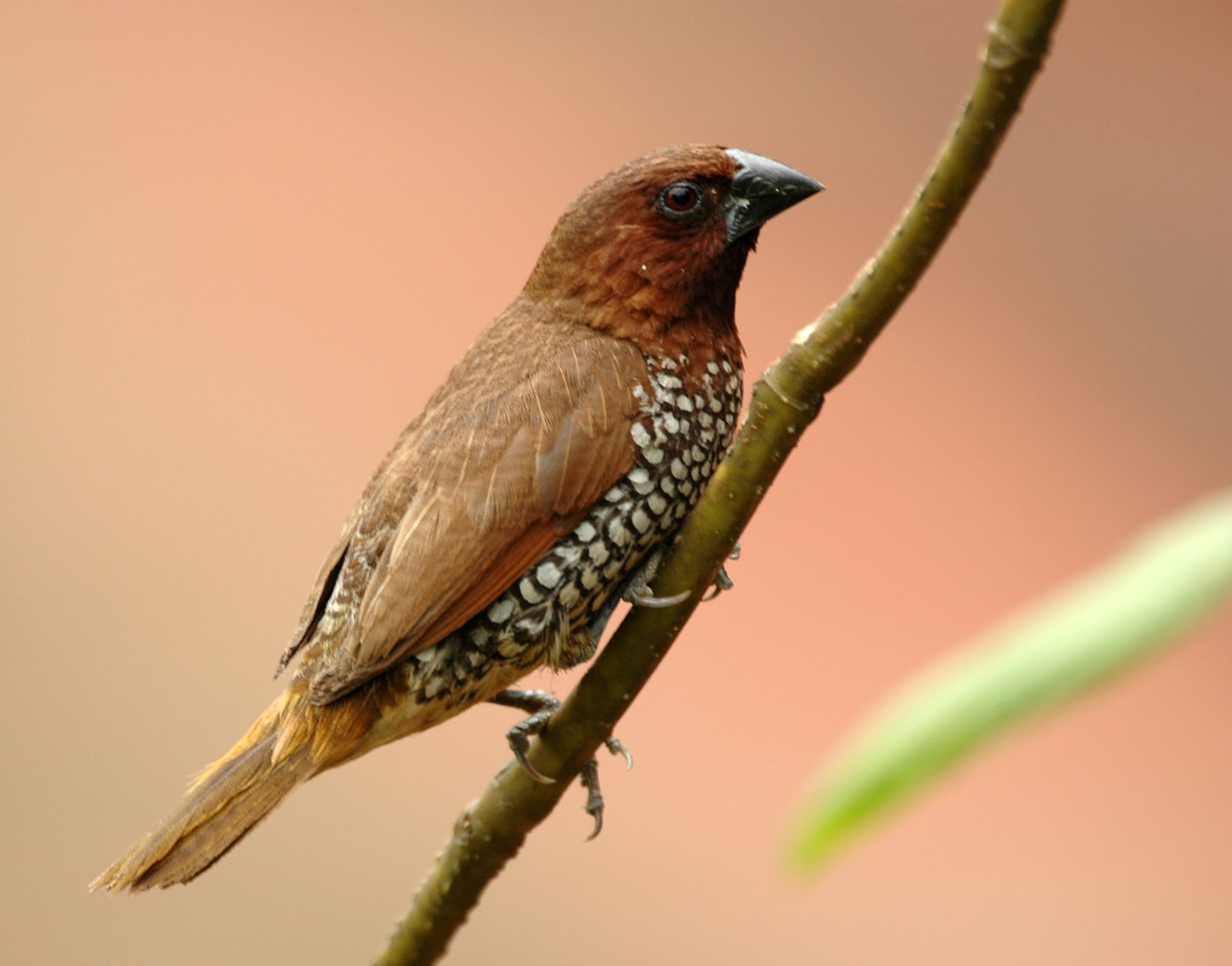
11–12 cm. Compact, with a short, rounded tail and a thick, dark bluish-grey conical bill. Head, throat and upperparts warm brown. The white underparts are densely marked with dark brown scales; centre of belly and undertail coverts white. Rump and tail with an olive-yellow wash. The sexes are alike. Young birds are plain brown above and plain light brown below, without scales.
Confusion species
Adults are readily identified by the scaly underparts. Tricolored Munia Lonchura malacca has a black head and white underparts with a black belly centre; young Tricolored Munias are almost identical to young Scaly-breasted Munias. Females of seedeaters such as Variable Seedeater Sporophila corvina and Morelet's Seedeater Sporophila morelleti are olive-brown with a shorter, more rounded bill and pale wing bars or a paler belly. Mixed flocks with adults help with identification.
Habitat
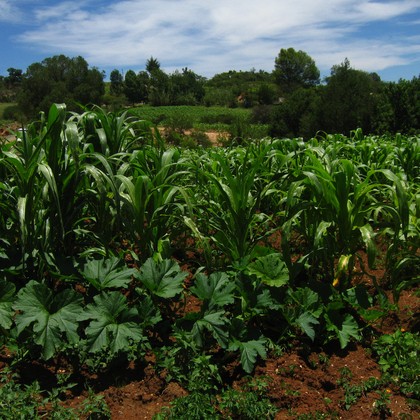
Gardens, parks, vacant lots and roadsides with seeding grasses in and around towns, also fields and weedy grassland. It feeds mainly on grass seeds, taken in small groups from the stems or from the ground. It builds a domed grass nest in a tree, shrub or palm.
Where the bird is most at home, classified by the vegetation units of Mexico and Central America.



Range and movements
Native from India and Sri Lanka to southern China, South-East Asia, the Philippines and Indonesia. Introduced to Hawaii, southern California, Florida, Puerto Rico and other Caribbean islands, among other places. In the guide area established in north-western Baja California (around Tijuana, adjoining the southern California population), on the Yucatán Peninsula (mainly Quintana Roo and Yucatán) and around Tegucigalpa in Honduras.
- Resident
- dark = core range, pale = thinly spread
How and when to look
Best looked for in city parks and gardens with tall, seeding grass in Mérida and Cancún; flocks often perch on the grass stems or low in bushes.
Conservation status
Globally not threatened (LC). In the guide area an introduced species with a few local populations. Little is known about its effects on native seed-eaters.
Scientific name
Lonchura punctulata | (Linnaeus, 1758)
Linnaeus described the species in 1758 as Loxia punctulata; because it was later moved to another genus, the author and year stand in brackets. The genus Lonchura was introduced in 1832 by Sykes. Lonchura is Greek, from lonkhē 'spear-head' and oura 'tail', after the pointed tail. punctulata is modern Latin for 'finely spotted', after the scaly markings on the breast. The specimen the first description was based on came from Calcutta, India.