All species › Passerines › Tyrant flycatchers and allies › Nutting's Flycatcher
Position in the tree Birds Aves › Birds with a flexible palate Neognathae › All other modern birds Neoaves › Landbirds Telluraves › Falcons, parrots and passerines Australaves › Falcons and passerines Eufalconimorphae › Parrots and passerines Psittacopasserae
Nutting's Flycatcher | Myiarchus nuttingi
Bleekkeeltiran | Papamoscas de Nutting
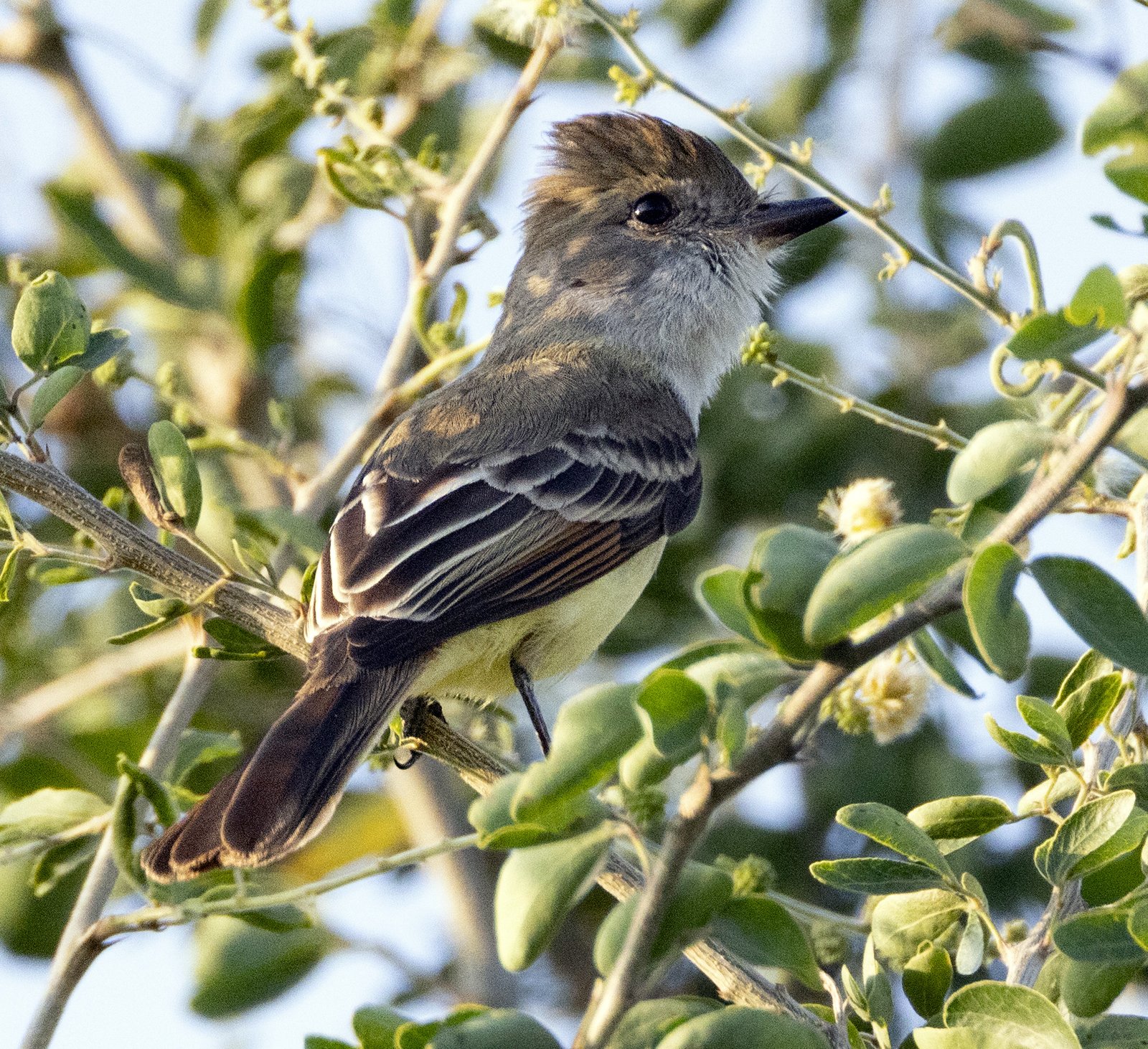
Nutting's Flycatcher is a Myiarchus flycatcher of dry forest and thorn scrub along the Pacific slope of Mexico and Central America. It closely resembles Ash-throated Flycatcher and in the field is best identified by its call.
Voice
A sharp, short wheep or peek, often repeated, and rolling, excited series.
Recording: Manuel Grosselet — CC BY-NC-SA 4.0 · shortened to the first 60 s, mono · xeno-canto
Identification
18 cm. Upperparts greyish olive-brown, crown slightly browner. Wings dark with pale wing-bars and rufous edges to the primaries. Tail with rufous inner webs reaching the tip. Throat and breast pale grey, belly pale yellow. Mouth lining orange. Bill black. Male and female are alike.
Confusion species
Ash-throated Flycatcher Myiarchus cinerascens (mainly a winter visitor in the same area) is slightly larger and paler below, with a flesh-coloured mouth lining and a dark tip to the outer tail feathers. Brown-crested Flycatcher Myiarchus tyrannulus is larger, with a heavier bill. Dusky-capped Flycatcher Myiarchus tuberculifer is smaller, with a dark cap and little rufous in the tail.
Habitat
Dry deciduous forest, thorn scrub, forest edges and riparian woodland in arid regions, from the lowlands into the lower mountains. It sallies for insects from a perch in the lower and middle levels. It nests in a tree cavity.
Where the bird is most at home, classified by the vegetation units of Mexico and Central America.




Range and movements
Found only in the guide area: the Pacific slope of Mexico from southern Sonora southwards, and on through Guatemala, El Salvador, Honduras and Nicaragua to north-western Costa Rica; also in dry interior valleys of Chiapas, Guatemala and Honduras.
- Resident
- dark = core range, pale = thinly spread
How and when to look
In the dry Pacific lowlands three or four Myiarchus species sometimes occur together. The sharp wheep points to Nutting's Flycatcher.
Conservation status
Not threatened. Common in dry forest and scrub.
Scientific name
Myiarchus nuttingi | Ridgway, 1882
Ridgway described the species in 1882 and placed it straight away in the genus where it still stands. The genus Myiarchus was introduced in 1844 by Cabanis. Myiarchus is Greek, from muia 'fly' and arkhos 'ruler': 'fly-ruler'. nuttingi honours the American zoologist Charles Cleveland Nutting (1858–1927), who collected birds in Costa Rica and Nicaragua. The specimen the first description was based on came from Hacienda La Palma on the Gulf of Nicoya, Costa Rica.