All species › Passerines › Tyrant flycatchers and allies › Eastern Wood Pewee
Position in the tree Birds Aves › Birds with a flexible palate Neognathae › All other modern birds Neoaves › Landbirds Telluraves › Falcons, parrots and passerines Australaves › Falcons and passerines Eufalconimorphae › Parrots and passerines Psittacopasserae
Eastern Wood Pewee | Contopus virens
Oostelijke bospiewie | Pibí oriental
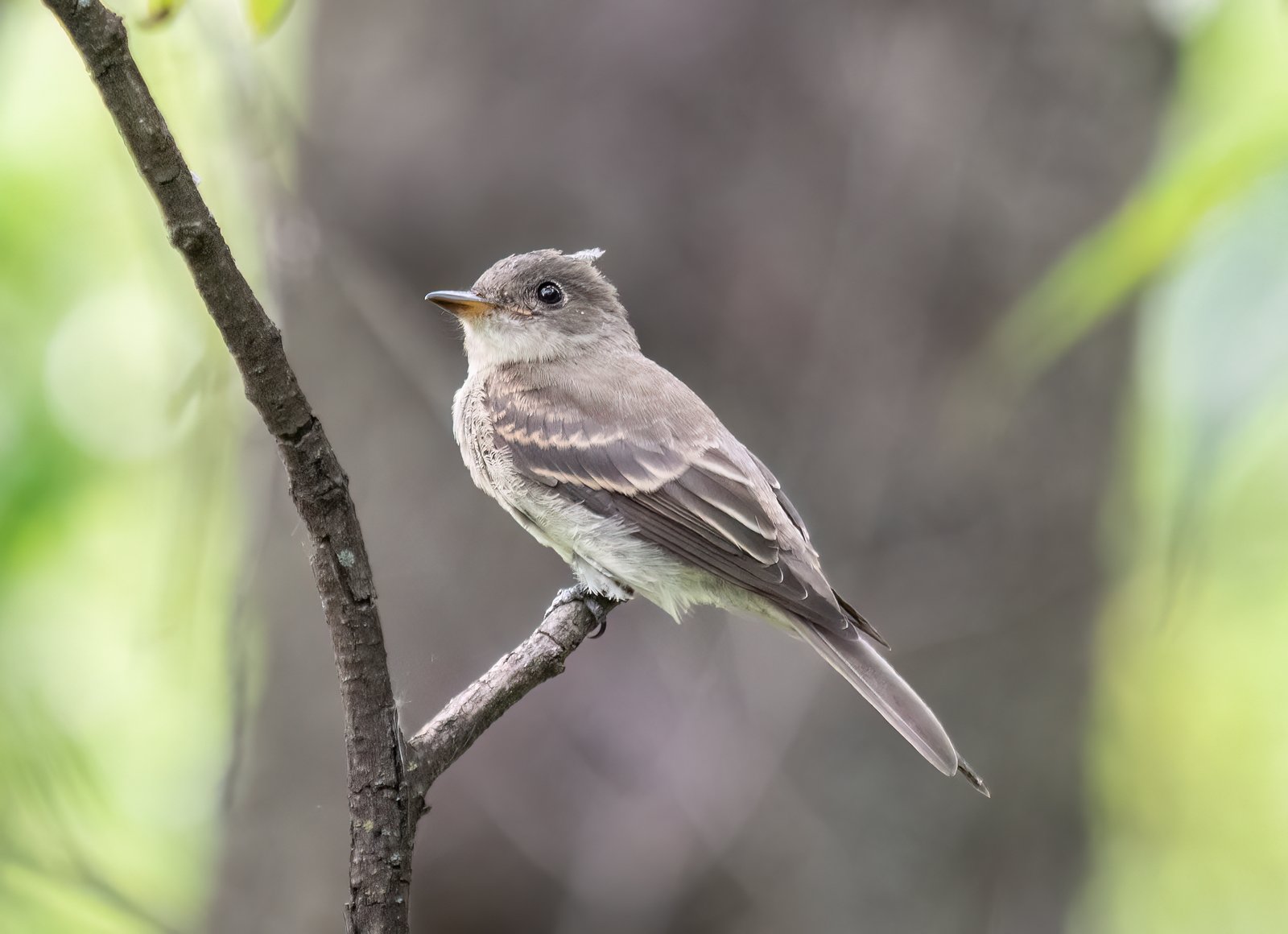
The Eastern Wood Pewee is a small, greyish-olive pewee that breeds in eastern North America and passes through the guide area in spring and autumn on its way to and from South America. It is very similar to the Western Wood Pewee and can only be reliably separated from it by song.
Voice
The song is a clear, drawn-out whistled pee-a-wee, followed by a falling pee-yoo; sometimes heard during spring migration. The calls are a dry chip and a rising chu-weet.
Recording: Rory Nefdt — CC BY-NC-SA 4.0 · converted to mono · xeno-canto
Identification
15–16 cm, with a slightly peaked crown, long wings projecting far beyond the upper tail coverts and a fairly long tail. Upperparts greyish olive, slightly greener than in Western Wood Pewee. Sides of the breast greyish olive, throat and centre of breast and belly dull white, sometimes washed yellowish. Two distinct, dull white wing bars. Lower mandible usually mostly orange-yellow with a dark tip. No eye ring. Male and female are alike.
Confusion species
Western Wood Pewee Contopus sordidulus is darker and greyer, with a darker breast and usually a mostly dark lower mandible; silent birds often cannot be identified with certainty. Northern Tropical Pewee Contopus bogotensis has shorter wings and pale lores. The Empidonax flycatchers have shorter wings, often an eye ring, and move their tail and wings a lot. Olive-sided Flycatcher Contopus cooperi is larger and stockier, with a dark vest and a white central stripe.
Habitat
On migration in humid and semi-humid forest, mainly in the middle and upper levels, at forest edges, clearings, in secondary woodland, gallery forest, shade coffee and gardens with tall trees, mainly in the lowlands and foothills. It perches on an open branch in the shade and sallies from there after insects.
Where the bird is most at home, classified by the vegetation units of Mexico and Central America.






Range and movements
A passage migrant through most of the guide area, mainly on the Gulf and Caribbean side of Mexico, on the Yucatán Peninsula and through Central America to Panama; rare in western and north-western Mexico. In spring mainly in April and May, in autumn from September to early November. Almost absent in winter. Outside the guide area it breeds in eastern North America, from southern Canada to the Gulf of Mexico; it winters mainly in north-western South America.
- Passage (Mar–Apr, Oct–Nov)
- dark = core range, pale = thinly spread
How and when to look
In autumn often at forest edges and in open woodland in the lowlands of the Yucatán Peninsula, Belize and Costa Rica; listen for the rising chu-weet, which can separate silent-looking birds from Western Wood Pewee.
Conservation status
Not threatened, but numbers in North America have declined over recent decades. In the guide area a regular passage migrant.
Scientific name
Contopus virens | (Linnaeus, 1766)
Linnaeus described the species in 1766 as [Muscicapa] virens; because it was later moved to another genus, the author and year stand in brackets. The genus Contopus was introduced in 1855 by Cabanis. Contopus is Greek, from kontos 'pole, shaft' and pous 'foot', after the short legs. virens is Latin for 'green', after the olive tinge of the upperparts. The specimen the first description was based on came from Carolina (USA).