All species › Passerines › Tyrant flycatchers and allies › Northern Scrub Flycatcher
Position in the tree Birds Aves › Birds with a flexible palate Neognathae › All other modern birds Neoaves › Landbirds Telluraves › Falcons, parrots and passerines Australaves › Falcons and passerines Eufalconimorphae › Parrots and passerines Psittacopasserae
Northern Scrub Flycatcher | Sublegatus arenarum
Noordelijke struikvliegenpikker | Mosquero matorralero norteño
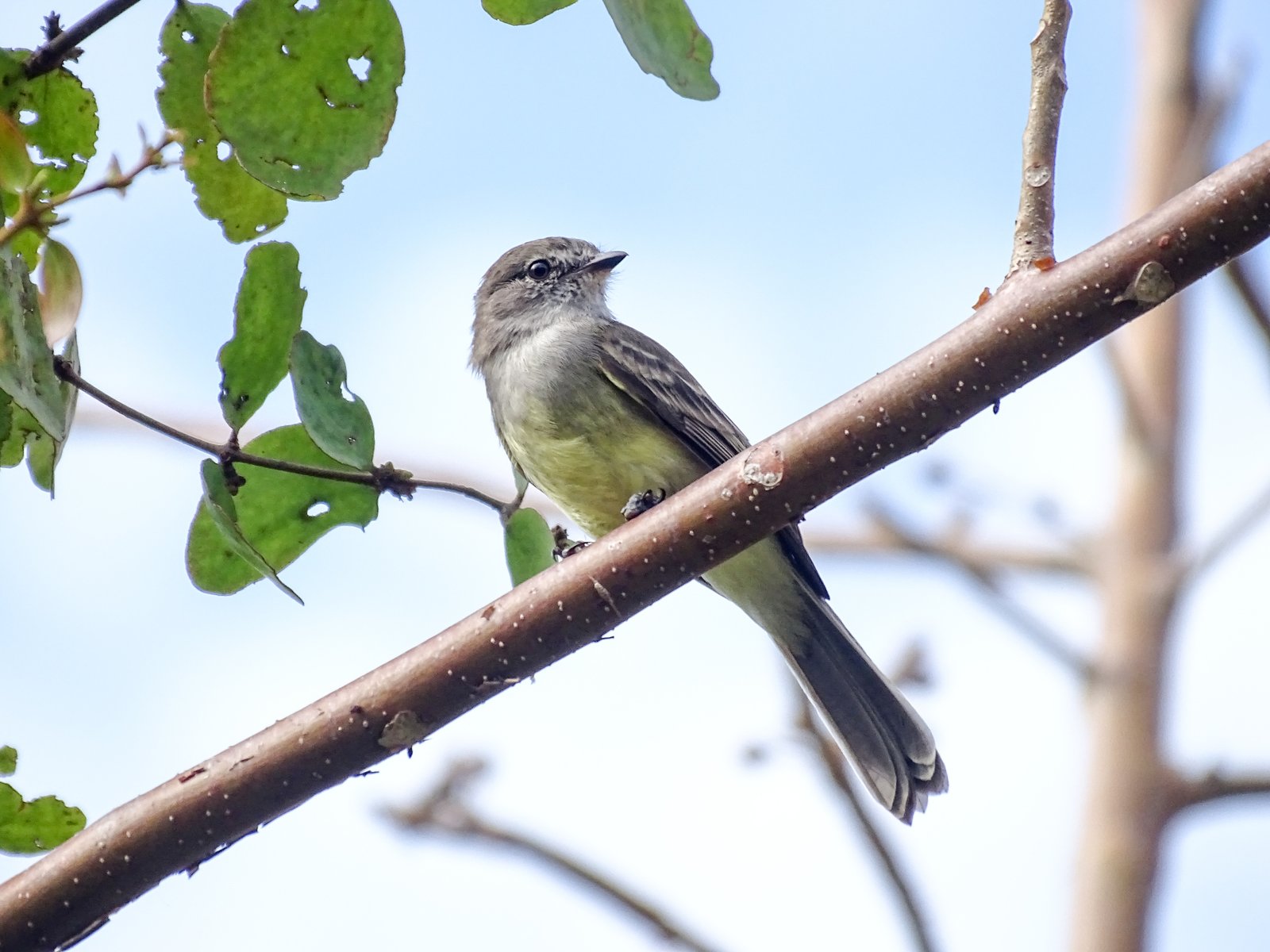
The Northern Scrub Flycatcher is a small, grey-brown flycatcher with a strikingly short, black bill that lives in mangroves and dry coastal scrub. In the guide area it occurs only along the Pacific coast of Costa Rica and Panama.
Voice
A soft, plaintive whistled peeeeu and short, thin calls; often silent.
Recording: Gean Carlo Valdés — CC0 · shortened to the first 60 s, mono · xeno-canto
Identification
14 cm, with a short, stubby, all-black bill. Upperparts grey-brown. A short whitish line above the lores and a narrow pale eye-ring. Wings dark with two dull whitish wing-bars. Throat and breast grey, belly pale yellow. Tail fairly long and dark. Male and female are alike.
Confusion species
Mouse-colored Tyrannulet Nesotriccus murinus is smaller and dull greyish-brown, with a pale base to the lower mandible, buff wing-bars and almost no yellow on the belly. Lesser Elaenia Elaenia chiriquensis and Yellow-bellied Elaenia Elaenia flavogaster have a longer bill with a pale base and a white crown patch; Yellow-bellied Elaenia also has a distinct crest. Empidonax flycatchers have a broader bill with a pale lower mandible.
Habitat
Mangroves and their edges, dry coastal scrub and open dry woodland in the lowlands, close to the coast. It perches fairly upright in the middle of bushes and low trees and takes insects with short sallies, often among the foliage.
Where the bird is most at home, classified by the vegetation units of Mexico and Central America.



Range and movements
In the guide area along the Pacific coast of Costa Rica (mainly around the Gulf of Nicoya) and Panama, including the Pearl Islands. Outside the guide area in northern Colombia and Venezuela, on the islands off the Venezuelan coast and in the Guianas.
- Resident
- dark = core range, pale = thinly spread
How and when to look
The best chance is in the mangroves around the Gulf of Nicoya in Costa Rica and along the Pacific coast of Panama. Look for the short, stubby black bill and the grey throat and breast.
Conservation status
Not threatened. In the guide area local and inconspicuous; dependent on the conservation of mangroves.
Scientific name
Sublegatus arenarum | (Salvin, 1863)
Salvin described the species in 1863 as Elainea arenarum; because it was later moved to another genus, the author and year stand in brackets. The genus Sublegatus was introduced in 1868 by Sclater & Salvin. Sublegatus is Latin sub 'near to' plus the genus Legatus (Piratic Flycatcher): 'allied to Legatus'. arenarum is Latin for 'of the sands', after the type locality Punta Arenas in Costa Rica. The specimen the first description was based on came from Punta Arenas, Costa Rica.