All species › Swifts › Hummingbirds › Mexican Violetear
Position in the tree Birds Aves › Birds with a flexible palate Neognathae › All other modern birds Neoaves › Birds of the elements Elementaves › Nightjars and swifts Strisores
Mexican Violetear | Colibri thalassinus
Mexicaanse violetoorkolibrie | Colibrí oreja violeta mexicano
The Mexican Violetear is a green hummingbird of montane forests and open highlands from Mexico to Nicaragua. Until 2016 it was treated as one species with the Lesser Violetear of Costa Rica, Panama and the Andes. Males sing a monotonous, rhythmic song for hours from a high, exposed branch. After breeding many birds wander to lower slopes, and individual birds regularly stray far into the United States and Canada.
Voice
The male sings endlessly from an exposed perch a dry, rhythmic chip-tsirr, chip-tsirr, often from dawn until late in the day. The call is a dry chit.
Recording: Étienne Leroy — CC BY-NC-SA 4.0 · converted to mono · xeno-canto
Identification
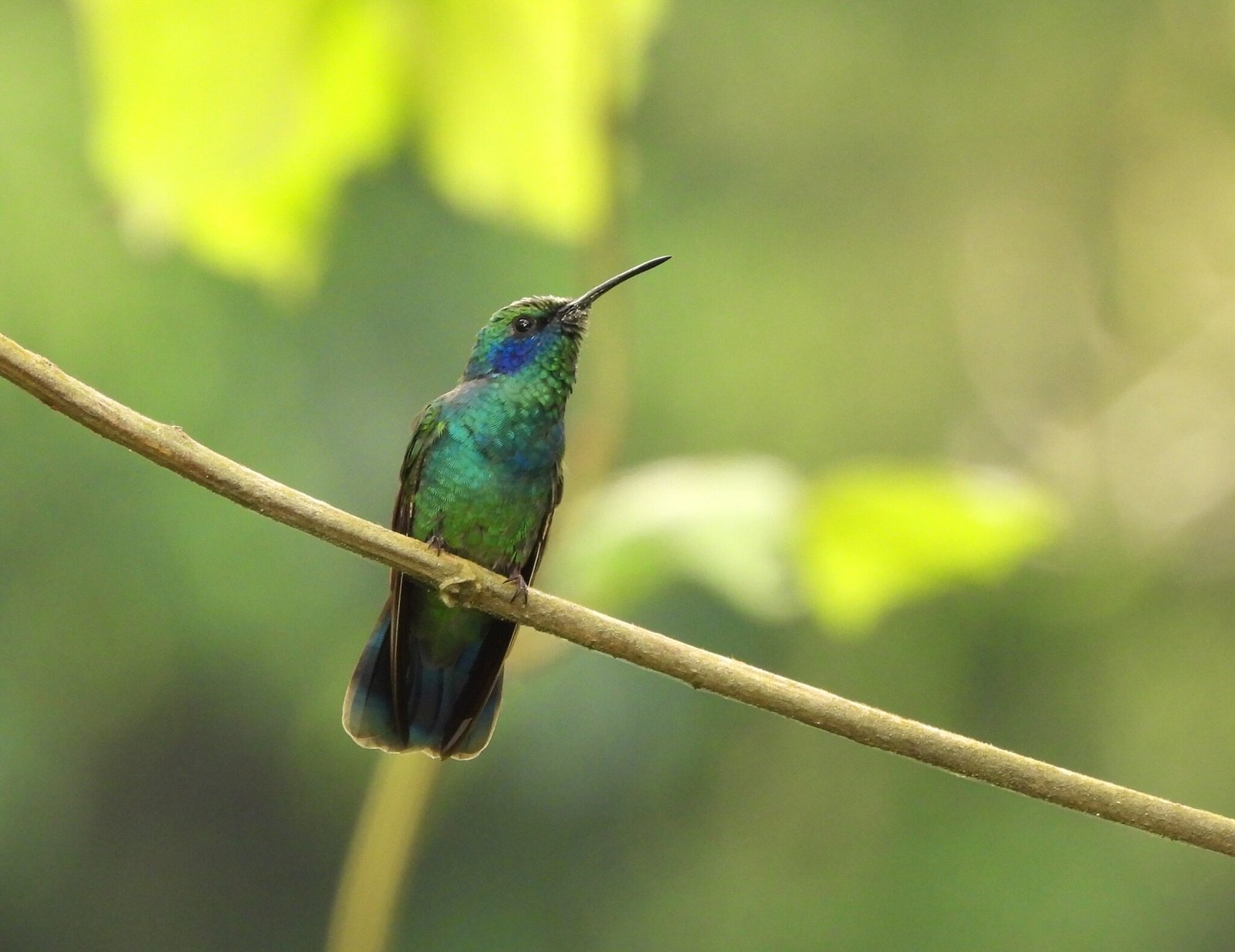
10–11 cm, with a straight, medium-length black bill. The plumage is glittering green, with a violet-blue ear patch running back from below the eye and a violet-blue patch in the centre of the breast. The throat is glittering green. The tail is blue-green, with a broad dark band before the tip. The female is slightly duller, with smaller violet-blue patches. Young birds are duller and have buff fringes to the crown and rump feathers.
Confusion species
Lesser Violetear Colibri cyanotus occurs only in Costa Rica and Panama; it is smaller, has a narrower ear patch and lacks the violet-blue breast patch. Brown Violetear Colibri delphinae is greyish brown. Female mountaingems, such as Amethyst-throated Mountaingem Lampornis amethystinus, have a dark ear patch with a white stripe behind it and paler underparts. White-eared Hummingbird Basilinna leucotis has a broad white stripe behind the eye and a red bill.
Habitat
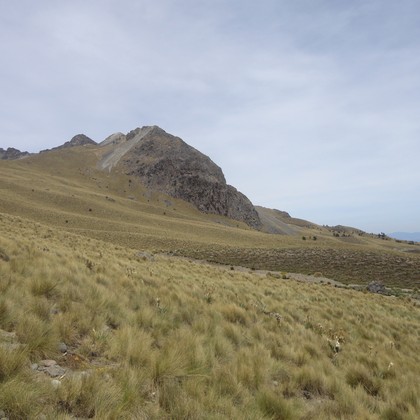
Edges and clearings in pine-oak forest, cloud forest and oak forest, shrubby mountain meadows, overgrown areas, gardens and shade coffee, mostly between about 1000 and 3000 m. After breeding also lower, into the foothills and locally almost to sea level. It feeds on nectar from flowering shrubs and herbs, such as Salvia, and catches small insects in the air.
Where the bird is most at home, classified by the vegetation units of Mexico and Central America.






Range and movements
In the mountains of Mexico, from the Sierra Madre Occidental in Sinaloa, Durango and Chihuahua and the Sierra Madre Oriental through the Trans-Mexican Volcanic Belt and the Sierra Madre del Sur to Chiapas, and on through the highlands of Guatemala, El Salvador and Honduras to northern Nicaragua. In northern Mexico present mainly in the breeding season; in winter more often on lower slopes on the Pacific and Gulf sides. Outside the guide area a vagrant to the United States and Canada.
- Resident
- Summer visitor (c. Apr–Sep)
- Winter visitor (c. Oct–Mar)
- dark = core range, pale = thinly spread
How and when to look
In clearings and at forest edges in the highlands, where a singing male often uses the same bare branch for days. The monotonous song is usually heard before the bird is seen.
Conservation status
Least Concern. The species is common in the highlands of Mexico and northern Central America and benefits from clearings and gardens. It is little affected by logging as long as shrubs and flowering scrub remain.
Scientific name
Colibri thalassinus | (Swainson, 1827)
Swainson described the species in 1827 as Trochilus thalassinus; because it was later moved to another genus, the author and year stand in brackets. The genus Colibri was introduced in 1824 by Spix. Colibri is the Spanish and French name for a hummingbird, supposedly based on a Carib word. thalassinus is Latin (from Greek thalassa 'sea') for 'sea-green', after the green plumage. The specimen the first description was based on came from Temascaltepec, State of México, Mexico.