All species › Swifts › Hummingbirds › Brown Violetear
Position in the tree Birds Aves › Birds with a flexible palate Neognathae › All other modern birds Neoaves › Birds of the elements Elementaves › Nightjars and swifts Strisores
Brown Violetear | Colibri delphinae
Bruine violetoorkolibrie | Colibrí pardo
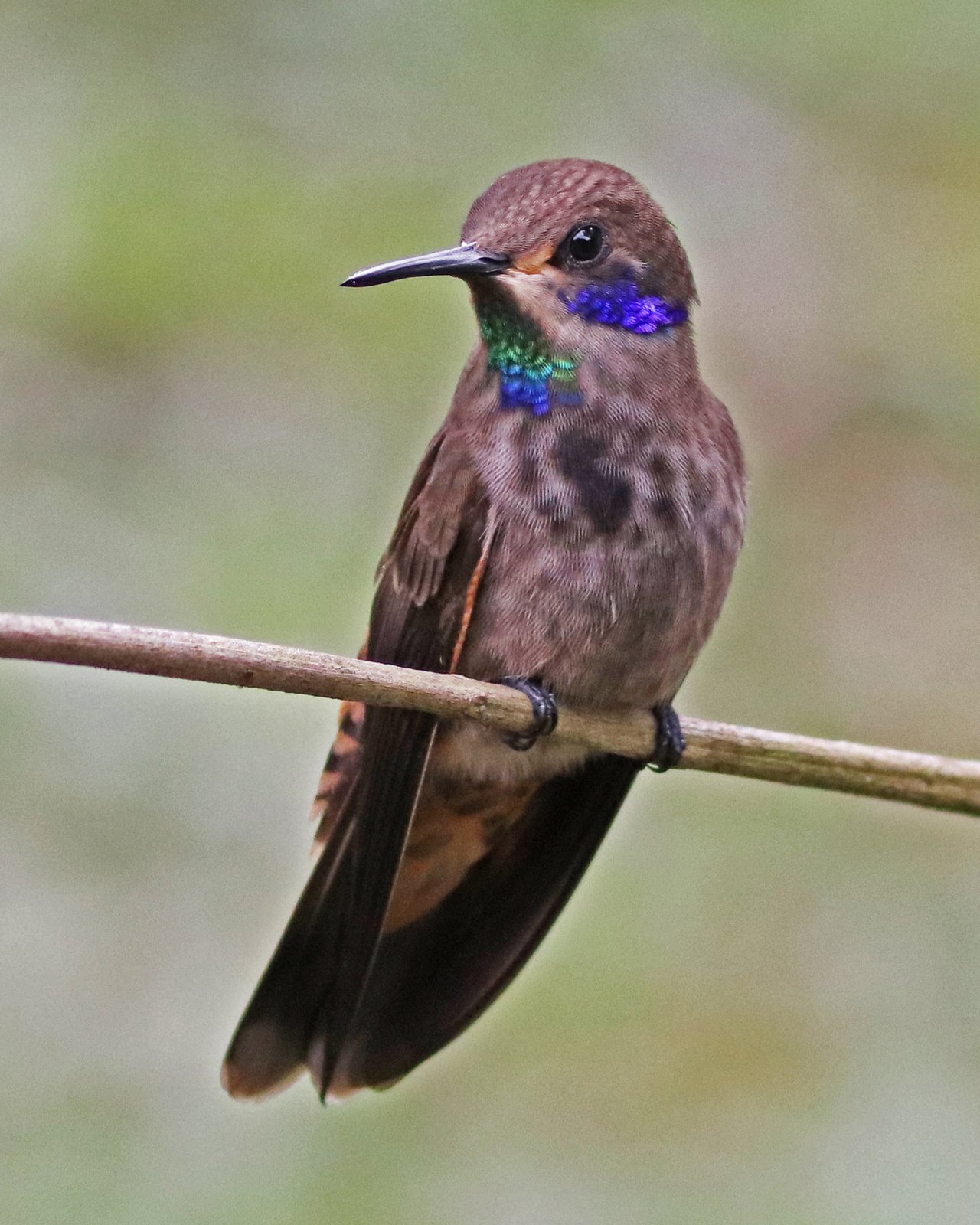
The Brown Violetear is a large, greyish-brown hummingbird that wanders irregularly and can suddenly appear in numbers where trees are in flower. At flowering trees it fiercely defends its own part of the canopy. In the guide area it lives mainly in the foothills and on lower mountain slopes.
Voice
A loud, dry chip, often repeated. The song is a series of sharp, dry chipping notes, given from a high perch.
Recording: Juan Freile — CC BY-NC-SA 4.0 · converted to mono · xeno-canto
Identification
11–12 cm, with a short, straight black bill. The plumage is dull greyish brown, with a rufous rump and rufous fringes to the uppertail coverts. Behind the eye is a violet-blue ear patch. The centre of the throat has glittering green-blue feathers, bordered by a white malar stripe and a dark moustachial stripe. The tail is bronzy brown, with a dark band before the buff tip. The sexes are almost alike.
Confusion species
Its brown plumage with the violet ear patch makes confusion unlikely. Mexican Violetear Colibri thalassinus and Lesser Violetear Colibri cyanotus are mostly green. Scaly-breasted Hummingbird Phaeochroa cuvierii is greener, with scaly underparts and white tail corners. Female and young mangos, such as Green-breasted Mango Anthracothorax prevostii, have pale underparts with a dark central stripe.
Habitat
Edges and clearings of humid foothill and lower montane forest, secondary forest and shade coffee, mainly between about 400 and 1600 m, but when wandering also lower and higher. It feeds mainly in the canopy of flowering trees such as Inga and Erythrina.
Where the bird is most at home, classified by the vegetation units of Mexico and Central America.





Range and movements
From southern Belize and eastern Guatemala through Honduras and Nicaragua to Costa Rica and Panama, on both sides of the mountains but most on the Caribbean side. Only isolated records are known from Mexico. Outside the guide area from Colombia, Venezuela, Trinidad and the Guianas through the Andes to Bolivia, and in eastern Brazil.
- Resident
- dark = core range, pale = thinly spread
How and when to look
At flowering Inga and Erythrina trees along forest edges and in coffee plantations in the foothills of Costa Rica and Panama. Because the species wanders, it may be present at a site for weeks and then absent for months.
Conservation status
Least Concern. The species has a very large range. In the guide area it is locally fairly common, but elsewhere irregular because of its wandering.
Scientific name
Colibri delphinae | (Lesson, 1839)
Lesson described the species in 1839 as Ornismya Delphinae; because it was later moved to another genus, the author and year stand in brackets. The genus Colibri was introduced in 1824 by Spix. Colibri is the Spanish and French name for a hummingbird, supposedly based on a Carib word. delphinae refers to Delphine d'Albémar, the tragic heroine of Madame de Staël's novel Delphine (1802). The specimen the first description was based on came from Bogotá, Colombia (designated later).