All species › Cuckoos › Cuckoos › Mangrove Cuckoo
Position in the tree Birds Aves › Birds with a flexible palate Neognathae › All other modern birds Neoaves › Doves, turacos and allies Columbaves › Bustards, turacos and cuckoos Otidimorphae
Mangrove Cuckoo | Coccyzus minor
Mangrovekoekoek | Cuclillo manglero
The Mangrove Cuckoo is a slender, long-tailed cuckoo of the coasts of Mexico and Central America. Despite its name, in the guide area it does not live only in mangrove: on the Yucatán Peninsula and along the Pacific coast it also inhabits dry forest and scrub far from the sea. It moves slowly and quietly through dense foliage and is heard more often than seen.
Voice
A slow series of guttural, nasal notes, gak gak gak gak gauk gauk, the last ones fuller; also a single weet. The bird calls mainly in the breeding season and can be silent for long periods outside it.
Recording: GABRIEL LEITE — CC BY-NC-SA 4.0 · shortened to the first 60 s, mono · xeno-canto
Identification
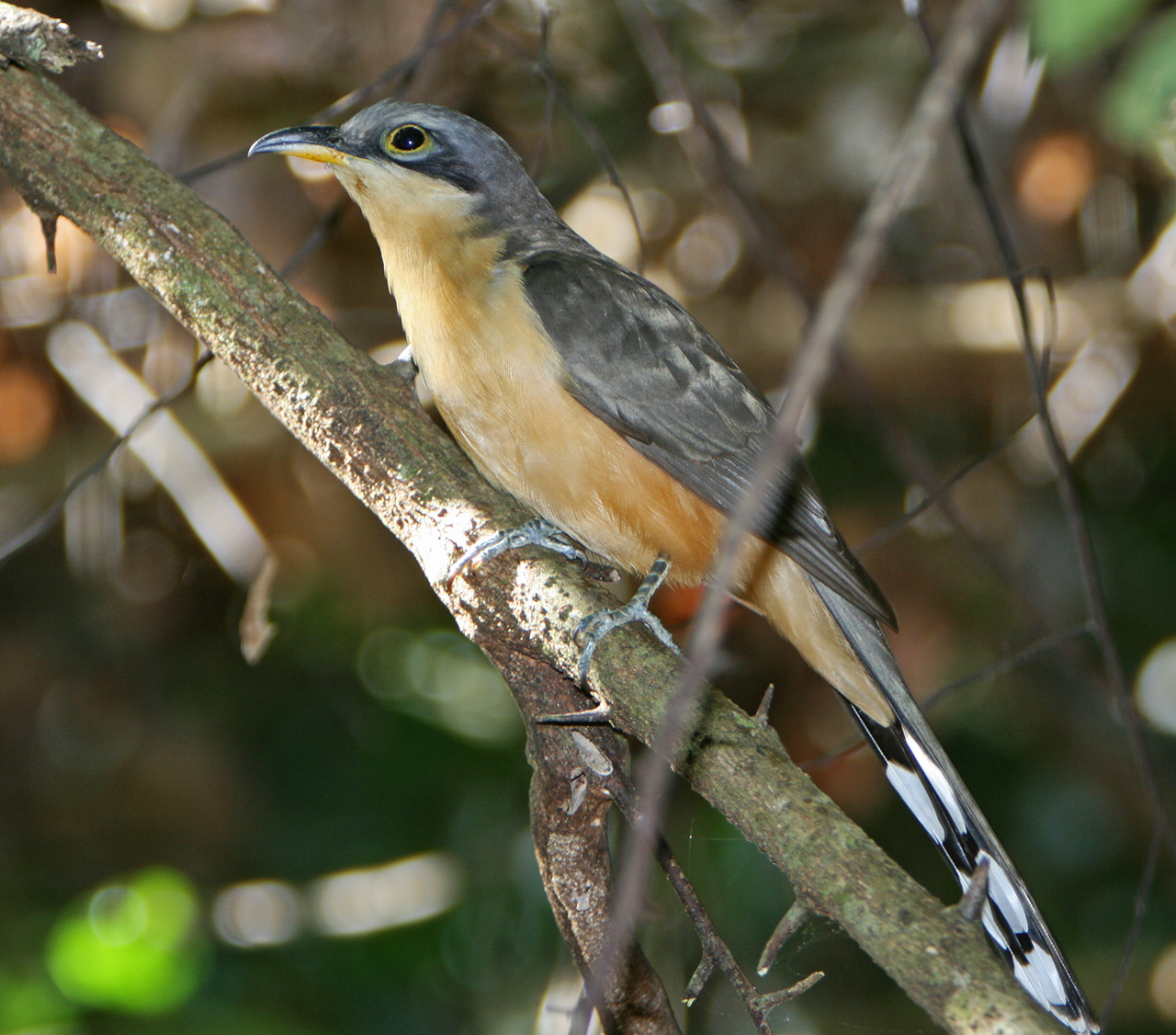
28–34 cm, more than half of it tail. The bill is slightly decurved, with a black upper mandible and a largely yellow lower mandible with a dark tip. The upperparts are grey-brown, the crown slightly greyer. A black mask runs through the eye and ear coverts, with a narrow yellow eye-ring. The throat and breast are pale buff, the belly and undertail coverts warmer buff. The wing is plain brown, without a rufous patch in the primaries. From below the tail is black with large white tips. The sexes are alike; young birds have a fainter mask and a paler tail pattern.
Confusion species
Yellow-billed Cuckoo Coccyzus americanus is pure white below, lacks the black mask and shows a rufous patch in the primaries. Black-billed Cuckoo Coccyzus erythropthalmus is also white below, with an all-black bill, a red eye-ring and narrow white tail tips. Common Squirrel Cuckoo Piaya cayana and Mexican Squirrel Cuckoo Piaya mexicana are much larger and almost entirely cinnamon-brown. On Isla del Coco only Cocos Cuckoo Coccyzus ferrugineus occurs, with a rufous patch in the wing.
Habitat
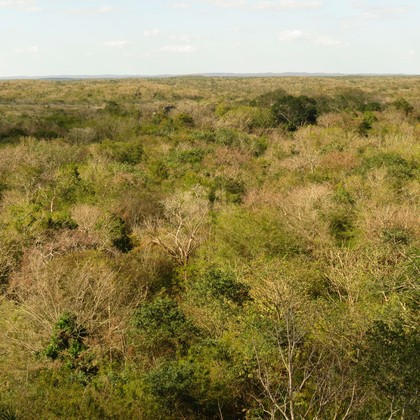
Mangrove and coastal forest, but also dry deciduous forest, thorn scrub, semi-evergreen forest and forest edge, mainly in the lowlands up to a few hundred metres. Feeds mainly on caterpillars and grasshoppers, also other insects, spiders, small lizards and some fruit. The nest is a loose platform of twigs low in a tree or shrub; in mangrove often above the water.
Where the bird is most at home, classified by the vegetation units of Mexico and Central America.




Range and movements
Along the Pacific coast of Mexico from southern Sonora and Sinaloa, where it is present mainly in summer, through Nayarit, Jalisco, Guerrero and Oaxaca to Chiapas, and on the Gulf side from Tamaulipas through Veracruz and Tabasco to the Yucatán Peninsula, including Cozumel. Further along the coasts of Belize, Guatemala, El Salvador, Honduras including the Bay Islands, Nicaragua, Costa Rica and Panama. Outside the guide area in southern Florida, in the Caribbean and along the north coast of South America to the mouth of the Amazon.
- Resident
- Summer visitor (c. Apr–Sep)
- Winter visitor (c. Oct–Mar)
- Passage (Mar–Apr, Oct–Nov)
- dark = core range, pale = thinly spread
How and when to look
On the Yucatán Peninsula the species is fairly common in many places in dry forest and mangrove, for example around Celestún and Río Lagartos. The call in the early morning is the quickest lead; the bird itself often sits motionless inside a tree and only stands out when it flies across and shows the black-and-white tail pattern.
Conservation status
Not threatened globally. Locally habitat is lost through the clearing of mangrove and coastal development, but because the species also inhabits dry forest and scrub, it depends on mangrove less than its name suggests.
Scientific name
Coccyzus minor | (Gmelin, 1788)
Gmelin described the species in 1788 as Cuculus minor; because it was later moved to another genus, the author and year stand in brackets. The genus Coccyzus was introduced in 1816 by Vieillot. Coccyzus is Greek, from kokkuzō 'to cry cuckoo', after the cuckoo's call. minor is Latin for 'smaller'. The specimen the first description was based on came from Cayenne, French Guiana.