All species › Swifts › Swifts › Lesser Swallow-tailed Swift
Position in the tree Birds Aves › Birds with a flexible palate Neognathae › All other modern birds Neoaves › Birds of the elements Elementaves › Nightjars and swifts Strisores
Lesser Swallow-tailed Swift | Panyptila cayennensis
Cayennegierzwaluw | Vencejo tijereta menor
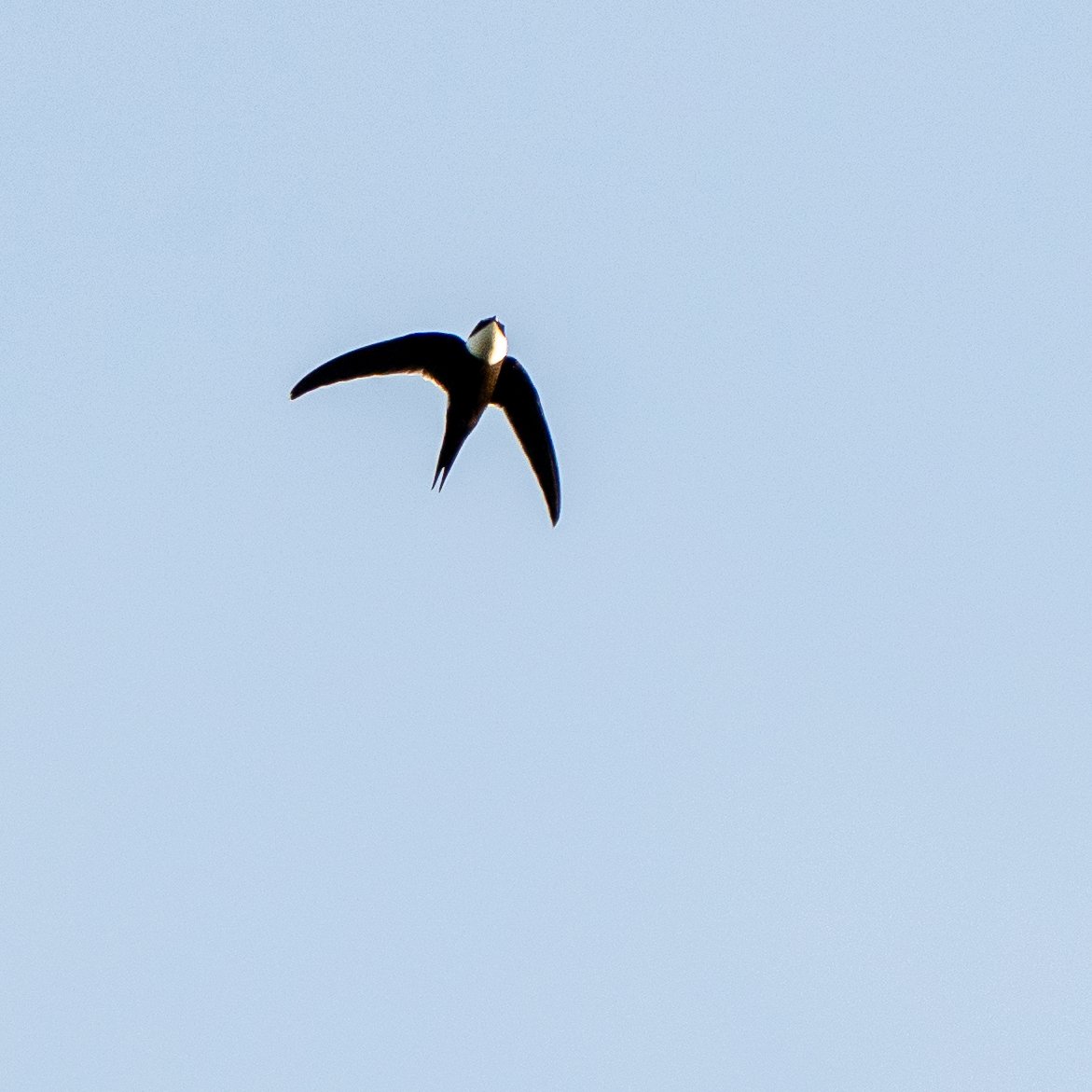
The Lesser Swallow-tailed Swift is a slender, black-and-white swift of the tropical lowlands, from south-eastern Mexico to Panama. It builds a remarkable nest: a long, felted tube of plant down and feathers, cemented with saliva and with the entrance at the bottom, hanging from a tree trunk, cliff or wall. The birds often hunt high and singly or in pairs, less often in groups than the Chaetura swifts.
Voice
A thin, squeaky series of rapid twittering notes and a repeated, drawn-out pzeeeh, often at the nest. Often flies so high that the call cannot be heard.
Recording: Dante Buzzetti — CC BY-NC-SA 4.0 · converted to mono · xeno-canto
Identification
13 cm. Slender, with long, narrow wings and a long, deeply forked tail that is usually held closed and then looks like a sharp point. The plumage is mostly black. The throat and upper breast are white, and the white continues as a narrow half-collar to the side of the neck. On the rear flanks there is a white patch on each side, conspicuous in flight against the black underparts. The secondaries sometimes have a narrow white trailing edge. Male and female are alike.
Confusion species
The Great Swallow-tailed Swift Panyptila sanctihieronymi has the same pattern but is much larger, with a longer tail and slower flight; it lives mainly in the mountains of the Pacific side, from Mexico to Nicaragua. The White-throated Swift Aeronautes saxatalis of the highlands is larger, with a less deeply forked tail and a white stripe running from the throat onto the belly. The White-collared Swift Streptoprocne zonaris is much larger, with a complete white collar and a short tail. The Chaetura swifts are dark, with a short tail and no white on the throat or flanks.
Habitat
Edges and clearings of lowland rainforest, humid foothill forest and secondary forest, river valleys, the seasonal forest of Yucatán, farmland with scattered trees and settlements, from sea level to about 1200 m. Usually hunts flying insects high in the air, sometimes together with other swifts. The nest, up to more than half a metre long, hangs from a large tree, a cliff, the underside of a bridge or the wall of a building; the eggs lie on a ledge at the top of the tube.
Where the bird is most at home, classified by the vegetation units of Mexico and Central America.






Range and movements
In Mexico in southern Veracruz, northern Oaxaca, Tabasco, Chiapas, Campeche and Quintana Roo. Further in Belize, Guatemala, Honduras, Nicaragua, Costa Rica and Panama, mainly on the Caribbean side, but in Costa Rica and Panama also on the Pacific side; scarce in El Salvador. Outside the guide area from Colombia, Venezuela, Trinidad and the Guianas to Ecuador, Amazonia and south-eastern Brazil.
- Resident
- dark = core range, pale = thinly spread
How and when to look
In Belize and in the Canal Area of Panama the birds are regularly seen over forest edges and clearings. Nests sometimes hang from buildings at lodges and under bridges near forest, for example in the Caribbean lowlands of Costa Rica. Among groups of other swifts, the white throat and white flank patches stand out.
Conservation status
Not threatened. The species has a very large range and also uses man-made structures as nest sites.
Scientific name
Panyptila cayennensis | (Gmelin, 1789)
Gmelin described the species in 1789 as Hirundo cayennensis; because it was later moved to another genus, the author and year stand in brackets. The genus Panyptila was introduced in 1847 by Cabanis. Panyptila is Greek, from panu 'exceedingly, wholly' and ptilon 'feather': 'well-feathered', after the legs feathered down to the toes. cayennensis refers to Cayenne in French Guiana, where the species was described. The specimen the first description was based on came from Cayenne, French Guiana.