All species › Swifts › Swifts › Great Swallow-tailed Swift
Position in the tree Birds Aves › Birds with a flexible palate Neognathae › All other modern birds Neoaves › Birds of the elements Elementaves › Nightjars and swifts Strisores
Great Swallow-tailed Swift | Panyptila sanctihieronymi
San-Geronimogierzwaluw | Vencejo tijereta mayor
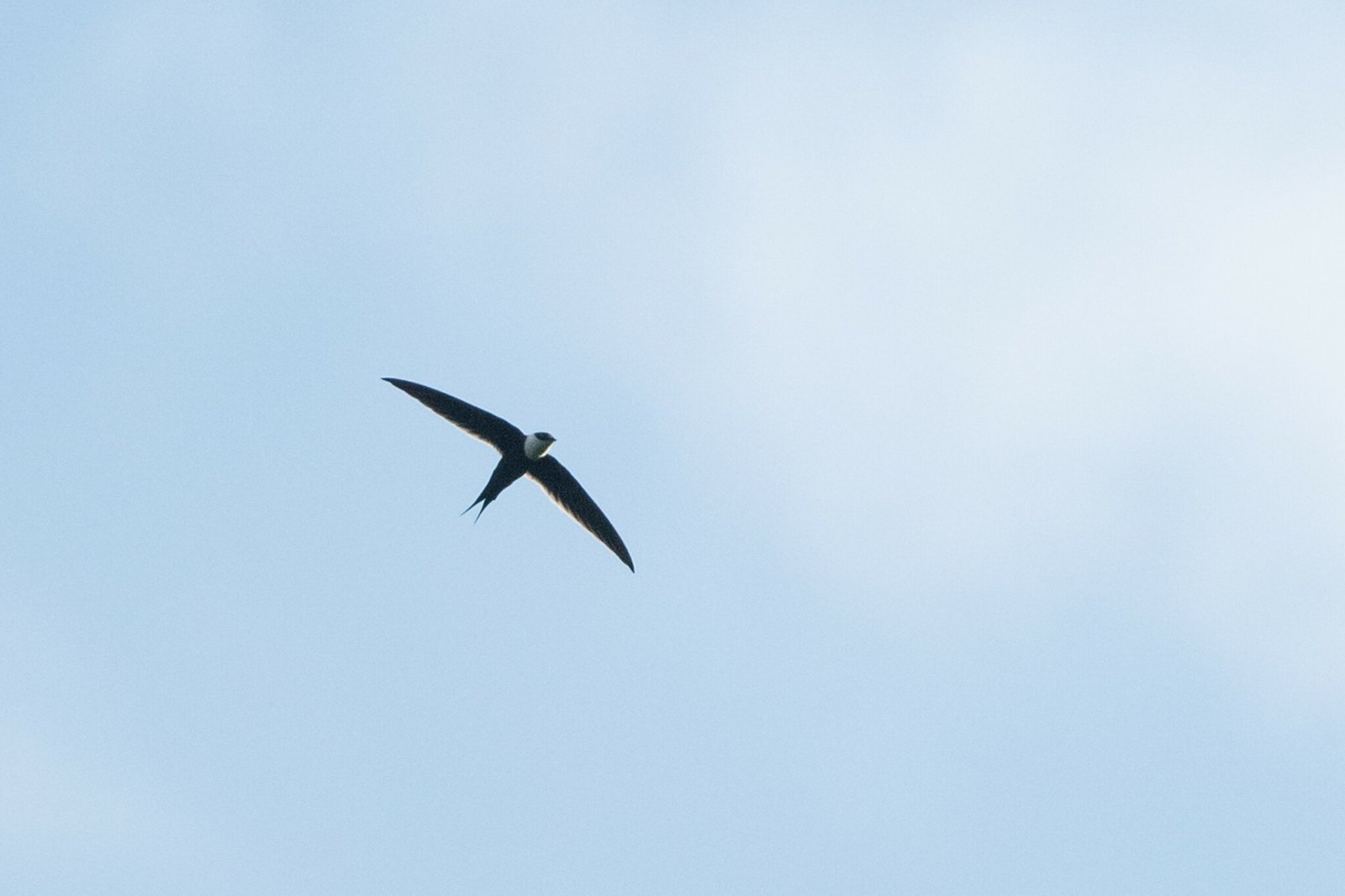
The Great Swallow-tailed Swift is a large, black-and-white swift with a very long, deeply forked tail that occurs almost only in the mountains of southern Mexico and northern Central America. Its scientific name refers to San Gerónimo in Baja Verapaz, Guatemala, where the species was first described. It looks like an enlarged Lesser Swallow-tailed Swift and, like that species, builds a long, hanging nest tube. It is a fairly scarce, local species that often flies high and singly or in pairs.
Voice
Poorly known. High, shrill calls and a rapid twittering have been reported, mainly at the nest; in flight the species is usually silent.
Recording: John van Dort — CC BY-NC-SA 3.0 · converted to mono · xeno-canto
Identification
18–20 cm, much of it tail. Slender, with long, narrow wings and a very long, deeply forked tail that is usually held closed and then looks like a long, sharp point. The plumage is mostly blackish brown. The throat and upper breast are white, and the white continues as a narrow half-collar to the side of the neck. On the rear flanks there is a white patch on each side, and the secondaries have a narrow white trailing edge. Male and female are alike. The flight is powerful, with deep wingbeats and long glides.
Confusion species
The Lesser Swallow-tailed Swift Panyptila cayennensis has the same pattern but is much smaller, with a shorter tail and faster, fluttering flight; it lives mainly in the lowlands of the Caribbean side. The White-throated Swift Aeronautes saxatalis has a less deeply forked, shorter tail and a white stripe running from the throat onto the belly. The White-collared Swift Streptoprocne zonaris is larger and heavier, with a complete white collar and a short tail.
Habitat
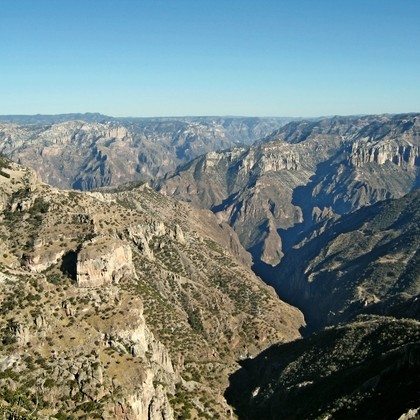
Mountainous terrain with canyons and gorges, over pine-oak forest, cloud forest, dry forest on the slopes and open farmland with forest remnants, mostly between about 500 and 2500 m; sometimes lower outside the breeding season. Hunts flying insects high in the air. The nest is a long tube of plant down cemented with saliva, under an overhanging rock, on a cliff face or on a tree, and sometimes on a building.
Where the bird is most at home, classified by the vegetation units of Mexico and Central America.




Range and movements
In Mexico in the mountains of the Pacific side, from Nayarit and Jalisco south through Colima, Michoacán, Guerrero, Morelos, the State of México and Oaxaca to Chiapas. Further in the highlands of Guatemala, El Salvador, Honduras and northern Nicaragua. In Costa Rica there are only a few isolated records. Scarce and local everywhere; not known from outside the guide area.
- Resident
- Summer visitor (c. Apr–Sep)
- Winter visitor (c. Oct–Mar)
- Passage (Mar–Apr, Oct–Nov)
- dark = core range, pale = thinly spread
How and when to look
The best chances are in the highlands of Alta and Baja Verapaz in Guatemala, in the valleys around Tegucigalpa in Honduras, and in the mountains of Chiapas and Jalisco. Large swifts with a long, pointed tail patrolling high over a valley deserve a second look; the birds often fly among groups of White-collared Swifts.
Conservation status
Not threatened. The species has a fairly large range but is scarce everywhere; little is known about numbers and trends.
Scientific name
Panyptila sanctihieronymi | Salvin, 1863
Salvin described the species in 1863 and placed it straight away in the genus where it still stands. The genus Panyptila was introduced in 1847 by Cabanis. Panyptila is Greek, from panu 'exceedingly, wholly' and ptilon 'feather': 'well-feathered', after the legs feathered down to the toes. sanctihieronymi is Latin for 'of Saint Jerome', after San Jerónimo in Baja Verapaz (Guatemala), where the type was collected. The specimen the first description was based on came from San Jerónimo, Baja Verapaz, Guatemala.