All species › Passerines › Cardinals and allies › Carmiol's Tanager
Position in the tree Birds Aves › Birds with a flexible palate Neognathae › All other modern birds Neoaves › Landbirds Telluraves › Falcons, parrots and passerines Australaves › Falcons and passerines Eufalconimorphae › Parrots and passerines Psittacopasserae
Carmiol's Tanager | Chlorothraupis carmioli
Carmiols tangare | Tangara de Carmiol
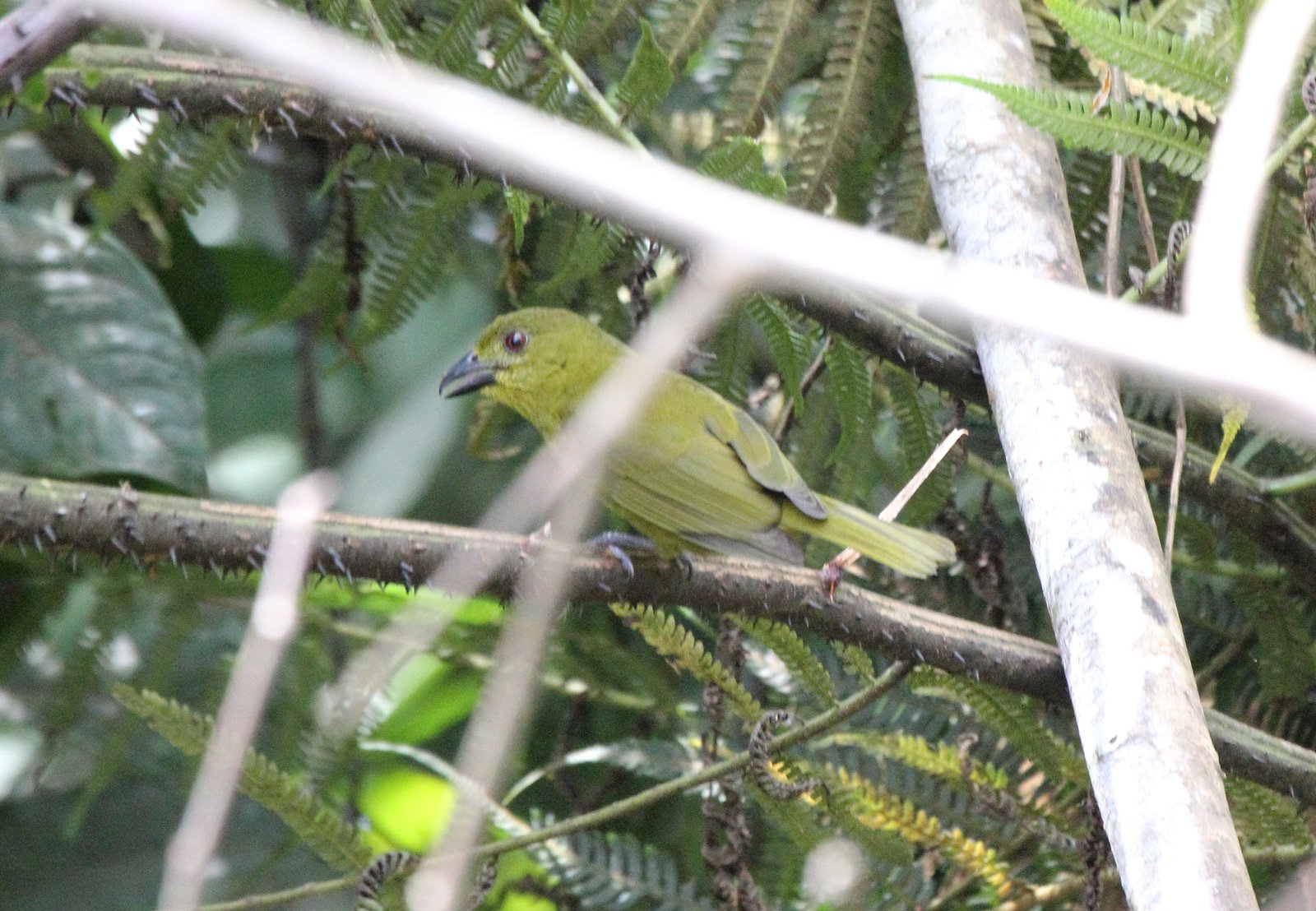
Carmiol's Tanager is a stocky, uniformly olive-green songbird of the understorey of humid forest. It lives in noisy groups that often form the core of mixed flocks of other forest birds. In the guide area it occurs on the Caribbean slope of Nicaragua and Costa Rica and in Panama.
Voice
Groups give a continuous, harsh and hoarse chatter and rattle. At dawn males sing a series of clear, whistled phrases repeated many times, such as chewee chewee.
Recording: Scott Olmstead — CC BY-NC-SA 4.0 · shortened to the first 60 s, mono · xeno-canto
Identification
16–18 cm. A fairly robust, short and thickset songbird with a heavy, dark bill. Entirely dark olive-green, slightly paler and yellower below, especially on the throat. No wing bars, eye-ring or other markings. Male and female are alike; the female often has a slightly yellower throat.
Confusion species
Lemon-spectacled Tanager Chlorothraupis olivacea (eastern Panama) has bright yellow spectacles around the eye and a yellower throat. Female ant tanagers, such as Red-throated Ant Tanager Driophlox fuscicauda, are browner and slimmer. The female Scarlet-rumped Tanager Ramphocelus passerinii has a grey head and an orange-yellow breast. Olive-green warblers and vireos are much smaller and have a thin bill.
Habitat
Lower and middle levels of humid evergreen lowland and foothill forest, mainly between 300 and 1200 m, locally lower; also mature secondary forest and forest edges. It eats insects, other invertebrates and fruit.
Where the bird is most at home, classified by the vegetation units of Mexico and Central America.



Range and movements
Caribbean slope of Nicaragua and Costa Rica; in Panama on the Caribbean slope in the west and further east locally on both slopes to the eastern mountains. Outside the guide area a related form, frenata, lives on the eastern slope of the Andes from Colombia to Bolivia; it is sometimes treated as a separate species.
- Resident
- dark = core range, pale = thinly spread
How and when to look
Regularly seen in the Caribbean foothills of Costa Rica, for example in Braulio Carrillo and at Rara Avis; the hoarse calls of a group often reveal the position of a mixed flock.
Conservation status
Not threatened (LC). Locally common in continuous forest; disappears where forest becomes fragmented.
Scientific name
Chlorothraupis carmioli | (Lawrence, 1868)
Lawrence described the species in 1868 as Phoenicothraupis carmioli; because it was later moved to another genus, the author and year stand in brackets. The genus Chlorothraupis was introduced in 1883 by Salvin & Godman. Chlorothraupis is Greek, from khlōros 'green' and thraupis, an unidentified small finch-like bird (in ornithology 'tanager'): 'green tanager'. carmioli honours Franz (Francisco) Carmiol (1844–1875), son of a German immigrant to Costa Rica, who collected the type for the Smithsonian. The specimen the first description was based on came from Angostura, Costa Rica.