All species › Falcons › Falcons and caracaras › Collared Forest Falcon
Position in the tree Birds Aves › Birds with a flexible palate Neognathae › All other modern birds Neoaves › Landbirds Telluraves › Falcons, parrots and passerines Australaves › Falcons and passerines Eufalconimorphae
Collared Forest Falcon | Micrastur semitorquatus
Grote bosvalk | Halcón montés collarejo
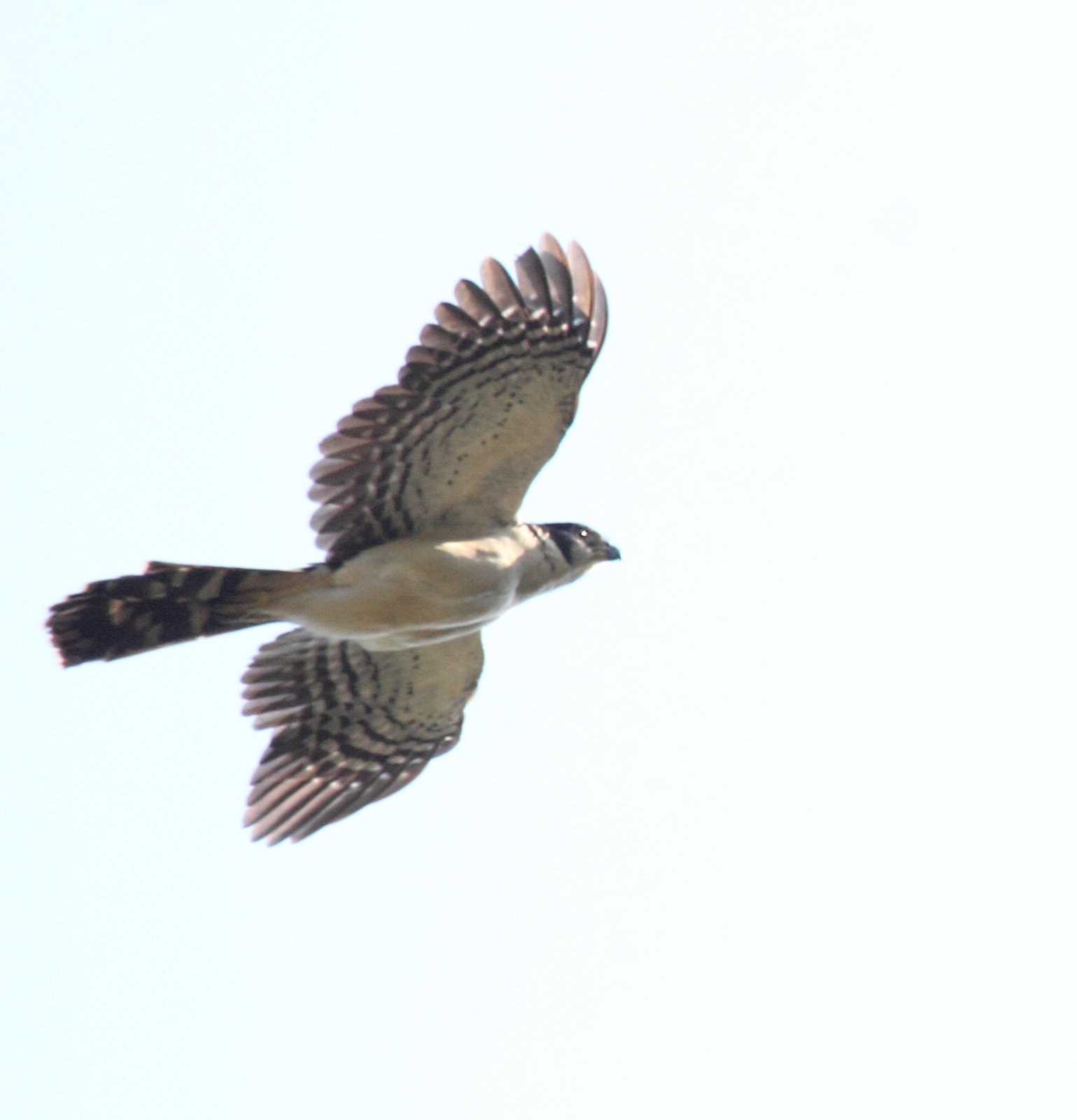
The Collared Forest Falcon is a slender forest raptor with short, rounded wings, long legs and a long tail, built for hunting among the trees. It watches from a hidden perch in the canopy and pursues birds, guans and chachalacas, and small mammals through the forest, sometimes also running on the ground. In the guide area it is a widespread but seldom seen resident from Mexico to Panama, noticed mainly by its mournful call at dawn.
Voice
A loud, mournful, almost human ow or aow, repeated at regular intervals, sometimes accelerating into a series ow-ow-ow-ow that sounds like laughter. It calls mainly in the half-light before dawn and at dusk, from a high perch in the forest.
Recording: Juan Freile — CC BY-NC-SA 4.0 · shortened to the first 60 s, mono · xeno-canto
Identification
46–62 cm; the female is clearly larger than the male. Most birds are blackish-brown above, with a black crown and a black crescent on the cheek, and a white or creamy collar that extends round the nape; the underparts are plain white to cream or buff. The tail is long and graduated, black with three to five narrow white bars and a white tip. Bare skin round the eye and bill greenish grey; legs yellow. A rare dark morph is entirely blackish-brown, with narrow white bars in the tail. Juveniles are brown above and buff below with dense dark barring.
Confusion species
The Laughing Falcon Herpetotheres cachinnans has a pale crown and a broad black mask and perches in the open at the forest edge. The Slaty-backed Forest Falcon Micrastur mirandollei is smaller, slate grey above, without a collar or cheek crescent, and has a yellow-orange face. The Barred Forest Falcon Micrastur ruficollis is much smaller and has finely barred underparts. Juveniles resemble the juvenile Bicolored Hawk Astur bicolor, which is plain below or only lightly barred.
Habitat
Humid and dry lowland forest, foothill forest, seasonal forest and gallery forest, locally also cloud forest and tall secondary forest; mostly below 1500 m, sometimes higher. It lives in and below the canopy and rarely enters open country. It nests in a tree cavity.
Where the bird is most at home, classified by the vegetation units of Mexico and Central America.







Range and movements
Resident. In Mexico on the Pacific side from southern Sinaloa and on the Gulf side from southern Tamaulipas, south to Chiapas and the Yucatán Peninsula. Further through Belize, Guatemala, El Salvador, Honduras, Nicaragua and Costa Rica to Panama, on both slopes. Outside the guide area in tropical South America to northern Argentina.
- Resident
- dark = core range, pale = thinly spread
How and when to look
Heard far more often than seen. At dawn its call is regularly heard at Tikal and Calakmul, in Guanacaste and along the Pipeline Road (Camino del Oleoducto) in Panama. By following the call the bird can sometimes be found on a high branch in the canopy.
Conservation status
Not threatened. Widespread, but dependent on larger tracts of forest; declines where the forest becomes fragmented.
Scientific name
Micrastur semitorquatus | (Vieillot, 1817)
Vieillot described the species in 1817 as Sparvius semi-torquatus; because it was later moved to another genus, the author and year stand in brackets. The genus Micrastur was introduced in 1841 by Gray. Micrastur combines Greek mikros 'small' with the genus Astur 'goshawk': 'small hawk'. semitorquatus is Latin for 'half-collared', from semi- 'half' and torquatus 'collared', after the pale hind-collar. The specimen the first description was based on came from Paraguay.