All species › Woodpeckers and allies › Woodpeckers › Imperial Woodpecker
Position in the tree Birds Aves › Birds with a flexible palate Neognathae › All other modern birds Neoaves › Landbirds Telluraves › Raptors, owls, kingfishers and woodpeckers Afroaves › Mousebirds, rollers and woodpeckers Coraciimorphae › Trogons and cavity nesters Cavitaves › Hornbills, kingfishers and woodpeckers Picocoraciae › Kingfishers, bee-eaters and woodpeckers Picodynastornithes
Imperial Woodpecker | Campephilus imperialis
Keizerspecht | Carpintero imperial
The Imperial Woodpecker is the largest woodpecker in the world and was endemic to the mountains of western and north-western Mexico. It lived in old-growth pine-oak forest in the Sierra Madre Occidental and is probably extinct: the last confirmed record dates from 1956, when a female was filmed in Durango. Later reports have never been confirmed.
No photograph of a living wild bird of this species with a suitable Creative Commons licence exists. Do you have one that meets the rules? Send it in.
Voice
No sound recording is known; the 1956 film has no sound. According to old descriptions the call was a nasal, trumpet-like note, compared to a toy trumpet. Like related Campephilus woodpeckers it probably also gave loud double knocks.
No recording with a suitable Creative Commons licence is available for this species yet.
Identification
56–60 cm, a very large black woodpecker with a long, pointed crest and a large ivory-white bill. The inner secondaries are white and form a white patch on the lower back of a perched bird; two narrow white stripes run over the scapulars to the back. The eye is pale yellow. The male has a red crest with a black centre, the female an all-black crest that curls forward. In flight the white trailing edge of the wing and the white underwing coverts stand out.
Confusion species
Pale-billed Woodpecker Campephilus guatemalensis and Lineated Woodpecker Dryocopus lineatus are much smaller (31–38 cm) and live mainly in the lowlands and foothills. Pale-billed Woodpecker has a red head in both sexes and a white neck stripe that continues down the back; Lineated Woodpecker has a white stripe across the cheek and a dark bill. Neither has white secondaries forming a white patch on the back of a perched bird.
Habitat
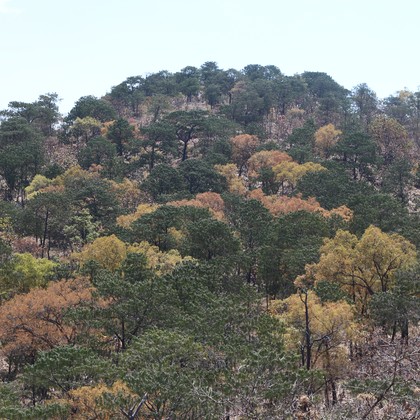
Open old-growth pine-oak and pine forest with many large, partly dead trees, at about 1700 to 3000 m, mainly between 2000 and 2700 m. It lived in pairs or family groups of a few to more than ten birds that ranged over long distances through the forest. It searched for wood-boring larvae under the bark of dead and dying pines, stripping off large pieces. A pair is estimated to have needed several tens of square kilometres of old forest.
Where the bird is most at home, classified by the vegetation units of Mexico and Central America.

Range and movements
Endemic to the Sierra Madre Occidental: from eastern Sonora and western Chihuahua through Durango, eastern Sinaloa, Zacatecas and Nayarit to Jalisco and northern Michoacán. It had already declined sharply in the first half of the twentieth century; after 1956 there are only unconfirmed reports. Targeted searches in the last remnants of old forest have found no trace of the species.
How and when to look
No site is known where the species still occurs. A record from the Sierra Madre Occidental documented with photographs, film or sound would be of great importance. Reports of a large black woodpecker in the mountains usually turn out, on enquiry, to refer to Lineated Woodpecker or to memories from decades ago.
Conservation status
Critically Endangered, possibly extinct. The decline was caused by the felling of almost all old-growth forest in the Sierra Madre Occidental and by hunting: the birds were shot for food, as curiosities and for use in folk medicine, and were regarded as pests by the timber industry. Almost no old forest of sufficient extent remains.
Scientific name
Campephilus imperialis | (Gould, 1832)
Gould described the species in 1832 as Picus imperialis; because it was later moved to another genus, the author and year stand in brackets. The genus Campephilus was introduced in 1840 by Gray. Campephilus is Greek, from kampē 'caterpillar' and philos 'loving': 'caterpillar-lover', after its diet of insect larvae. imperialis is Latin for 'imperial', after its size: the largest woodpecker in the world. The specimen the first description was based on came from Jalisco, Mexico.