All species › Woodpeckers and allies › Woodpeckers › Pale-billed Woodpecker
Position in the tree Birds Aves › Birds with a flexible palate Neognathae › All other modern birds Neoaves › Landbirds Telluraves › Raptors, owls, kingfishers and woodpeckers Afroaves › Mousebirds, rollers and woodpeckers Coraciimorphae › Trogons and cavity nesters Cavitaves › Hornbills, kingfishers and woodpeckers Picocoraciae › Kingfishers, bee-eaters and woodpeckers Picodynastornithes
Pale-billed Woodpecker | Campephilus guatemalensis
Koningsspecht | Carpintero pico plata
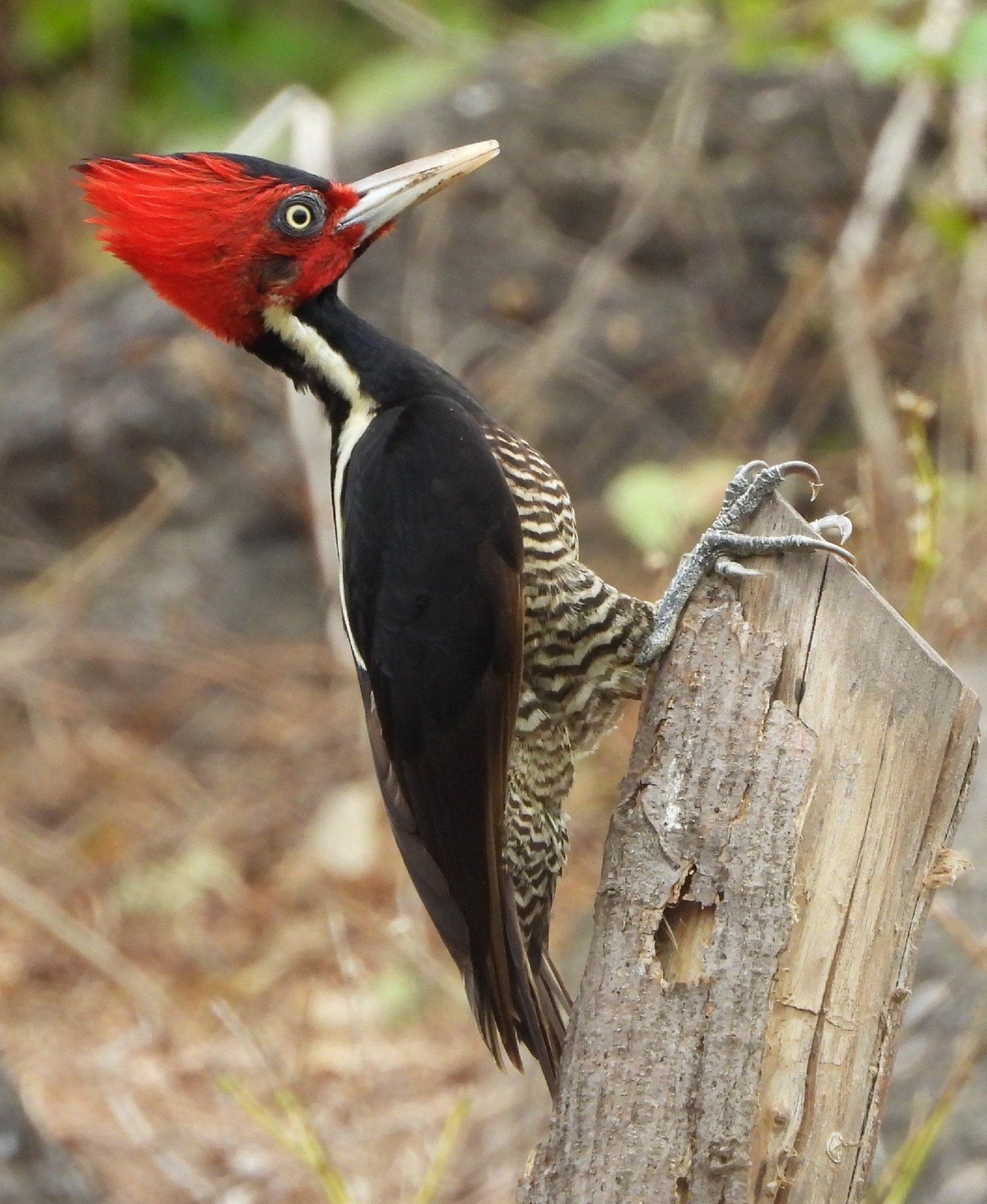
The Pale-billed Woodpecker is the largest widespread woodpecker of Mexico and Central America, with a red head and crest and a pale, ivory-coloured bill. It occurs in forest and semi-open country of the lowlands and foothills from Sonora and Tamaulipas to western Panama.
Voice
Drums with a loud double knock. Calls a nasal kient or kient-kient and a fast, cackling chatter.
Recording: GABRIEL LEITE — CC BY-NC-SA 4.0 · shortened to the first 60 s, mono · xeno-canto
Identification
35–38 cm. The male has an all-red head with crest and a red throat; the female has a black throat and a black front to the crest. In both sexes a white stripe runs from the neck along the side of the back; the stripes meet in a V. Upperparts otherwise black, underparts ochre-buff with black barring. The bill is long and ivory white to pale horn, the eye pale.
Confusion species
Lineated Woodpecker Dryocopus lineatus has a dark bill, a white stripe from the base of the bill across the face, a black-and-white streaked throat and white back stripes that do not meet. Crimson-crested Woodpecker Campephilus melanoleucos (Panama) has a black throat and a white cheek stripe in both sexes.
Habitat
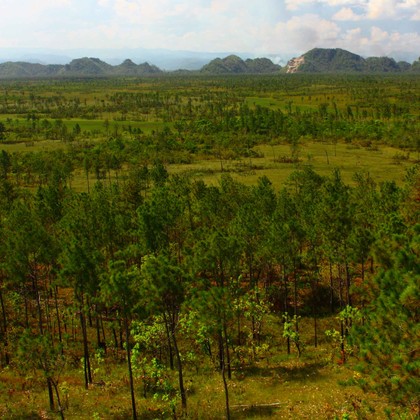
Humid and dry lowland forest, seasonal forest, tall secondary forest, forest edges, gallery forest, mangroves and pine savanna with scattered large trees, up to about 1500 m but mainly lower. It usually forages in pairs on large trunks and thick branches for beetle larvae.
Where the bird is most at home, classified by the vegetation units of Mexico and Central America.






Range and movements
Pacific lowlands and foothills from southern Sonora southwards, and the Gulf and Caribbean side from southern Tamaulipas southwards, including the Yucatán Peninsula, through all of Central America to western Panama (Bocas del Toro, Chiriquí and western Veraguas). Hardly occurs outside the guide area.
- Resident
- dark = core range, pale = thinly spread
How and when to look
Often seen at Tikal in Guatemala, at Calakmul in Campeche and in the forests around San Blas in Nayarit. Pairs are often located by their double-knock drum.
Conservation status
Not threatened. Widespread, but dependent on large and dead trees; disappears from heavily deforested regions.
Scientific name
Campephilus guatemalensis | (Hartlaub, 1844)
Hartlaub described the species in 1844 as Picus guatemalensis; because it was later moved to another genus, the author and year stand in brackets. The genus Campephilus was introduced in 1840 by Gray. Campephilus is Greek, from kampē 'caterpillar' and philos 'loving': 'caterpillar-lover', after its diet of insect larvae. guatemalensis means 'of Guatemala', the country where the type was collected. The specimen the first description was based on came from Guatemala.