All species › Swifts › Hummingbirds › Humboldt's Sapphire
Position in the tree Birds Aves › Birds with a flexible palate Neognathae › All other modern birds Neoaves › Birds of the elements Elementaves › Nightjars and swifts Strisores
Humboldt's Sapphire | Chrysuronia humboldtii
Humboldts saffierkolibrie | Zafiro de Humboldt
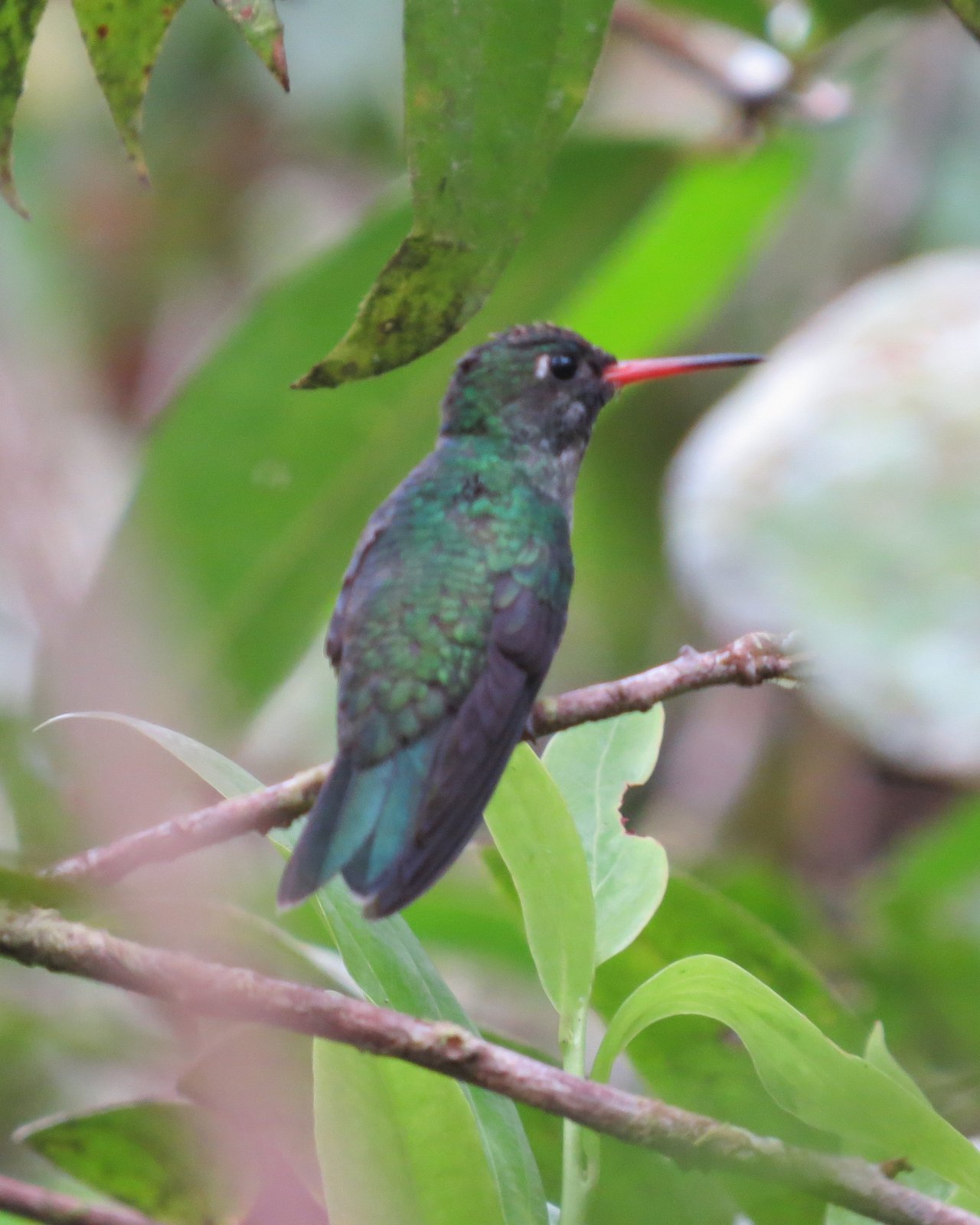
Humboldt's Sapphire is a hummingbird of mangroves and coastal forest along the Pacific coast of north-western South America. In the guide area it occurs only in the far east of Panama, in Darién. The male has a glittering blue head and throat and a red bill with a black tip.
Voice
High, thin tsit calls and a series of soft, squeaky notes.
Recording: Olaf Jahn — CC BY-NC-SA 4.0 · converted to mono · xeno-canto
Identification
9–10 cm, with a straight red bill with a black tip; in the female the upper mandible is largely dark. The male is green, with a glittering violet-blue crown, cheek and throat, a green breast and belly, whitish undertail coverts and a bronze-green tail. The female is green above and white to pale grey below, with green spots on the flanks and a bronze-green tail with a dark band and grey tips.
Confusion species
Sapphire-throated Hummingbird Chrysuronia coeruleogularis also lives in mangroves; the male has only a blue throat, no blue crown, and a forked dark tail. The male Violet-bellied Hummingbird Chlorestes julie has a violet belly and a green head. Blue-throated Sapphire Chlorestes eliciae has a golden-coppery tail and in Darién occurs mainly along forest edges inland.
Habitat
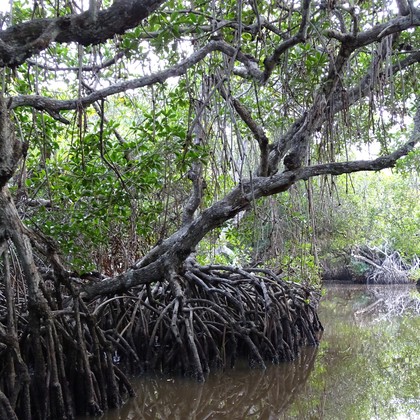
Mangrove forest and the adjacent edges of humid coastal forest and scrub, at sea level. It feeds mainly at flowering mangrove trees and flowering shrubs at the edge of the mangroves.
Where the bird is most at home, classified by the vegetation units of Mexico and Central America.


Range and movements
In the guide area only along the Pacific coast of eastern Panama, mainly around the Gulf of San Miguel in Darién. Outside the guide area along the Pacific coast of Colombia to north-western Ecuador.
- Resident
- dark = core range, pale = thinly spread
How and when to look
In the mangroves around the Gulf of San Miguel in Darién, usually reached by boat. The best chance is at flowering mangrove trees along channels and creeks.
Conservation status
Not threatened. Local and seldom recorded in Panama, fairly common in Colombia. The species depends on mangroves, which are cleared in places.
Scientific name
Chrysuronia humboldtii | (Bourcier & Mulsant, 1852)
Bourcier & Mulsant described the species in 1852 as Trochilus humboldtii; because it was later moved to another genus, the author and year stand in brackets. The genus Chrysuronia was introduced in 1850 by Bonaparte. Chrysuronia is Greek, from khrusos 'gold' and oura 'tail', after the golden-glossed tail. humboldtii honours the German naturalist and explorer Alexander von Humboldt (1769–1859). The specimen the first description was based on came from Río Mira, Esmeraldas, Ecuador.