All species › Swifts › Hummingbirds › Blue-chested Hummingbird
Position in the tree Birds Aves › Birds with a flexible palate Neognathae › All other modern birds Neoaves › Birds of the elements Elementaves › Nightjars and swifts Strisores
Blue-chested Hummingbird | Polyerata amabilis
Blauwborstamazilia | Amazilia amable
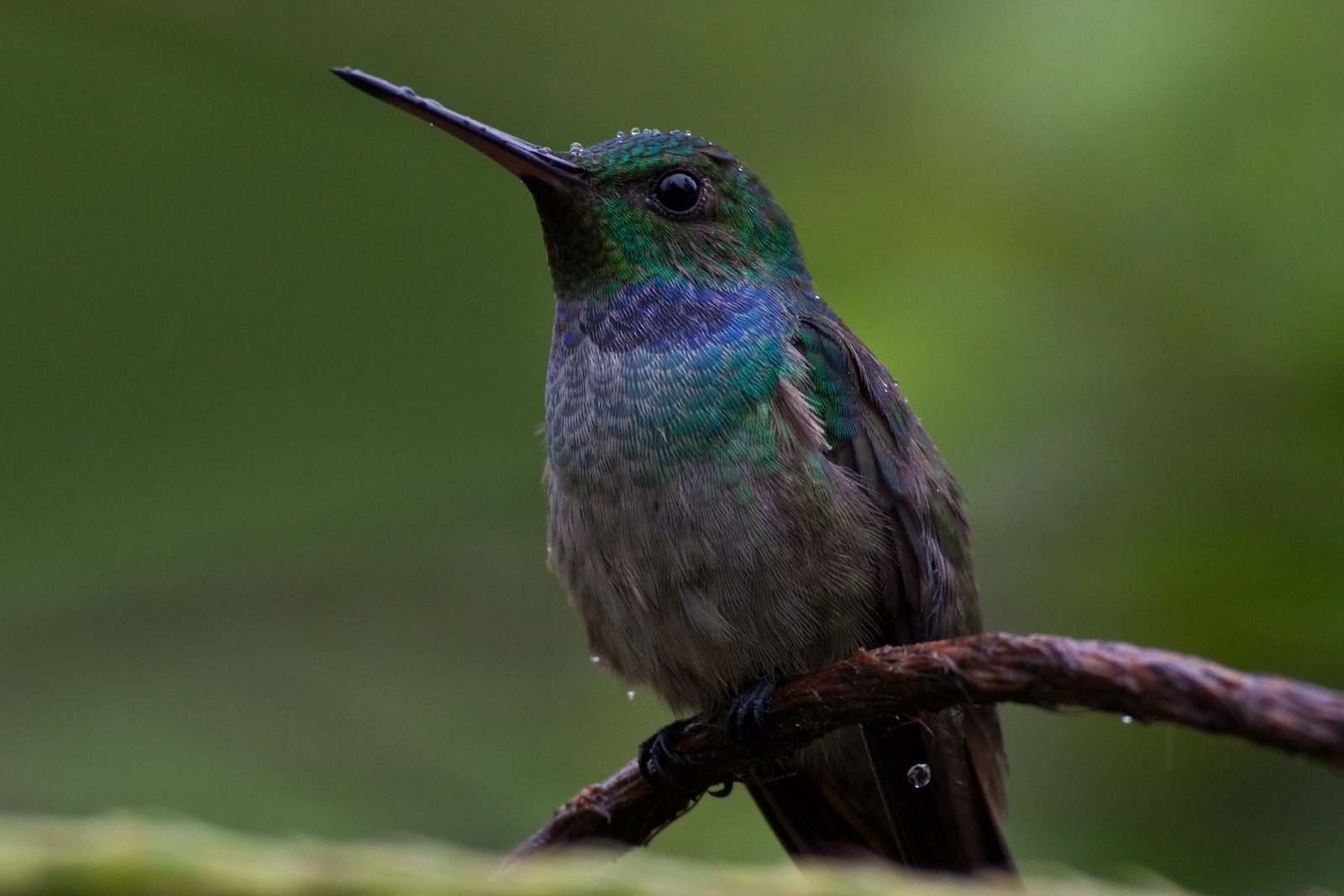
The Blue-chested Hummingbird is a small green hummingbird of the humid lowlands on the Caribbean side of southern Central America. The male has a glittering blue-violet patch on the breast, which only shows in good light. Along the Pacific coast of Costa Rica and western Panama it is replaced by the Charming Hummingbird.
Voice
A dry chip or tsit; the song is a repeated series of high, squeaky notes from a fixed perch.
Recording: Juan Freile — CC BY-NC-SA 4.0 · shortened to the first 60 s, mono · xeno-canto
Identification
8–9 cm, with a straight bill that is black above and has a pink to red lower mandible with a dark tip. The male is green above, with a glittering green crown and throat, a blue-violet patch on the breast, a grey belly and a dark bronze-green tail. The female has pale grey underparts with green spots on the throat and breast and often a few blue feathers on the breast; the tail has grey tips.
Confusion species
Charming Hummingbird Polyerata decora is very similar, but the male has a larger, bluer patch that extends onto the throat and crown; the two species hardly overlap anywhere. Rufous-tailed Hummingbird Amazilia tzacatl is larger, with a red bill and a rufous tail. The male Violet-bellied Hummingbird Chlorestes julie is smaller and has an entirely violet belly.
Habitat
Edges of humid lowland forest, secondary forest, clearings with shrubs, shade coffee, cacao plantations and gardens, from sea level to about 700 m. It feeds mainly at low and middle levels and defends flowering shrubs.
Where the bird is most at home, classified by the vegetation units of Mexico and Central America.





Range and movements
On the Caribbean side from south-eastern Nicaragua (Río San Juan), through Costa Rica and Panama; in central and eastern Panama on both slopes, east to Darién. Locally also in the far east of Honduras. Outside the guide area in western Colombia and western Ecuador.
- Resident
- dark = core range, pale = thinly spread
How and when to look
In the Caribbean lowlands of Costa Rica, for example around La Selva biological station, and in Panama along Pipeline Road in Soberanía National Park, at flowering shrubs along forest edges.
Conservation status
Not threatened. Common in suitable habitat. The species tolerates secondary forest and semi-open country well.
Scientific name
Polyerata amabilis | (Gould, 1853)
Gould described the species in 1853 as Trochilus (--?) amabilis; because it was later moved to another genus, the author and year stand in brackets. The genus Polyerata was introduced in 1863 by Heine. Polyerata is Greek, from polus 'much' and eratos 'lovely, beloved': 'very lovely'. amabilis is Latin for 'lovely, charming', after the handsome glittering blue breast. The specimen the first description was based on came from Colombia.