All species › Gamebirds › Guans, curassows and chachalacas › Horned Guan
Position in the tree Birds Aves › Birds with a flexible palate Neognathae › Fowl Galloanserae
Horned Guan | Oreophasis derbianus
Hoorngoean | Pavón cornudo
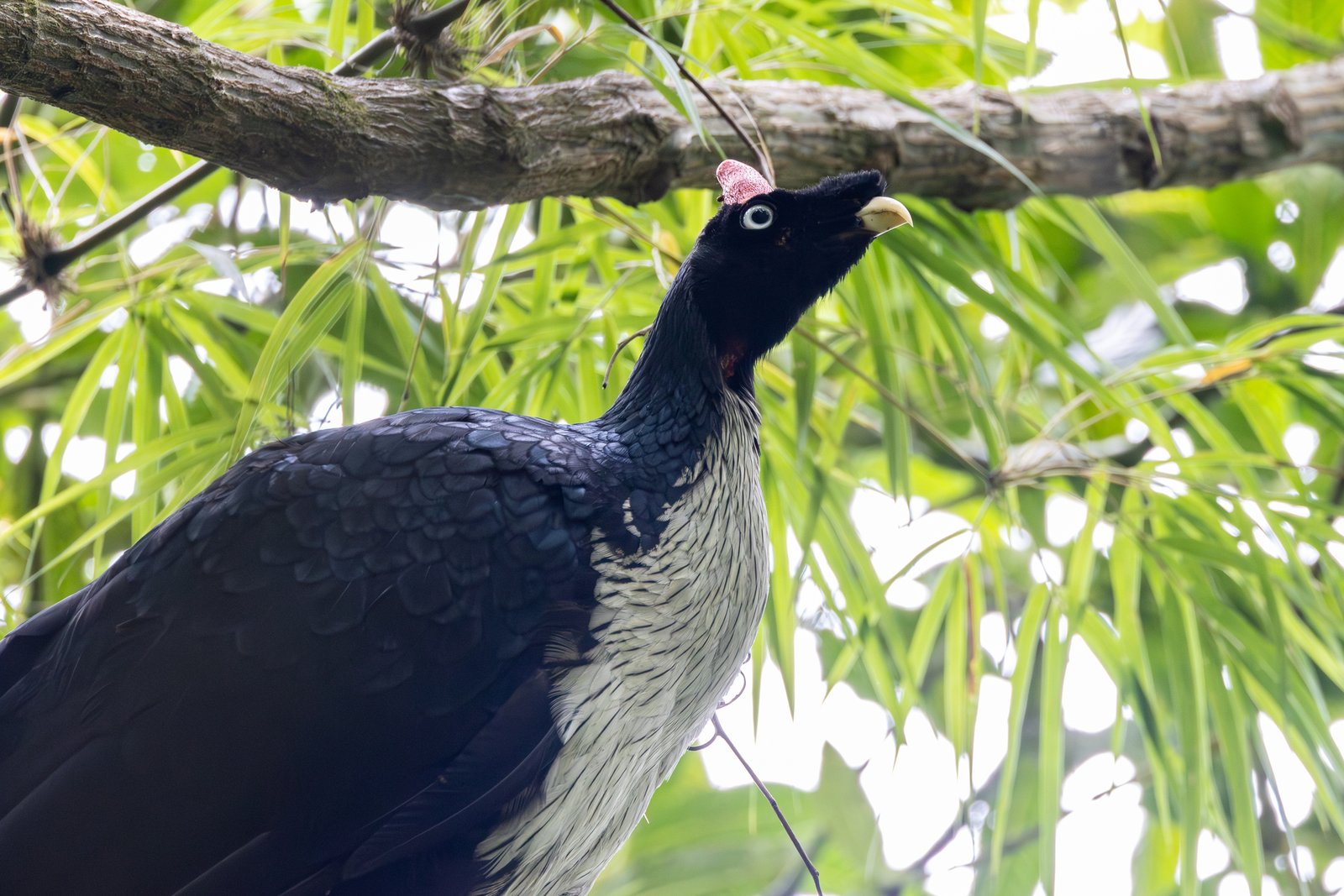
The Horned Guan is a large, rare guan of the cloud forest on the highest mountains of Chiapas and western Guatemala. An upright red horn on the crown makes the bird unmistakable. It is the only species in the genus Oreophasis, has one of the smallest ranges of all curassows and guans and does not occur outside the guide area.
Voice
In the breeding season, roughly January to April, the male gives a deep, low, ventriloquial moan, oomh oomh, whose direction can scarcely be determined. Also soft, cackling calls and a sharp kruk when alarmed; also a clapping sound made with the wings.
Recording: Sasha Robinson — CC BY-NC-SA 4.0 · converted to mono · xeno-canto
Identification
75–85 cm; a large, heavy guan with a long tail. The head, neck and upperparts are black with a blue-green gloss. The foreneck and breast are white with fine black streaks, and the belly is brownish black. The long black tail has a broad white band across the middle. On the crown stands a bare, upright, crimson horn several centimetres high. The throat has a small bare red patch, the eye is white, the bill yellow and the legs red. Male and female are alike; the female has a slightly smaller horn.
Confusion species
With its horn, white breast and white tail band, the species cannot be confused. Highland Guan Penelopina nigra lives in the same mountains; the male is also black, but much smaller, without white and without a horn, and has a red dewlap. Crested Guan Penelope purpurascens is olive-brown with a bushy crest and lives mainly lower down.
Habitat
Humid cloud forest and higher forest with oaks, pines and dense undergrowth, mainly between about 1800 and 3100 m. It lives alone, in pairs or in small groups in the trees, where it moves by hopping from branch to branch, and sometimes comes to the ground. It eats mainly fruit and leaves. The nest is placed high in a tree.
Where the bird is most at home, classified by the vegetation units of Mexico and Central America.


Range and movements
Sierra Madre de Chiapas, from El Triunfo to Tacaná on the border with Guatemala, and the volcanoes and highest mountains of western and central Guatemala, including those around Lake Atitlán. The species does not occur outside the guide area.
- Resident
- dark = core range, pale = thinly spread
How and when to look
To be looked for at El Triunfo in Chiapas, which can only be reached on a hike of several days, and on the slopes of the volcanoes around Lake Atitlán in Guatemala, such as Volcán San Pedro and Volcán Atitlán. Early in the breeding season the male's low moan helps to find the bird.
Conservation status
Endangered. Fewer than an estimated 2500 adult birds remain, spread over a small number of isolated mountain tops. The species is declining through forest loss, the conversion of forest to fields and coffee plantations, and hunting.
Scientific name
Oreophasis derbianus | Gray, 1844
Gray described the species in 1844 and placed it straight away in the genus where it still stands. He introduced the genus Oreophasis in that same work. Oreophasis is Greek, from oros 'mountain' and phasianos 'pheasant': 'mountain pheasant', after its highland forests. derbianus honours Edward Smith-Stanley, 13th Earl of Derby (1775–1851), an English natural history collector with a large menagerie. The specimen the first description was based on came from Guatemala.