All species › Gamebirds › Guans, curassows and chachalacas › Crested Guan
Position in the tree Birds Aves › Birds with a flexible palate Neognathae › Fowl Galloanserae
Crested Guan | Penelope purpurascens
Kuifsjakohoen | Pava cojolita
The Crested Guan is the largest and most widespread guan in the guide area, a forest bird of the lowlands and lower slopes from western and eastern Mexico to Panama. Pairs and small groups live in the canopy and often give themselves away by loud, yelping calls. The species also lives in north-western South America.
Voice
Loud and conspicuous: a series of yelping, honking calls, kyow kyow kyow, often at dusk and when alarmed. In the breeding season the bird makes a dry, rattling sound with its wings at dawn, during a short glide.
Recording: José María Loaiza B. — CC BY-NC-SA 4.0 · shortened to the first 60 s, mono · xeno-canto
Identification
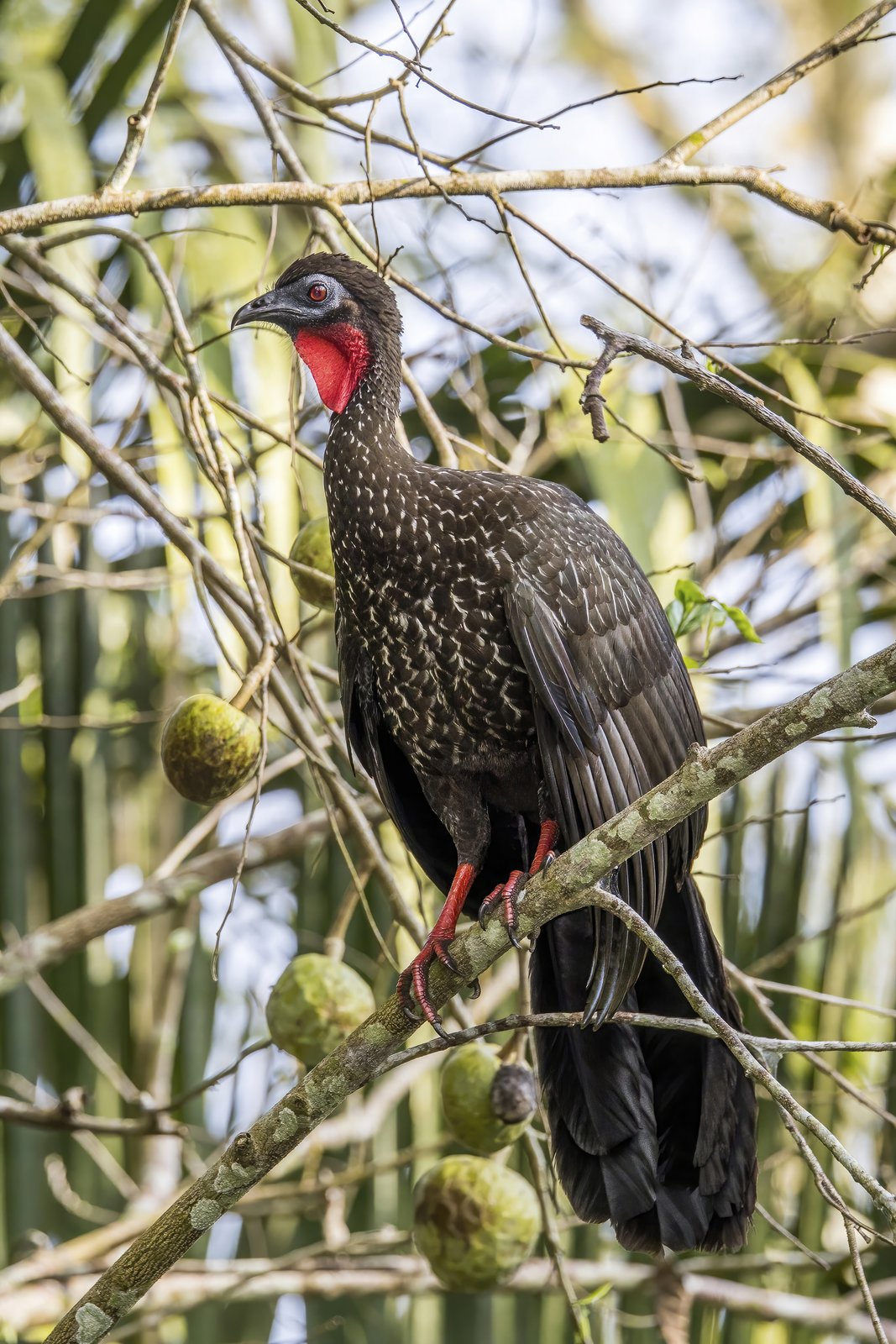
84–91 cm; a large, long-tailed guan with a long neck, a small head and a bushy crest. The plumage is dark olive-brown with a bronze-green gloss, somewhat more rufous on the upperparts. The neck, breast and wing coverts have fine white streaks and fringes. The face around the eye is bare and grey-blue, and the throat has a bare, bright red dewlap. The eye is red, the bill dark and the legs red. Male and female are alike.
Confusion species
Chachalacas, such as Plain Chachalaca Ortalis vetula, are much smaller and slimmer, grey-brown without white streaks, with a small bare pink throat patch and a smaller crest; they live in noisy groups in scrub and forest edges. Black Guan Chamaepetes unicolor is smaller and plain black, with a blue face and no dewlap. The female Great Curassow Crax rubra is larger, barred and lives mainly on the ground. Highland Guan Penelopina nigra is smaller and lives higher up.
Habitat
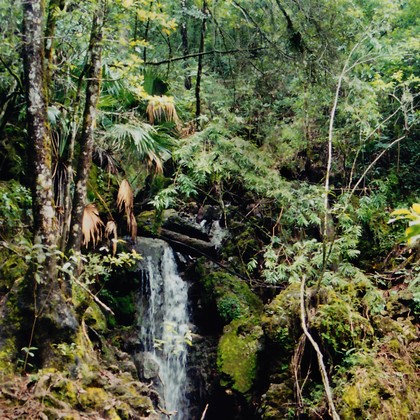
Evergreen and semi-evergreen lowland forest, foothill forest, gallery forest and humid parts of dry forest, locally also cloud forest, from sea level to about 2000 m, mainly below 1500 m. It lives in pairs or small groups in the canopy and rarely comes to the ground. It eats mainly fruit, as well as leaves and flowers. The nest is a platform of twigs high in a tree.
Where the bird is most at home, classified by the vegetation units of Mexico and Central America.






Range and movements
In Mexico on the Pacific side from southern Sinaloa to Chiapas, and on the Caribbean side from southern Tamaulipas through Veracruz, Tabasco and the southern Yucatán Peninsula to Chiapas. Further in Belize, Guatemala, Honduras, El Salvador, Nicaragua, Costa Rica and Panama. Outside the guide area in Colombia, Venezuela and western Ecuador.
- Resident
- dark = core range, pale = thinly spread
How and when to look
Crested Guan is regularly seen in large protected forests where it is not hunted, such as Calakmul in Campeche, Tikal in Guatemala, Corcovado and Carara in Costa Rica and along the Pipeline Road in Soberanía in Panama. Fruiting trees often attract several birds; the loud calls help to find them.
Conservation status
Near Threatened. The species disappears from areas with heavy hunting and forest loss and has become scarce in large parts of Mexico and the lowlands of Central America. In large protected forests it is still fairly common.
Scientific name
Penelope purpurascens | Wagler, 1830
Wagler described the species in 1830 and placed it straight away in the genus where it still stands. The genus Penelope was introduced in 1786 by Merrem. Penelope comes from Greek pēnelops, an unidentified duck-like bird; the same name as Penelope, the wife of Odysseus. purpurascens is Latin for 'purplish', after the purple to green gloss on the dark plumage. The specimen the first description was based on came from Mexico (not specified).