All species › Gamebirds › Guans, curassows and chachalacas › Great Curassow
Position in the tree Birds Aves › Birds with a flexible palate Neognathae › Fowl Galloanserae
Great Curassow | Crax rubra
Bruine hokko | Hocofaisán
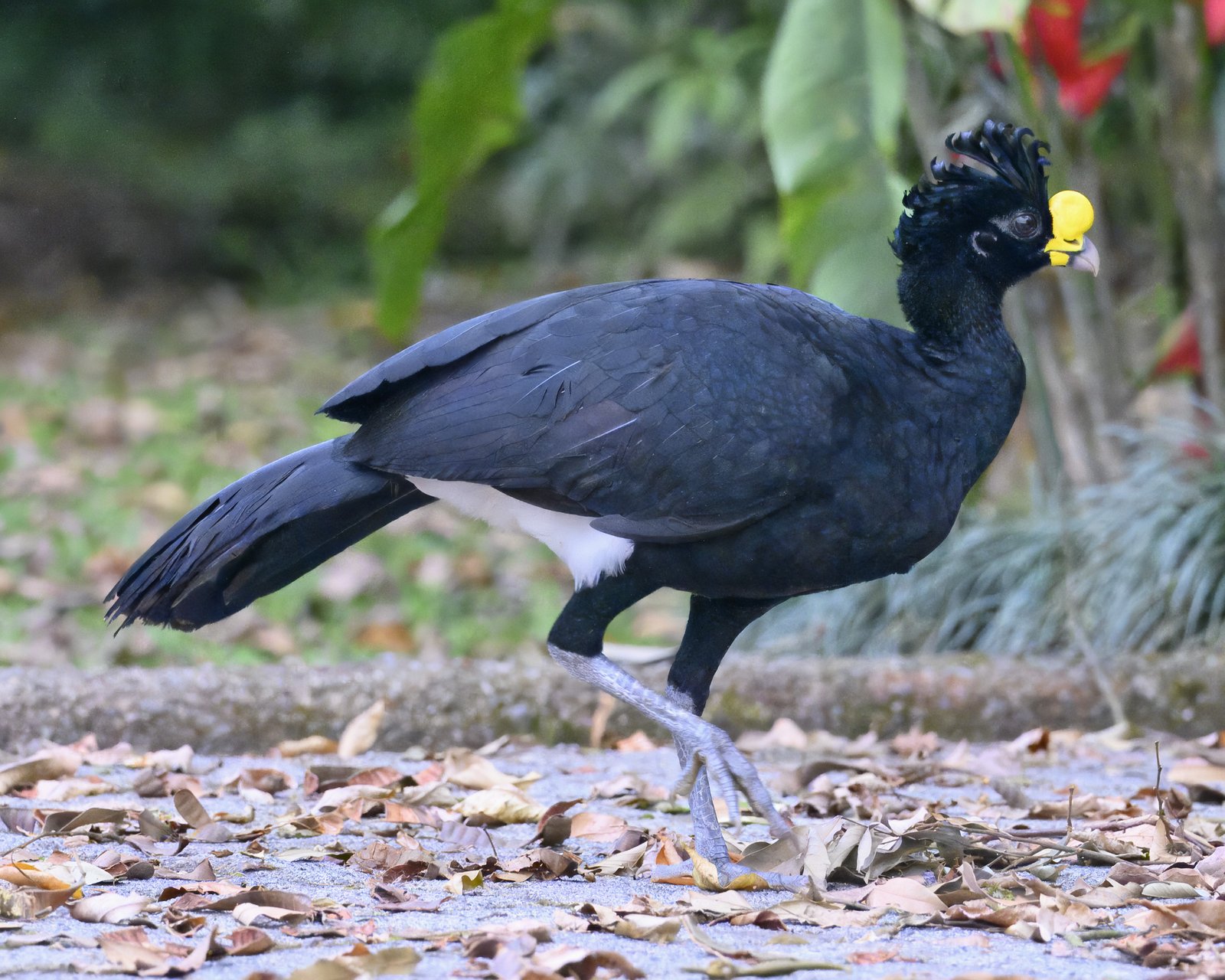
The Great Curassow is the largest and heaviest gamebird in the guide area, a ground bird of undisturbed lowland forest from eastern Mexico to Panama. Male and female differ strongly: the male is black with a yellow bill knob, the female rufous or barred. The species also lives in western Colombia and Ecuador.
Voice
In the breeding season the male gives a very low, booming, ventriloquial hum, oomm, that carries a long way but whose source can scarcely be pinpointed. Also a high, drawn-out whistled wheeeeh, mainly when alarmed.
Recording: Ilias Van Hende — CC BY-NC-SA 4.0 · converted to mono · xeno-canto
Identification
78–92 cm; a very large, heavy gamebird with a long, broad tail and a crest of forward-curled feathers. The male is glossy black with a white lower belly and white undertail coverts, and a bright yellow knob at the base of the bill. The female occurs in several morphs. Usually she is rufous-brown with a black-and-white barred head and crest, a barred tail and an ochre belly; in addition there are heavily black-and-white barred and dark, almost black females. The female has no bill knob.
Confusion species
Crested Guan Penelope purpurascens is slimmer and olive-brown, with white streaks on the neck and breast, a red dewlap and a small head, and lives mainly in the trees. Black Guan Chamaepetes unicolor is much smaller, plain black with a blue face and lives in the mountains. Tinamous, such as Great Tinamou Tinamus major, also walk on the forest floor, but are smaller and have no crest and an almost invisible tail.
Habitat
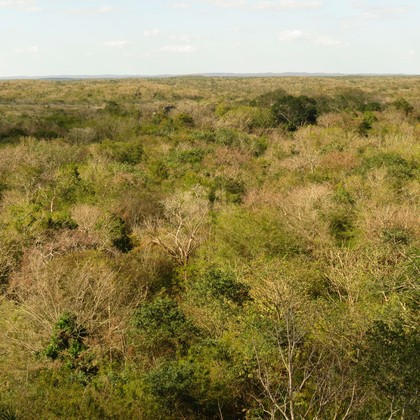
Evergreen and semi-evergreen lowland forest, foothill forest and gallery forest, locally also humid parts of dry forest, from sea level to about 800 m, locally higher. It lives alone, in pairs or in small groups on the forest floor, and flies up into a tree when in danger or to roost. It eats mainly fallen fruit, as well as seeds, leaves and invertebrates. The nest is a platform of twigs and leaves in a tree.
Where the bird is most at home, classified by the vegetation units of Mexico and Central America.




Range and movements
In Mexico from south-eastern San Luis Potosí and southern Tamaulipas through Veracruz, Oaxaca, Tabasco and Chiapas to the Yucatán Peninsula and Cozumel Island. Further in Belize, Guatemala, Honduras, Nicaragua, Costa Rica and Panama; probably extirpated in El Salvador. A small population of its own subspecies (C. r. griscomi) lives on Cozumel. Outside the guide area in western Colombia and western Ecuador.
- Resident
- dark = core range, pale = thinly spread
How and when to look
The best chances are in large protected forests where it is not hunted, such as Calakmul in Campeche, Tikal in Guatemala and Corcovado and Santa Rosa in Costa Rica. There birds sometimes walk calmly across trails and clearings early in the morning. The male's low boom is heard more often than the bird is seen.
Conservation status
Vulnerable. The species is highly sensitive to hunting and the loss of lowland forest and has disappeared from large parts of the guide area. A bird this large that lives on the ground survives mainly in large, well-guarded forests. The small population on Cozumel is also vulnerable to hurricanes.
Scientific name
Crax rubra | Linnaeus, 1758
Linnaeus described the species in 1758 and placed it straight away in the genus where it still stands. He introduced the genus Crax in that same work. The origin of Crax is uncertain; the name may go back to Greek kras 'head' or kranos 'helmet', after the striking crest. rubra is Latin for 'red', after the rufous female (the 'Red Peruvian Hen' on which the name is based). The specimen the first description was based on came from not stated (described from an illustration by Albin).