All species › Passerines › New World warblers › Hooded Yellowthroat
Position in the tree Birds Aves › Birds with a flexible palate Neognathae › All other modern birds Neoaves › Landbirds Telluraves › Falcons, parrots and passerines Australaves › Falcons and passerines Eufalconimorphae › Parrots and passerines Psittacopasserae
Hooded Yellowthroat | Geothlypis nelsoni
Nelsons maskerzanger | Mascarita matorralera
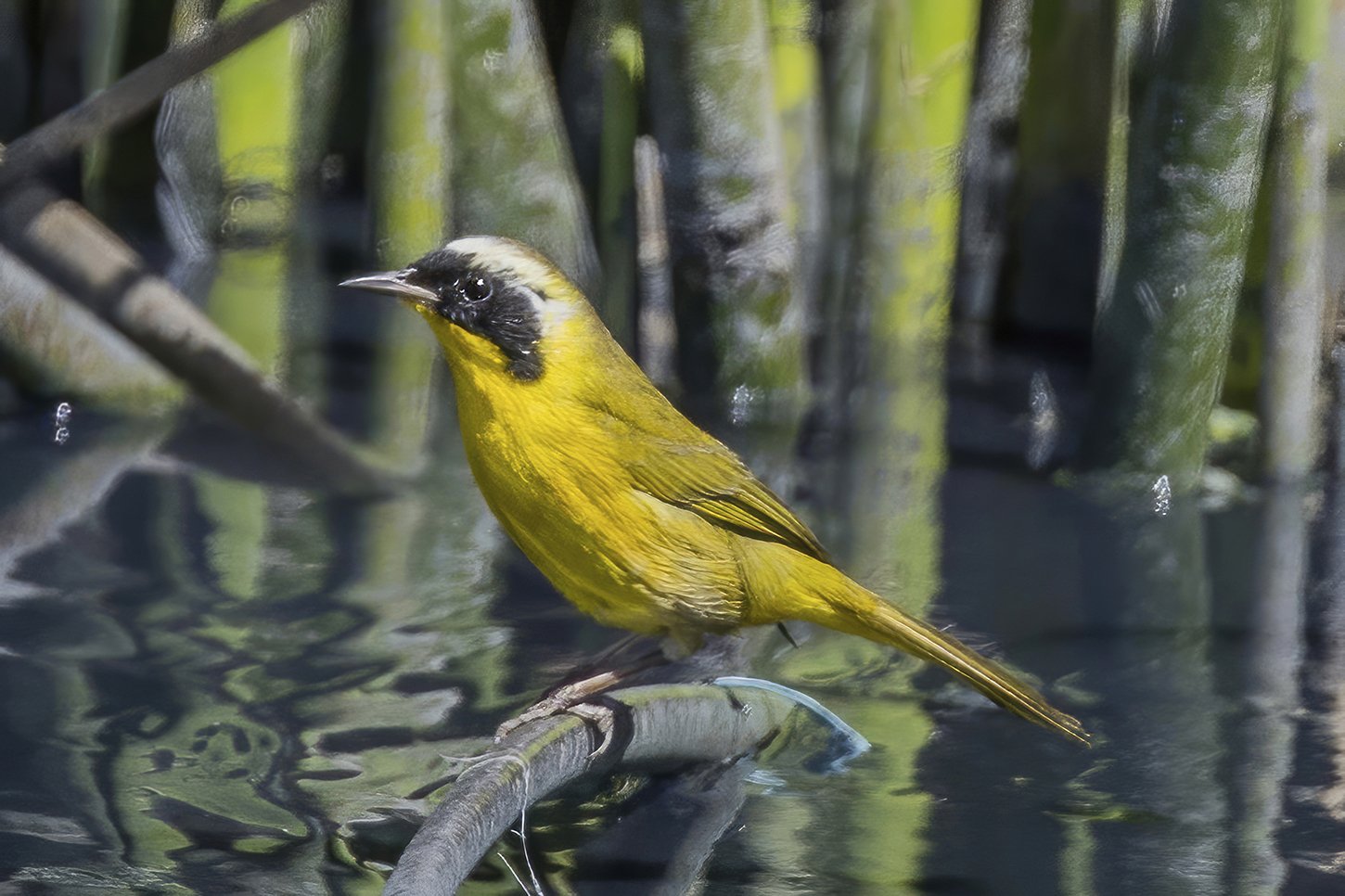
The Hooded Yellowthroat is a yellowthroat of dry scrub on mountain slopes in eastern and southern Mexico. Unlike most of its relatives it does not live in marshes. The male has a black mask with a pale grey border above it and yellow underparts.
Voice
The song is a clear, rolling warble, richer and more varied than that of Common Yellowthroat. The call is a dry chek.
Recording: ALAN MONROY OJEDA — CC BY-NC-SA 4.0 · converted to mono · xeno-canto
Identification
12–13 cm. The male has a broad black mask across the forehead, lores and cheeks, bordered above by a pale grey band that merges into the olive-grey crown. Upperparts olive-green, throat and breast bright yellow, flanks olive-brown, centre of belly paler yellow. The female has no mask, an olive-grey head, a pale eye-ring and yellow throat and breast. Bill dark, legs pink.
Confusion species
Common Yellowthroat Geothlypis trichas is very similar, but lives mainly in marshes and wet vegetation and usually has a whiter border above the mask and a paler belly; in winter both species may occur in the same area. Black-polled Yellowthroat Geothlypis speciosa has a mask without a pale border and lives in marshes. Grey-crowned Yellowthroat Geothlypis poliocephala has a small mask in front of the eye, a grey crown and a thick, two-toned bill.
Habitat
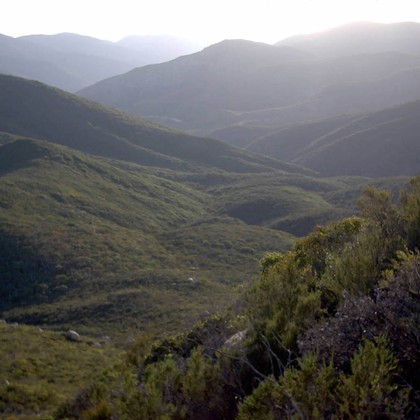
Dense scrub and brush on dry mountain slopes, edges and clearings in pine-oak and oak woodland, brushy ravines and overgrown grassland with shrubs, mostly between about 1500 and 3000 m. It searches for insects low in the shrubs.
Where the bird is most at home, classified by the vegetation units of Mexico and Central America.



Range and movements
Endemic to Mexico. Found in the Sierra Madre Oriental from south-eastern Coahuila and Nuevo León south through San Luis Potosí, Hidalgo and Querétaro, and further in the Trans-Mexican Volcanic Belt and the highlands of Puebla, western Veracruz and Oaxaca.
- Resident
- dark = core range, pale = thinly spread
How and when to look
Best searched for on brushy slopes in pine-oak country early in the morning, when the males sing from the top of a shrub.
Conservation status
Not threatened (LC). Fairly common in suitable scrub; suffers little from human use of the landscape as long as dense shrubs remain.
Scientific name
Geothlypis nelsoni | Richmond, 1900
Richmond described the species in 1900 and placed it straight away in the genus where it still stands. The genus Geothlypis was introduced in 1847 by Cabanis. Geothlypis is Greek, from gē 'ground' and thlupis, an unidentified small bird: 'ground warbler', after its life low in dense cover. nelsoni honours the American naturalist Edward William Nelson (1855–1934), who explored Mexico thoroughly for many years. The specimen the first description was based on came from Cofre de Perote, Veracruz, Mexico.