All species › Woodpeckers and allies › Woodpeckers › Hoffmann's Woodpecker
Position in the tree Birds Aves › Birds with a flexible palate Neognathae › All other modern birds Neoaves › Landbirds Telluraves › Raptors, owls, kingfishers and woodpeckers Afroaves › Mousebirds, rollers and woodpeckers Coraciimorphae › Trogons and cavity nesters Cavitaves › Hornbills, kingfishers and woodpeckers Picocoraciae › Kingfishers, bee-eaters and woodpeckers Picodynastornithes
Hoffmann's Woodpecker | Melanerpes hoffmannii
Hoffmanns specht | Carpintero de Hoffmann
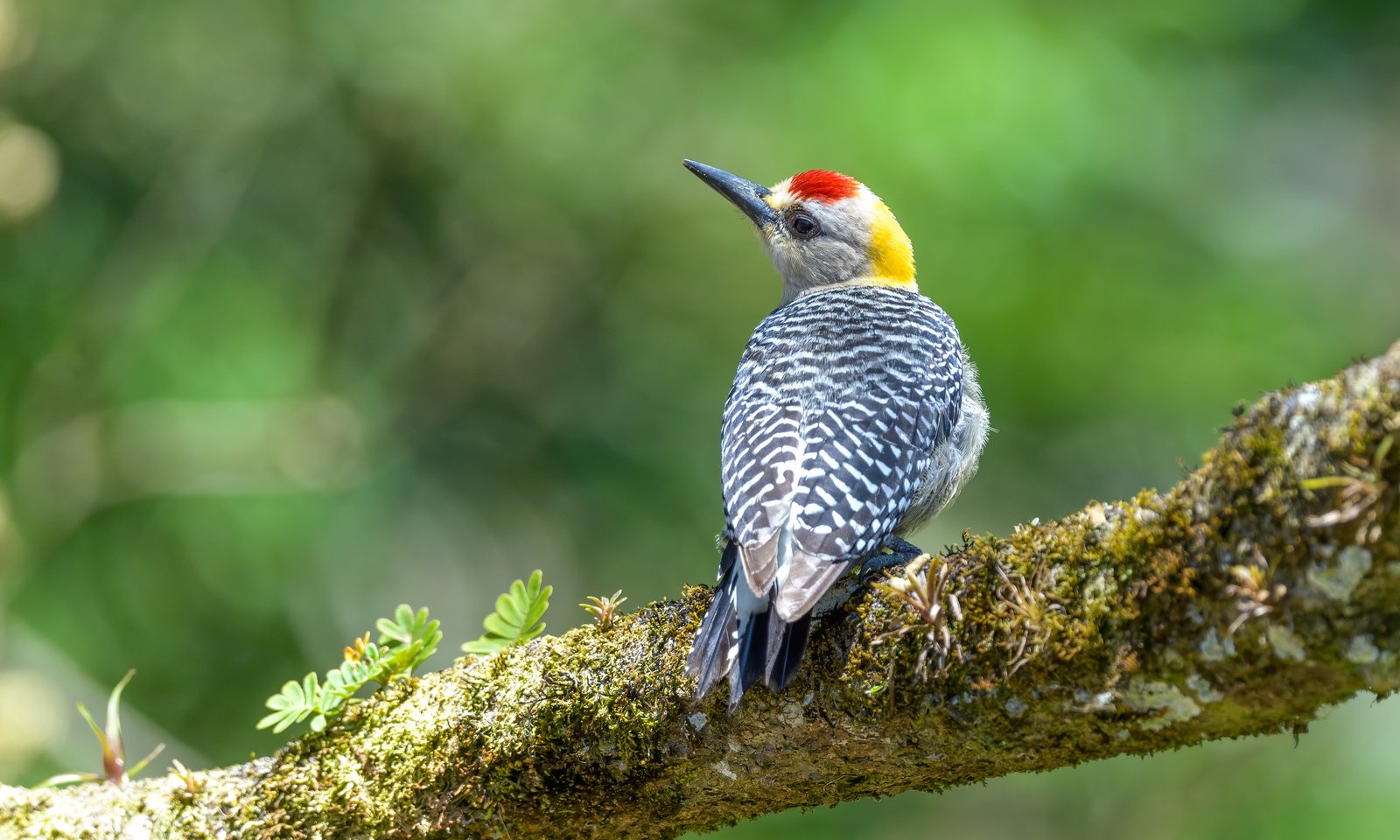
Hoffmann's Woodpecker is a medium-sized Melanerpes woodpecker of the dry Pacific side of Honduras, Nicaragua and Costa Rica. It is common in open country with trees, coffee plantations, parks and gardens. In the north of its range it meets Golden-fronted Woodpecker, in the south Red-crowned Woodpecker.
Voice
Usually a rolling churrr, given by both sexes; also a harsh, grating call. Drums on dead wood and occasionally on metal.
Recording: Max Noack — CC BY-NC-SA 4.0 · converted to mono · xeno-canto
Identification
18–21 cm. Forehead and supercilium dull white, face and sides of the neck yellowish grey. The male has a red crown and yellow to orange nape; the female has a dull white crown and pale yellow nape. Back barred black and white, rump white. Underparts drab greyish buff with a bright yellow patch in the centre of the belly.
Confusion species
Golden-fronted Woodpecker Melanerpes aurifrons (further north, from Honduras) is larger, with a red or orange-red nape and often a reddish belly patch; intermediate birds occur in southern Honduras and northern Nicaragua. Red-crowned Woodpecker Melanerpes rubricapillus (further south in Costa Rica) has a red nape and red belly patch; it also forms intermediates with this species. Black-cheeked Woodpecker Melanerpes pucherani has a black patch around the eye and lives in humid forest.
Habitat
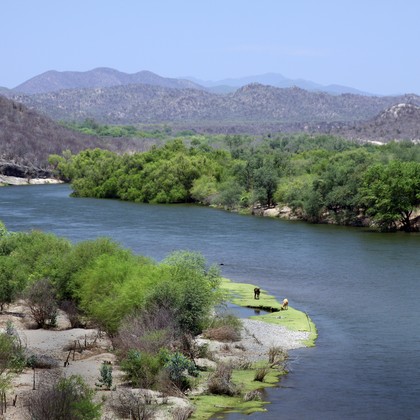
Dry deciduous and open woodland, forest edges, pasture with trees, shade coffee, parks and gardens; in Honduras to about 400 m, in Nicaragua to 800 m and in Costa Rica to above 2100 m. It eats insects and fruit and visits flowering trees.
Where the bird is most at home, classified by the vegetation units of Mexico and Central America.





Range and movements
From southern Honduras (Choluteca) through Nicaragua, mainly on the Pacific side, to central Costa Rica, including Guanacaste and the Central Valley. In Costa Rica it is spreading into cleared land. One record from El Salvador.
- Resident
- dark = core range, pale = thinly spread
How and when to look
One of the most frequent woodpeckers in gardens and parks of Costa Rica's Central Valley, for example in San José, and in Guanacaste at Palo Verde and Santa Rosa.
Conservation status
Not threatened. Common and benefits from open, man-made landscapes.
Scientific name
Melanerpes hoffmannii | (Cabanis, 1862)
Cabanis described the species in 1862 as Centurus Hoffmannii; because it was later moved to another genus, the author and year stand in brackets. The genus Melanerpes was introduced in 1832 by Swainson. Melanerpes is Greek, from melas 'black' and herpēs 'creeper': 'black creeper'. hoffmannii honours the German naturalist and collector Carl Hoffmann (1823–1859), who worked in Costa Rica from 1854 until his death. The specimen the first description was based on came from Costa Rica.