All species › Woodpeckers and allies › Woodpeckers › Golden-fronted Woodpecker
Position in the tree Birds Aves › Birds with a flexible palate Neognathae › All other modern birds Neoaves › Landbirds Telluraves › Raptors, owls, kingfishers and woodpeckers Afroaves › Mousebirds, rollers and woodpeckers Coraciimorphae › Trogons and cavity nesters Cavitaves › Hornbills, kingfishers and woodpeckers Picocoraciae › Kingfishers, bee-eaters and woodpeckers Picodynastornithes
Golden-fronted Woodpecker | Melanerpes aurifrons
Goudvoorhoofdspecht | Carpintero cheje
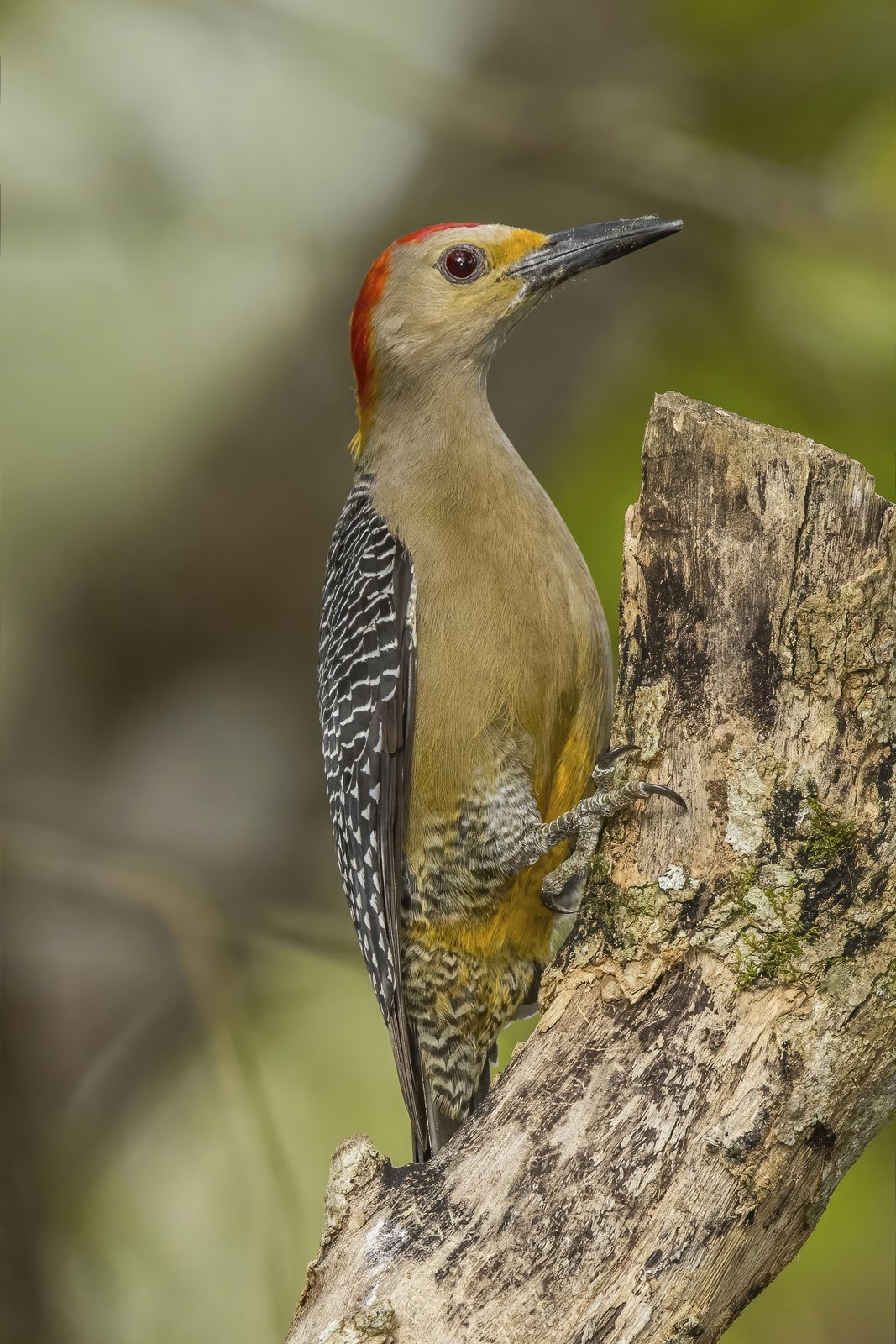
The Golden-fronted Woodpecker is the most widespread Melanerpes woodpecker of Mexico and northern Central America. Its plumage varies greatly: northern birds have a yellow-orange nape, southern ones more red on the head and belly. It is common in semi-open country, dry forest, plantations and villages.
Voice
A loud, harsh, rolling kirrr or churr, often from a post or dead branch, and a hard, dry tik-tik in short series. Drums in short, rather slow rolls, also on wooden posts and poles.
Recording: Angel Castillo Cime — CC BY-NC-SA 4.0 · converted to mono · xeno-canto
Identification
22–27 cm. Back finely to fairly broadly barred black and white, rump white, central tail feathers black. Head and underparts pale grey to drab, with a yellow to red patch in the centre of the belly. Yellow nasal tufts above the bill. Northern birds have a yellow-orange nape; in the male the red crown patch is separated from the nape by grey, and the female has a grey crown. Southern forms, from southern Mexico, have a red nape, and in the male the red runs from crown to nape. Subspecies on islands off Yucatán and Honduras differ from one another.
Confusion species
Gila Woodpecker Melanerpes uropygialis has a plain greyish-brown head with no yellow or orange and barred central tail feathers. Yucatan Woodpecker Melanerpes pygmaeus is clearly smaller, with a short bill and more yellow around the base of the bill. Hoffmann's Woodpecker Melanerpes hoffmannii (from southern Honduras) is smaller, with a yellow nape and yellow belly patch; intermediate birds occur in the contact zone. Golden-cheeked Woodpecker Melanerpes chrysogenys has a black patch around the eye. Ladder-backed Woodpecker Dryobates scalaris is much smaller, with a black-and-white striped face.
Habitat
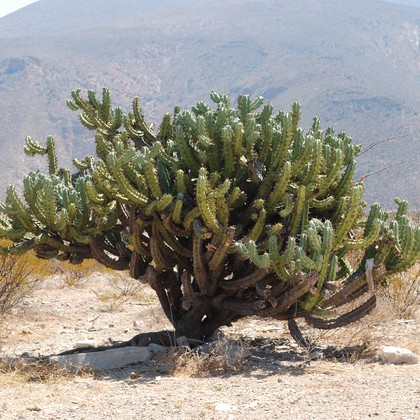
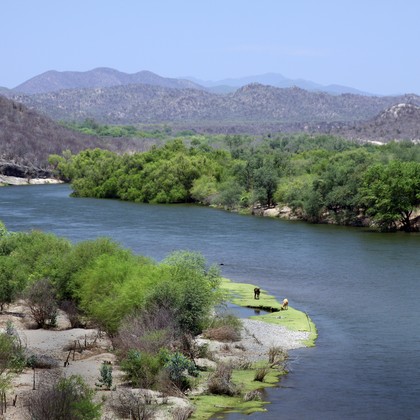
Dry and seasonal forest, thorn scrub, forest edges, gallery forest, pasture with scattered trees, plantations, parks and villages, from sea level to about 2500 m. It eats insects, fruit, seeds and nuts. The nest hole is excavated in a tree, palm or post.
Where the bird is most at home, classified by the vegetation units of Mexico and Central America.





Range and movements
From the Texas border across north-eastern and central Mexico (to Jalisco, San Luis Potosí and Hidalgo), along the Gulf coast, across the Yucatán Peninsula and through Chiapas, Guatemala, Belize, El Salvador and Honduras to northern Nicaragua; also on islands off Yucatán and Honduras. Outside the guide area in Texas and south-western Oklahoma. The southern forms are sometimes treated as a separate species.
- Resident
- dark = core range, pale = thinly spread
How and when to look
At Tikal, at Chichén Itzá and around Copán, and in Belize in gardens and along roads. It often perches conspicuously on dead branches and posts.
Conservation status
Not threatened. Common and well adapted to man-made landscapes.
Scientific name
Melanerpes aurifrons | (Wagler, 1829)
Wagler described the species in 1829 as Picus Aurifrons; because it was later moved to another genus, the author and year stand in brackets. The genus Melanerpes was introduced in 1832 by Swainson. Melanerpes is Greek, from melas 'black' and herpēs 'creeper': 'black creeper'. aurifrons is Latin, from aurum 'gold' and frons 'forehead', after the yellow patch above the bill. The specimen the first description was based on came from Hidalgo, Mexico.