All species › Passerines › Mockingbirds and thrashers › Grey Thrasher
Position in the tree Birds Aves › Birds with a flexible palate Neognathae › All other modern birds Neoaves › Landbirds Telluraves › Falcons, parrots and passerines Australaves › Falcons and passerines Eufalconimorphae › Parrots and passerines Psittacopasserae
Grey Thrasher | Toxostoma cinereum
Grijze spotlijster | Cuitlacoche peninsular
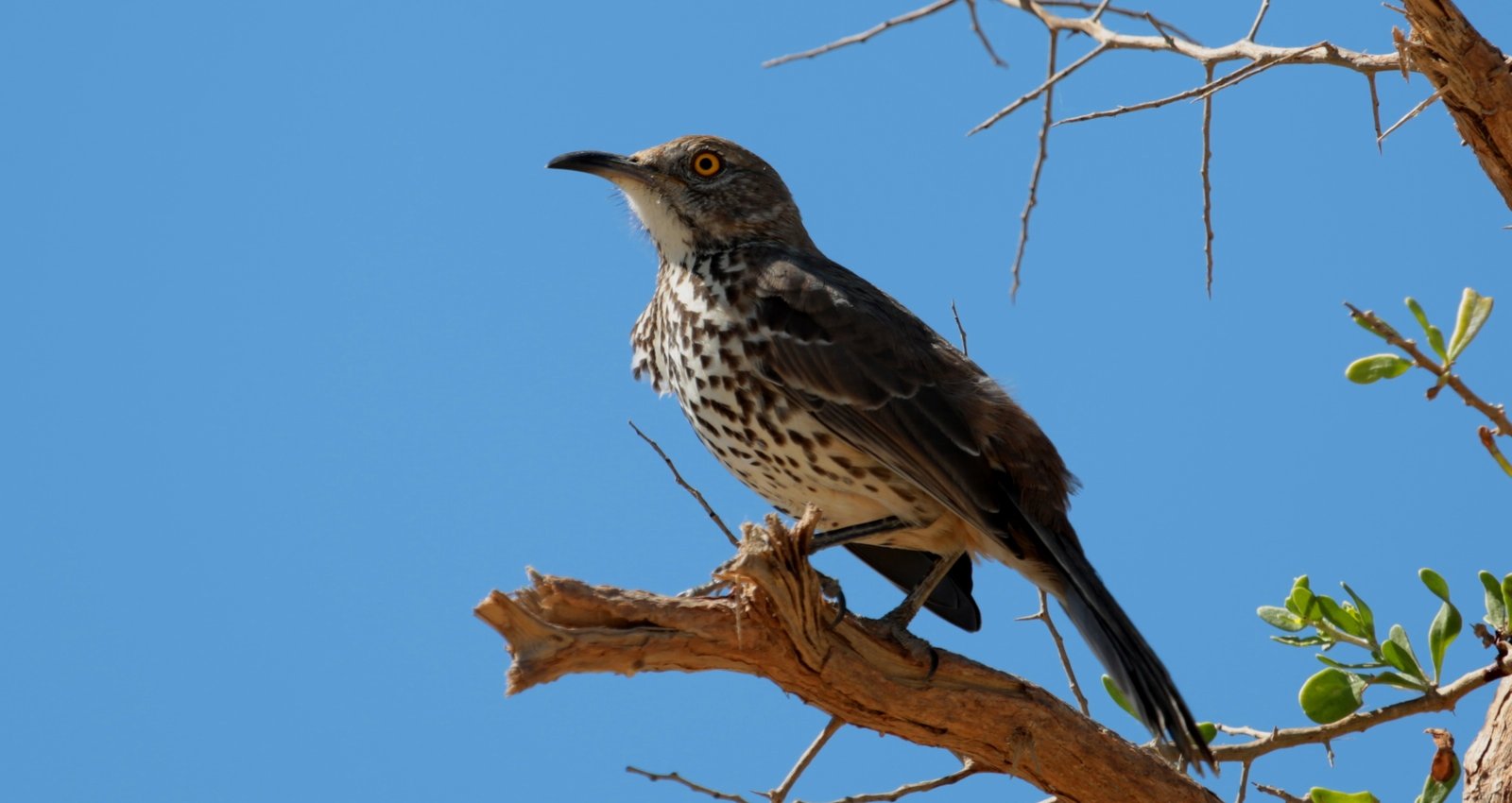
The Grey Thrasher is a grey-brown thrasher with black-spotted white underparts, found only on the Baja California peninsula. It is common in desert scrub and even in villages and gardens, and sings loudly from cacti and shrubs.
Voice
A varied song of rich, whistled and hoarse phrases, often repeated, with mimicry. Call a husky chhr and a dry chak.
Recording: Richard E. Webster — CC BY-NC-SA 4.0 · shortened to the first 60 s, mono · xeno-canto
Identification
23–26 cm. Upperparts plain grey-brown. Underparts white with distinct black arrowhead- to teardrop-shaped spots on breast and flanks; flanks and undertail pale buff. Eye orange-yellow. Bill fairly long, black and slightly decurved. Narrow pale wing bars; tail long. The sexes are alike.
Confusion species
California Thrasher Toxostoma redivivum, found only in north-western Baja California, is larger and darker, without breast spots, with a long, strongly curved bill and a dark eye. LeConte's Thrasher Toxostoma lecontei is pale and sandy without spots, with a dark eye. Northern Mockingbird Mimus polyglottos is grey with white wing patches and a short, straight bill.
Habitat
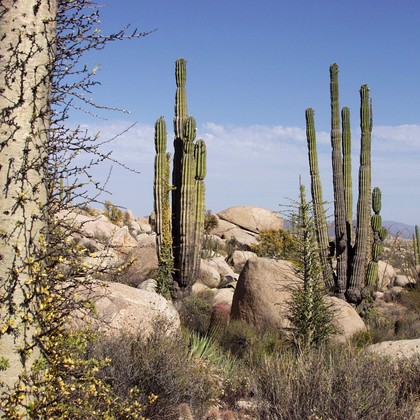
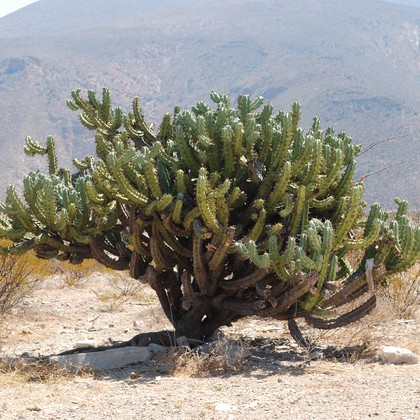
Desert scrub with cacti and thorny shrubs, dry arroyos, edges of oases and fields, also villages and gardens; from sea level into the lower mountains. It forages on the ground for insects and also eats fruit.
Where the bird is most at home, classified by the vegetation units of Mexico and Central America.

Range and movements
Endemic to Baja California, from the northern part of the central peninsula south to the Cape region; also on some offshore islands. It does not occur outside the guide area.
- Resident
- dark = core range, pale = thinly spread
How and when to look
In the Cape region, for example around La Paz and Todos Santos, it is often found in gardens and along roadsides with scrub. In spring it sings from the top of a cactus.
Conservation status
Not threatened (LC). Common within its limited range and tolerant of villages and gardens.
Scientific name
Toxostoma cinereum | (Xántus, 1860)
Xántus described the species in 1860 as Harporhynchus cinereus; because it was later moved to another genus, the author and year stand in brackets. The genus Toxostoma was introduced in 1831 by Wagler. Toxostoma is Greek, from toxon 'bow' and stoma 'mouth', after the long, curved bill. cinereum is Latin for 'ash-grey', after the greyish-brown upperparts. The specimen the first description was based on came from Cabo San Lucas, Baja California Sur, Mexico.