All species › Passerines › Mockingbirds and thrashers › Bendire's Thrasher
Position in the tree Birds Aves › Birds with a flexible palate Neognathae › All other modern birds Neoaves › Landbirds Telluraves › Falcons, parrots and passerines Australaves › Falcons and passerines Eufalconimorphae › Parrots and passerines Psittacopasserae
Bendire's Thrasher | Toxostoma bendirei
Cactusspotlijster | Cuitlacoche pico corto
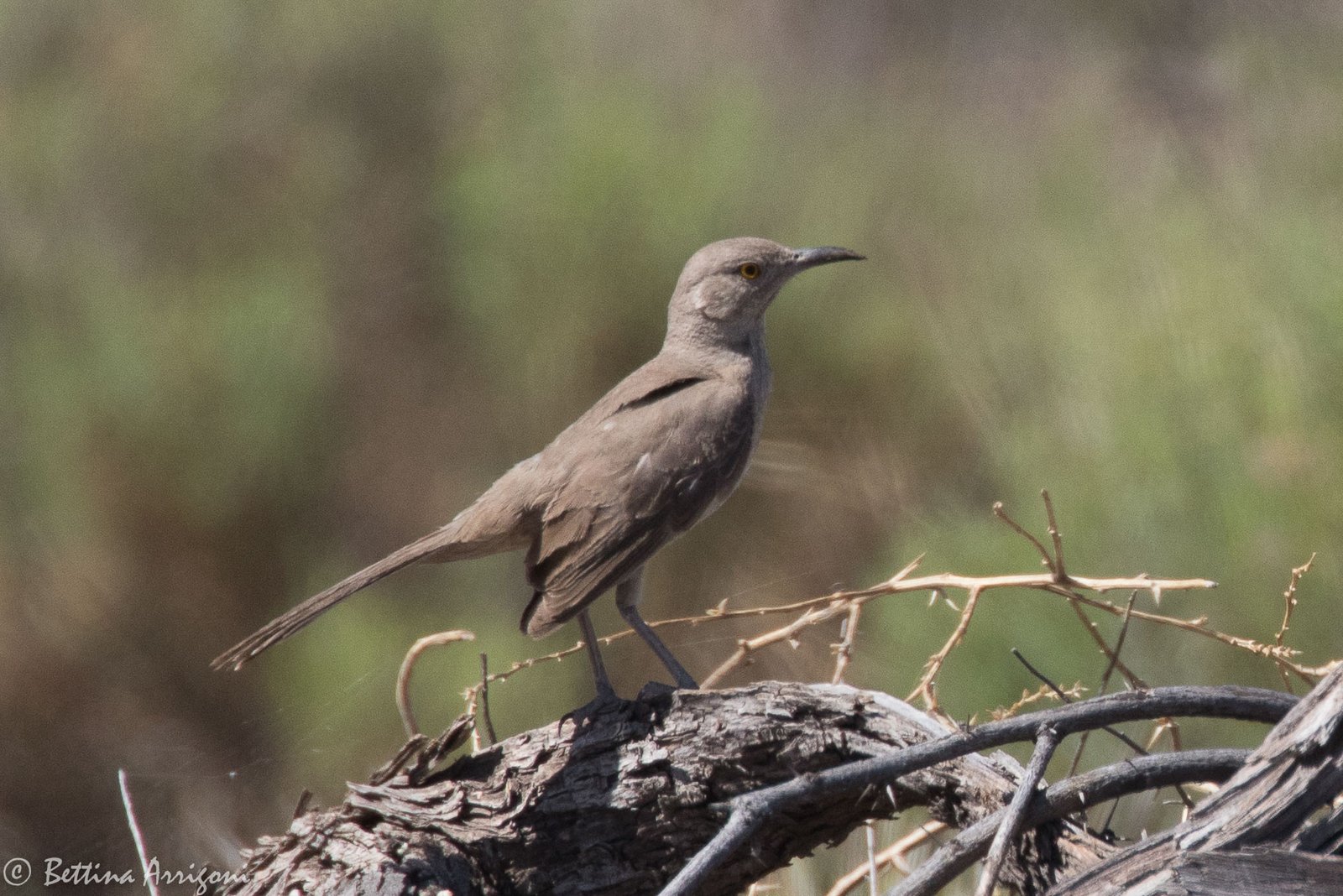
Bendire's Thrasher is a rather small, plain grey-brown thrasher of open desert in the south-western United States and north-western Mexico. With its short, almost straight bill and yellow eye it looks more like a thrush than a typical thrasher. It is declining steeply and is considered Vulnerable.
Voice
A long, continuous, musical warbling song, softer and more melodious than that of Curve-billed Thrasher and with little repetition. Call a low chuk.
Recording: Paul Marvin — CC BY-NC-SA 4.0 · shortened to the first 60 s, mono · xeno-canto
Identification
23–27 cm. Upperparts plain grey-brown. Underparts paler buffy grey, with fine, arrowhead- or triangle-shaped dark streaks on the breast that may disappear in worn birds in summer. Eye bright yellow. Bill rather short, only slightly decurved, with a pale base to the lower mandible. Tail long, with narrow pale tips. The sexes are alike.
Confusion species
Curve-billed Thrasher Toxostoma curvirostre is larger, with a longer, more strongly curved and all-black bill, an orange eye and blurry, round breast spots; young Curve-billed Thrashers with shorter bills cause the most confusion. Sage Thrasher Oreoscoptes montanus, a winter visitor to the same area, is smaller, with a short straight bill, crisp black streaks on the breast and white wing bars.
Habitat
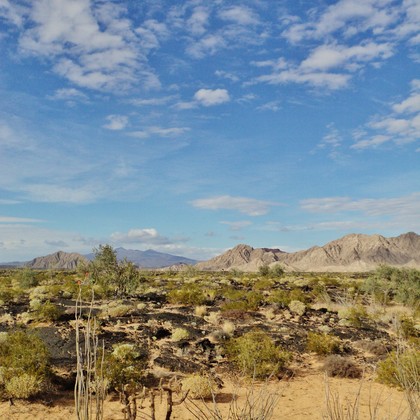
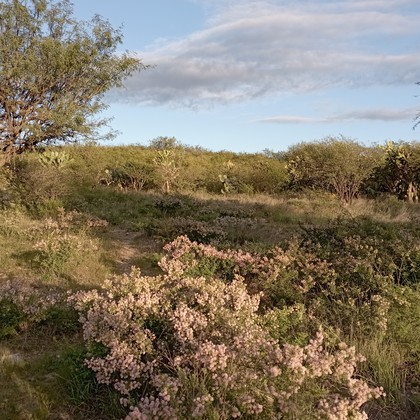
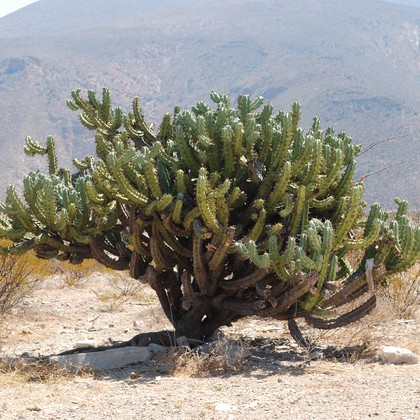
Open desert and semi-desert with scattered shrubs, yucca, cholla and other cacti, also desert grassland and field edges; mainly on flat ground in the lowlands. It forages on the ground for insects. Breeds early in the year, from February.
Where the bird is most at home, classified by the vegetation units of Mexico and Central America.
Range and movements
Breeds in the south-western United States (south-eastern California, southern Nevada and Utah, Arizona and New Mexico) and in Sonora. Northern birds move south in winter to southern Arizona, Sonora and northern Sinaloa.
- Resident
- dark = core range, pale = thinly spread
How and when to look
In Sonora it is easiest to find in spring, when males sing from a shrub or cactus. Bill shape and eye colour need careful attention to avoid confusion with young Curve-billed Thrashers.
Conservation status
Vulnerable (VU). Numbers have fallen sharply in recent decades through conversion of desert to farmland and built-up areas, overgrazing and the loss of open desert grassland.
Scientific name
Toxostoma bendirei | (Coues, 1873)
Coues described the species in 1873 as Harporhynchus Bendirei; because it was later moved to another genus, the author and year stand in brackets. The genus Toxostoma was introduced in 1831 by Wagler. Toxostoma is Greek, from toxon 'bow' and stoma 'mouth', after the long, curved bill. bendirei honours Charles Emil Bendire (1836–1897), German-born US Army officer and oologist, who collected the species in Arizona. The specimen the first description was based on came from Tucson, Arizona.