All species › Passerines › Mockingbirds and thrashers › California Thrasher
Position in the tree Birds Aves › Birds with a flexible palate Neognathae › All other modern birds Neoaves › Landbirds Telluraves › Falcons, parrots and passerines Australaves › Falcons and passerines Eufalconimorphae › Parrots and passerines Psittacopasserae
California Thrasher | Toxostoma redivivum
Californische spotlijster | Cuitlacoche californiano
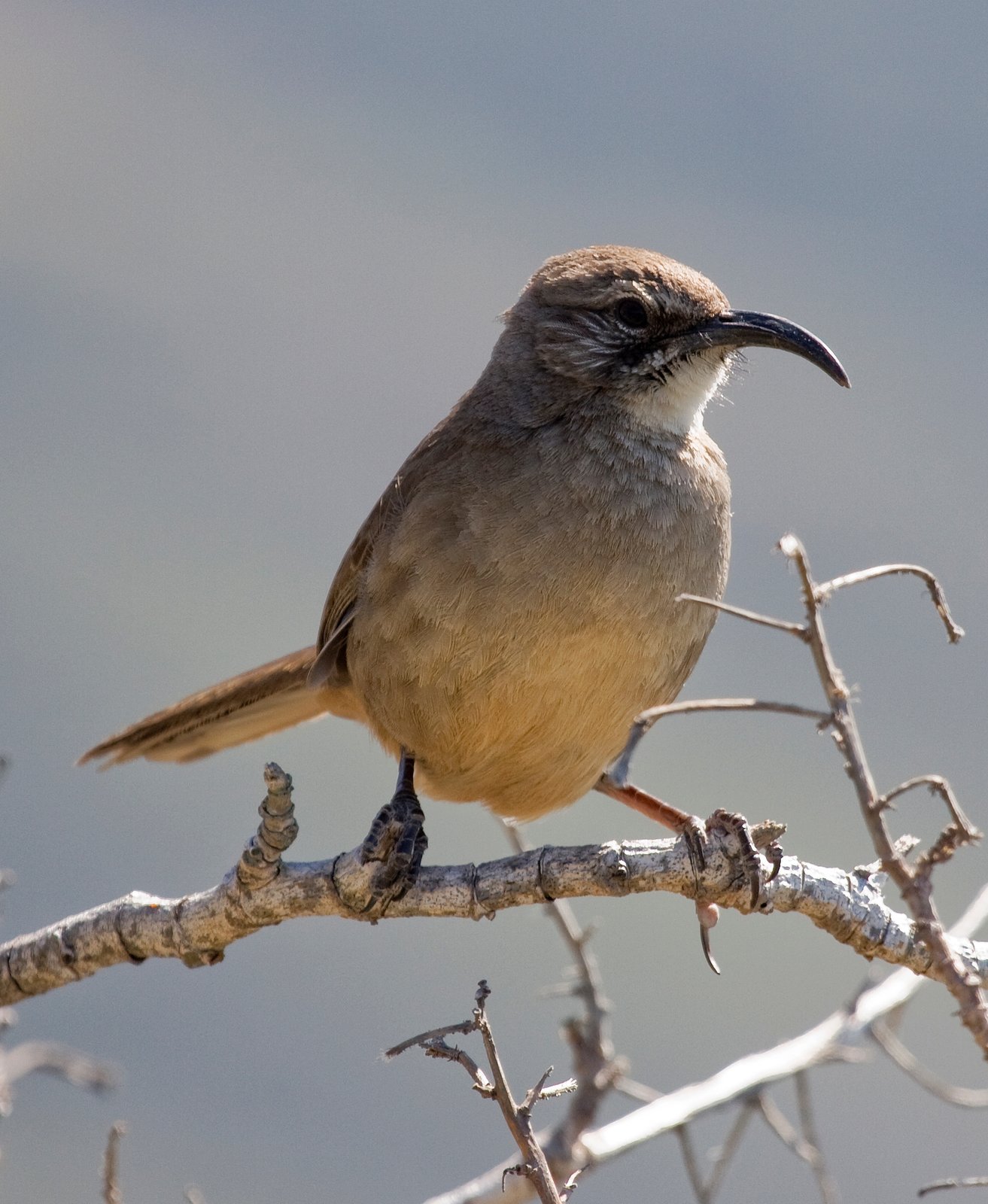
The California Thrasher is a large, dark brown thrasher with a long, sickle-shaped bill. It lives in chaparral and dense coastal scrub in California and north-western Baja California. It usually walks hidden beneath shrubs, but early in the morning it sings from the top of a bush.
Voice
A long, varied series of rich and hoarse phrases, often repeated twice, with mimicry; louder and slower than the song of Northern Mockingbird. Call a low, dry chuk and a husky chierr.
Recording: Thomas G. Graves — CC BY-NC-SA 4.0 · shortened to the first 60 s, mono · xeno-canto
Identification
29–32 cm. Upperparts plain dark greyish brown. Throat pale, with a dark malar stripe and a faint pale supercilium; breast greyish brown without spots, belly and undertail warm cinnamon. Eye dark. Bill long, black and strongly decurved. Tail long, often cocked when walking. The sexes are alike.
Confusion species
Grey Thrasher Toxostoma cinereum is smaller and paler, with black-spotted white underparts and an orange-yellow eye. LeConte's Thrasher Toxostoma lecontei is much paler and sandier and lives in open desert. Crissal Thrasher Toxostoma crissale is greyer, with a sharply rufous undertail and a paler belly. California Towhee Melozone crissalis has a short conical bill.
Habitat
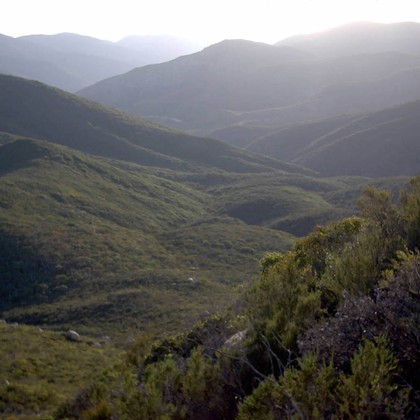
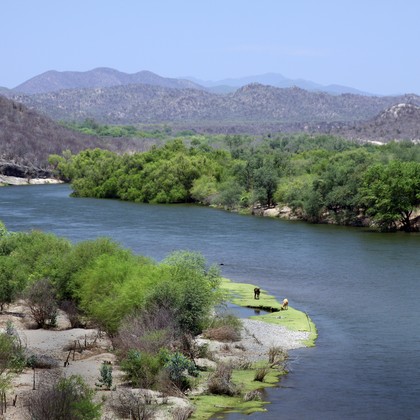
Chaparral and dense coastal sage scrub, riparian woodland and thickets along streams, also parks and gardens with dense shrubs; from the coast into the mountains. It forages on the ground for insects by digging in leaf litter and loose soil with its long bill.
Where the bird is most at home, classified by the vegetation units of Mexico and Central America.

Range and movements
California west of the deserts, from the northern Central Valley to the Mexican border. In the guide area only in north-western Baja California, south to about the Sierra San Pedro Mártir and El Rosario.
- Resident
- dark = core range, pale = thinly spread
How and when to look
In north-western Baja California found in chaparral along mountain roads, for example on the way to the Sierra San Pedro Mártir. Best seen early in the morning, when males sing from an open bush top.
Conservation status
Not threatened (LC). Common in suitable habitat; chaparral and coastal scrub are being lost locally to development and to increasingly frequent fires.
Scientific name
Toxostoma redivivum | (Gambel, 1845)
Gambel described the species in 1845 as Harpes rediviva; because it was later moved to another genus, the author and year stand in brackets. The genus Toxostoma was introduced in 1831 by Wagler. Toxostoma is Greek, from toxon 'bow' and stoma 'mouth', after the long, curved bill. redivivum is Latin for 'renewed, reinstated' (from redire 'to return'); Gambel used it for a bird first noticed by La Pérouse's expedition and now described anew. The specimen the first description was based on came from near Monterey, California.