All species › Birds of prey › Kites, Old World vultures, eagles and hawks › Grey-lined Hawk
Position in the tree Birds Aves › Birds with a flexible palate Neognathae › All other modern birds Neoaves › Landbirds Telluraves › Raptors, owls, kingfishers and woodpeckers Afroaves › Hawks and owls Hieraves
Grey-lined Hawk | Buteo nitidus
Grijsgestreepte buizerd | Aguililla gris
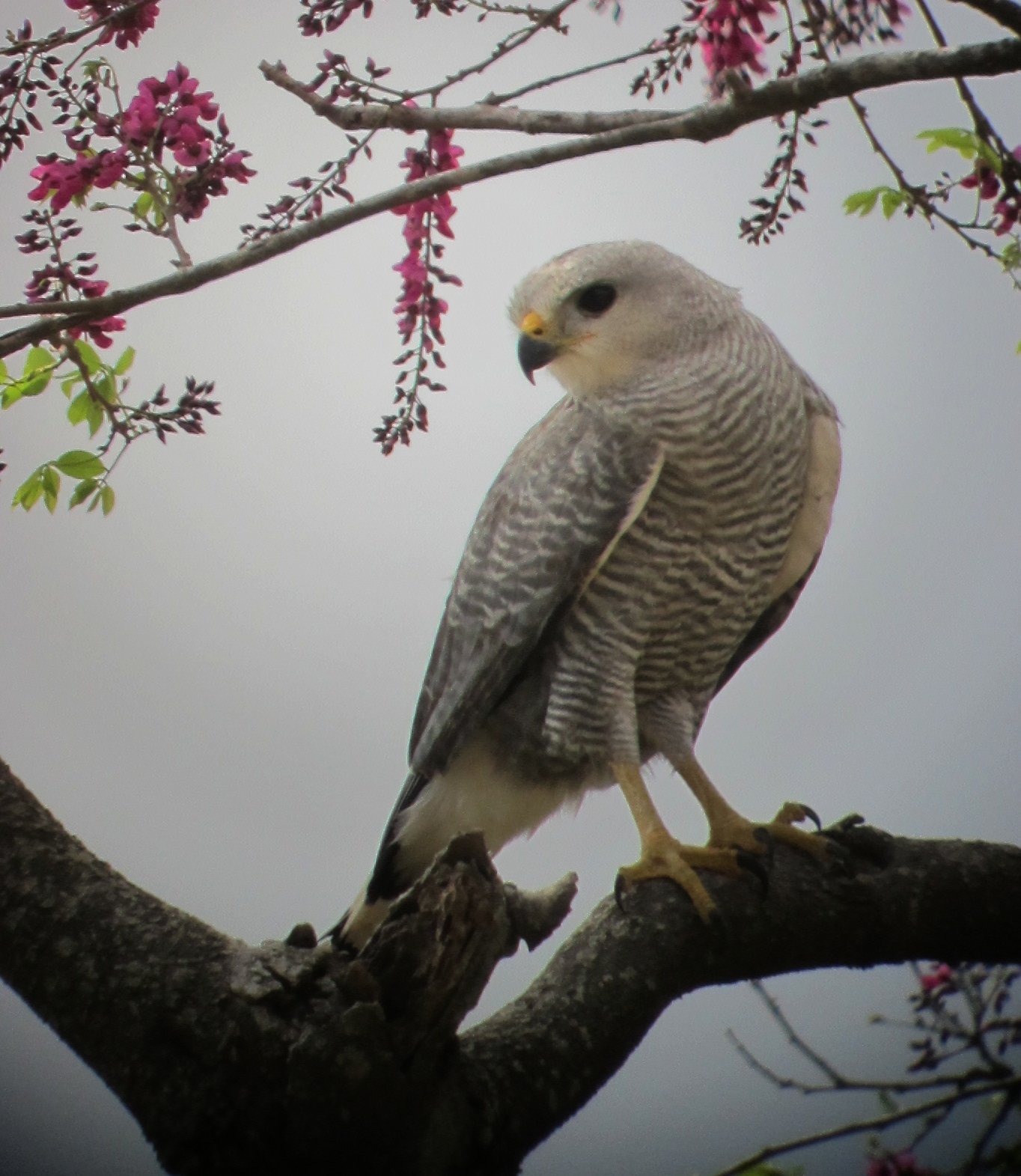
The Grey-lined Hawk is a compact, pale grey buzzard with finely barred upperparts and underparts, a dark eye and a black tail with white bands. It hunts from a perch at a forest edge, along a river or in semi-open country, mainly for lizards, but also for frogs, large insects and small birds. In the guide area it is a resident from central Costa Rica to Panama; further north it is replaced by the closely related Grey Hawk.
Voice
A clear, whistled, descending hoo-weeeoo, often from a perch or in flight; also a high, drawn-out scream kreeee.
Recording: JAYRSON ARAUJO DE OLIVEIRA — CC BY-NC-SA 4.0 · converted to mono · xeno-canto
Identification
40–46 cm, with fairly short, broad wings and a medium-length tail. Adults are pale grey, with fine grey-and-white bars on the back and wing coverts and finely grey-and-white barred underparts. The eye is dark, cere and legs are yellow to orange-yellow. The tail is black with two or three white bands, and the rump is white. In flight the underwings are whitish with fine grey bars and dark tips. Young birds are dark brown above, with a pale head with a dark eye-stripe and moustachial stripe, white to buffish underparts with dark teardrop spots and a brown tail with many narrow dark bands. Male and female are alike; the female is larger.
Confusion species
The Grey Hawk Buteo plagiatus is very similar, but has a plain grey back without bars; it occurs from Mexico to northwestern Costa Rica, where the ranges of the two species meet. The Roadside Hawk Rupornis magnirostris has a pale eye, a plain greyish-brown breast, rufous bars on the belly and often rufous in the primaries. Young Broad-winged Hawks Buteo platypterus, which winter here, resemble young Grey-lined Hawks, but have a less striking head pattern and no white rump. The Semiplumbeous Hawk Leucopternis semiplumbeus is dark slate-grey above and unbarred white below, with an orange cere, and lives in the forest interior.
Habitat
Forest edges, open and secondary forest, gallery forest along rivers, dry and semi-humid forest on the Pacific side, and pastures, plantations and gardens with tall trees, from the lowlands up to about 1500 m. Often perches on a bare branch or a post at a forest edge. Avoids the interior of closed rainforest.
Where the bird is most at home, classified by the vegetation units of Mexico and Central America.






Range and movements
Resident from central and southern Costa Rica to Panama: in Costa Rica mainly on the Pacific side south of Guanacaste and in the Central Valley, scarcer on the Caribbean side; in Panama widespread on both slopes, mainly in the lowlands. In northwestern Costa Rica, around the Gulf of Nicoya, lies the boundary with the range of the Grey Hawk. Outside the guide area in tropical South America south to northern Argentina, and on Trinidad.
- Resident
- dark = core range, pale = thinly spread
How and when to look
Common in semi-open country around the Panama Canal and in the Pacific lowlands of Panama, and in Costa Rica around Carara among other places. Often perches in full view on a bare branch and gives itself away with its whistled call. In northwestern Costa Rica it can only be told from the Grey Hawk when the back is clearly visible.
Conservation status
Not threatened. Locally benefits from semi-open country.
Scientific name
Buteo nitidus | (Latham, 1790)
Latham described the species in 1790 as Falco nitidus; because it was later moved to another genus, the author and year stand in brackets. The genus Buteo was introduced in 1799 by De Lacépède. Buteo is the Latin word for a buzzard. nitidus is Latin for 'shining, elegant', after the handsome, finely barred grey plumage. The specimen the first description was based on came from Cayenne, French Guiana.