All species › Passerines › Tanagers and allies › Grey-and-gold Tanager
Position in the tree Birds Aves › Birds with a flexible palate Neognathae › All other modern birds Neoaves › Landbirds Telluraves › Falcons, parrots and passerines Australaves › Falcons and passerines Eufalconimorphae › Parrots and passerines Psittacopasserae
Grey-and-gold Tanager | Poecilostreptus palmeri
Palmers tangare | Tangara grisdorada
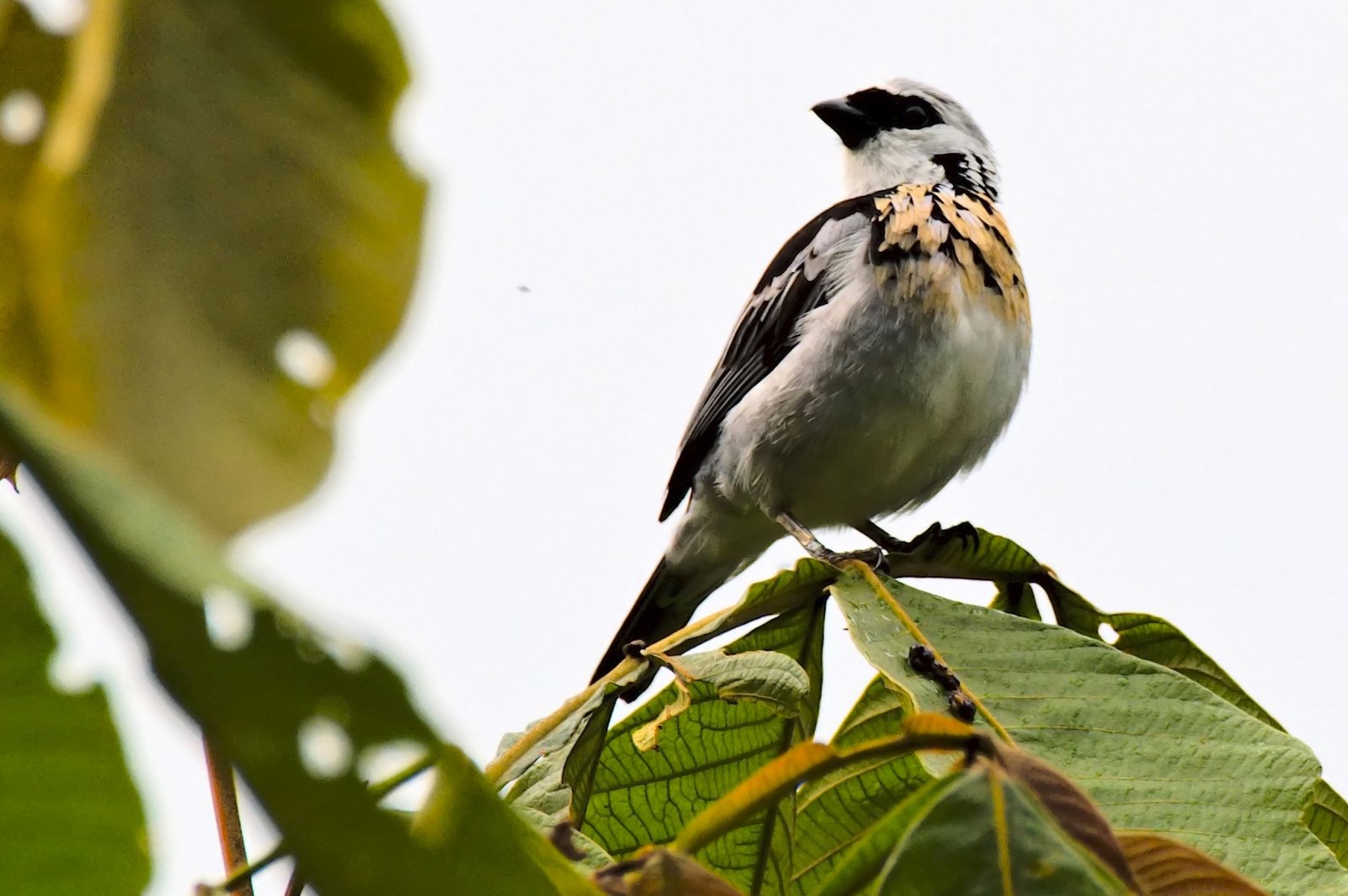
The Grey-and-gold Tanager is a fairly large, pale grey tanager with a golden-yellow wash and black spots on the back and breast. It lives in pairs or small groups in the canopy of humid forest and often perches high on bare branches. In the guide area it occurs only in eastern Panama.
Voice
Calls loudly and shrilly, a repeated cheep or a series of rapid tsee notes, often from a high branch.
Recording: Juan Freile — CC BY-NC-SA 4.0 · converted to mono · xeno-canto
Identification
15–16 cm. A fairly large tanager with a stout, dark bill. Upperparts pale grey with a golden-yellow wash on the mantle and black spots on the back. Black around the base of the bill and on the lores. Underparts whitish, with a band of black spots across the breast and along the flanks, and golden yellow on the sides of the breast. Wings and tail dark grey with pale grey edges. Male and female are alike.
Confusion species
Speckled Tanager Ixothraupis guttata is smaller, green above and spotted black all over. Plain-colored Tanager Tangara inornata is smaller and uniform dark grey, without spots or yellow. Blue-grey Tanager Thraupis episcopus is blue-grey, without spots.
Habitat
Canopy and edges of humid forest in lowlands and foothills, mostly between about 300 and 1100 m, locally lower; also tall secondary forest and clearings. It often perches in the open on high, bare branches above the canopy and joins mixed tanager flocks. It eats fruit and insects.
Where the bird is most at home, classified by the vegetation units of Mexico and Central America.



Range and movements
In the guide area only in eastern Panama: Darién, eastern Panamá province and Guna Yala. Outside the guide area from western Colombia to north-western Ecuador. Resident.
- Resident
- dark = core range, pale = thinly spread
How and when to look
In the guide area most often seen in the foothills of Darién and on Cerro Chucantí, frequently in a mixed flock in the canopy at forest edges.
Conservation status
Not threatened (LC). Rather scarce and local in the guide area; dependent on continuous forest.
Scientific name
Poecilostreptus palmeri | (Hellmayr, 1909)
Hellmayr described the species in 1909 as Calospiza palmeri; because it was later moved to another genus, the author and year stand in brackets. The genus Poecilostreptus was introduced in 2016 by Burns, Unitt & Mason. Poecilostreptus is Greek, from poikilos 'spotted, variegated' and streptos 'collar', after the band of black spots across the pale breast. palmeri probably honours the English naturalist and collector Mervyn George Palmer (1882–1955), who collected in Colombia and Ecuador. The specimen the first description was based on came from Sipí on the Río Sipí, Chocó, Colombia.