All species › Passerines › Tanagers and allies › Golden-hooded Tanager
Position in the tree Birds Aves › Birds with a flexible palate Neognathae › All other modern birds Neoaves › Landbirds Telluraves › Falcons, parrots and passerines Australaves › Falcons and passerines Eufalconimorphae › Parrots and passerines Psittacopasserae
Golden-hooded Tanager | Stilpnia larvata
Purpermaskertangare | Tangara capucha dorada
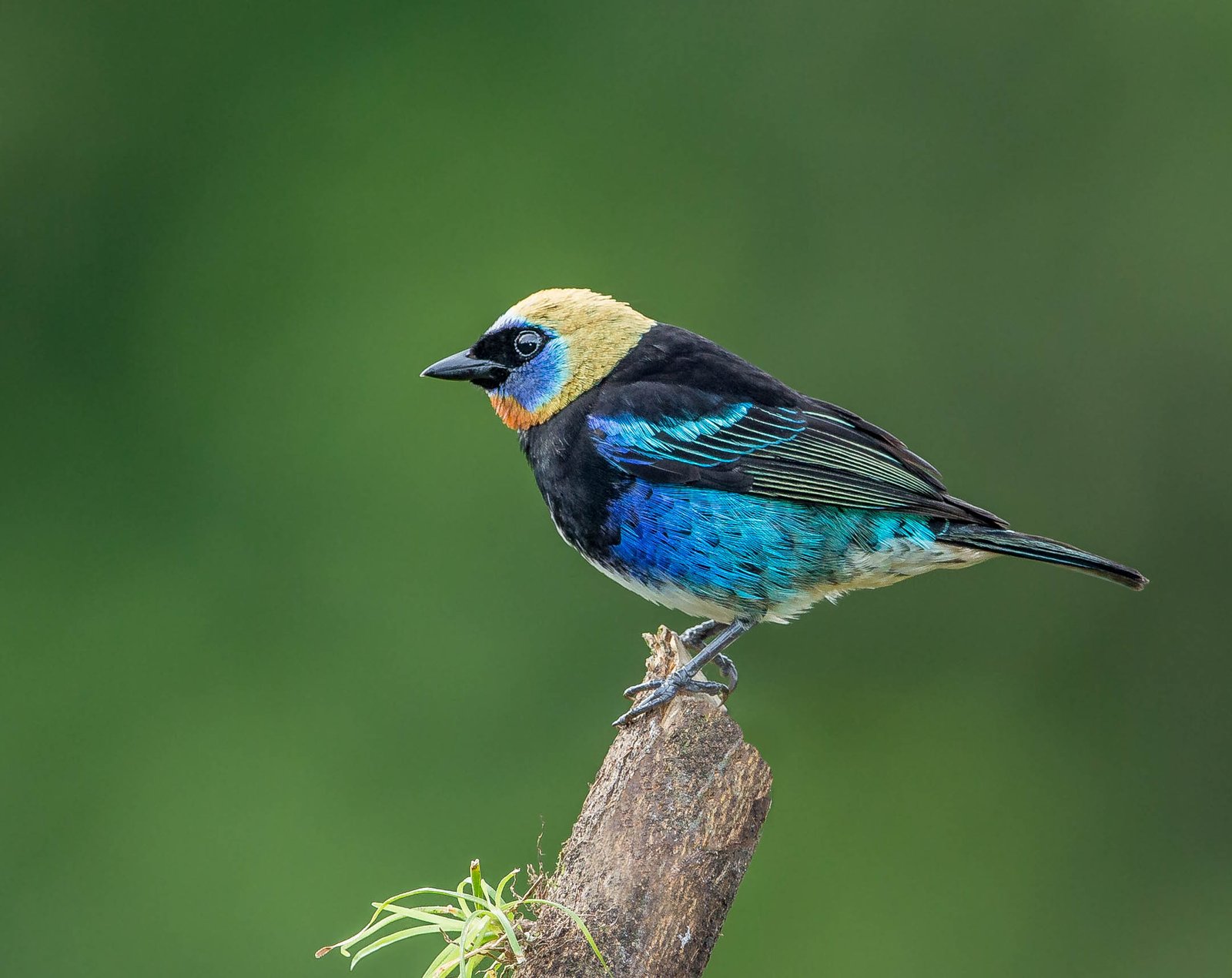
The Golden-hooded Tanager is a small tanager with a golden-yellow head, a black mask edged violet-blue and a black, white and turquoise body. It lives in pairs or small groups in forest edges, secondary forest and gardens. In the guide area it occurs from southern Mexico to Panama.
Voice
Calls include a short, sharp tsit or a repeated chik. The song is a rapid, dry series of ticking and twittering notes that accelerates into a short rattle.
Recording: Oscar Campbell — CC BY-NC-SA 4.0 · converted to mono · xeno-canto
Identification
12–13 cm. A small tanager with a short, dark bill. Head and nape golden yellow to golden buff, with a black mask around the bill and eye that is bordered above and behind the eye by violet-blue and pale blue. Back, breast and tail black; shoulders and rump pale blue to turquoise; belly white, flanks blue. The female resembles the male but is duller, with a greenish wash on the back and breast. Young birds are greyish green with a faint yellowish head.
Confusion species
Bay-headed Tanager Tangara gyrola has a rufous head and is otherwise green, without a black mask. Blue-and-gold Tanager Bangsia arcaei (mountains of Costa Rica and Panama) is larger, dark blue with a yellow belly. Young birds resemble other dull small tanagers but already show a hint of the yellow head.
Habitat
Forest edges, open woodland, secondary forest, shade coffee, plantations with scattered trees, gardens and parks in humid lowlands and hills up to about 1500 m. It forages in pairs or small groups, often in mixed tanager flocks, eating small fruits and insects picked from twigs and leaves.
Where the bird is most at home, classified by the vegetation units of Mexico and Central America.





Range and movements
From southern Veracruz, Oaxaca, Tabasco and Chiapas along the Caribbean slope through Guatemala, Belize, Honduras and Nicaragua to Costa Rica, where it also occurs on the Pacific side, and throughout Panama. Outside the guide area in western Colombia and Ecuador. Resident.
- Resident
- dark = core range, pale = thinly spread
How and when to look
Common in gardens and at lodges in the lowlands of Costa Rica and Panama, where small groups come to feeders with bananas; also in the Panama Canal area, such as along Pipeline Road.
Conservation status
Not threatened (LC). Common and widespread; adapts well to secondary forest and gardens.
Scientific name
Stilpnia larvata | (Du Bus de Gisignies, B-AL, 1846)
Du Bus de Gisignies, B-AL described the species in 1846 as Calliste larvata; because it was later moved to another genus, the author and year stand in brackets. The genus Stilpnia was introduced in 2016 by Burns, Unitt & Mason. Stilpnia comes from Greek stilpnos 'glittering, glistening', after the glossy plumage. larvata is Latin for 'masked', after the black mask around the bill and eye. The specimen the first description was based on came from Tabasco, Mexico.