All species › Swifts › Hummingbirds › Green-fronted Lancebill
Position in the tree Birds Aves › Birds with a flexible palate Neognathae › All other modern birds Neoaves › Birds of the elements Elementaves › Nightjars and swifts Strisores
Green-fronted Lancebill | Doryfera ludovicae
Groenvoorhoofdlancetkolibrie | Picolanza frentiverde
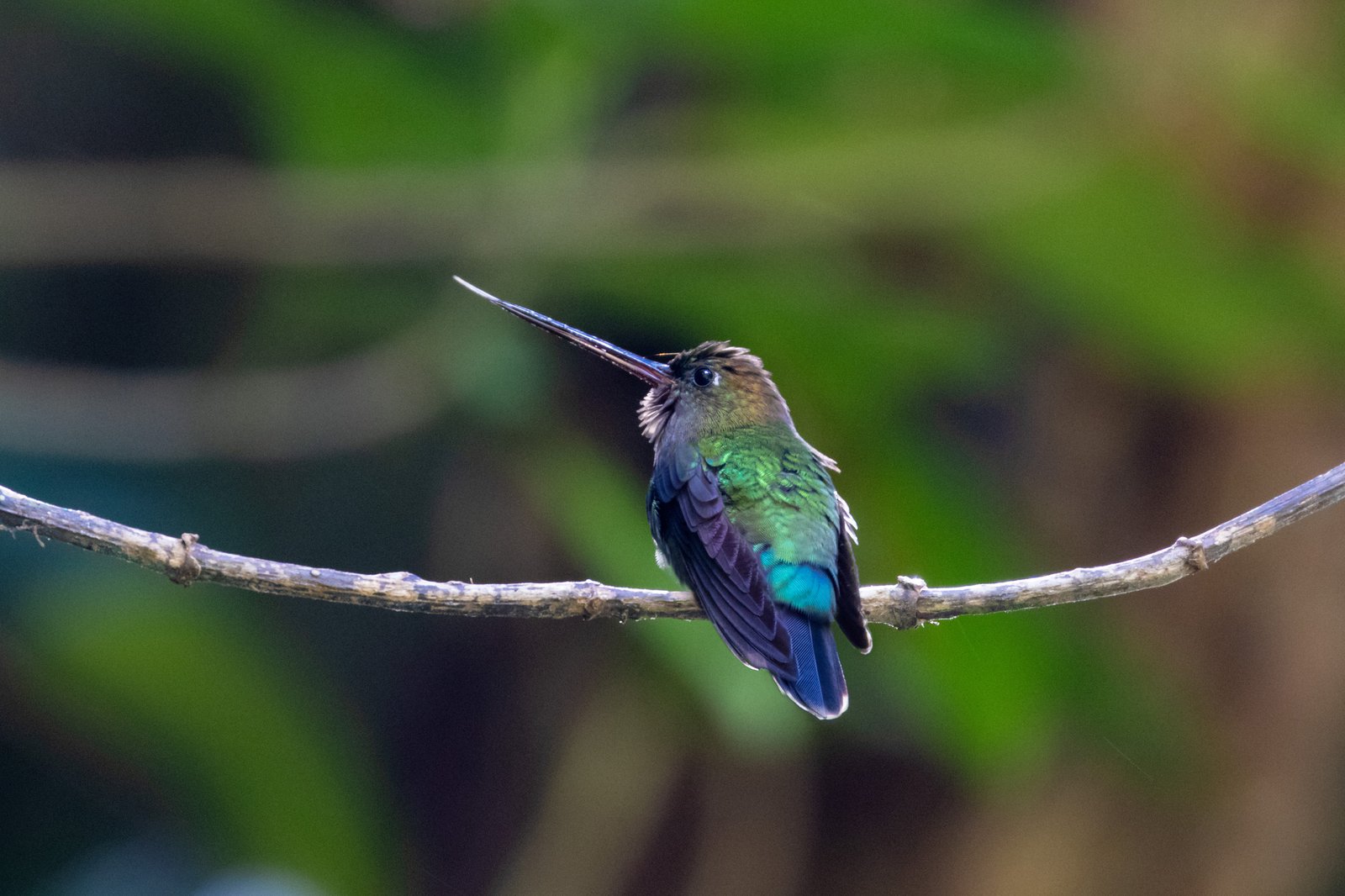
The Green-fronted Lancebill is a dark hummingbird of ravines in montane forest, with a long, straight, thin bill. It takes nectar from hanging flowers of epiphytes and catches insects over running water. The nest usually hangs under an overhang or from rootlets above a stream.
Voice
A high, sharp tseet, sometimes repeated in flight along a stream. A true song is little known.
Recording: Mitch Lysinger — CC BY-NC-SA 4.0 · converted to mono · xeno-canto
Identification
10–11 cm, with a straight, needle-like black bill of about 3 cm that appears slightly upturned. The male is dark bronzy green, with a glittering green frontal patch, a coppery crown and nape and a blue-black tail with grey tips. The female is duller, with a smaller or absent green frontal patch and greyer underparts. Young birds resemble the female.
Confusion species
The long, straight bill and dark plumage make the species readily recognisable in montane forest. Green Hermit Phaethornis guy has a decurved bill and long, white-tipped central tail feathers. Purple-throated Mountaingem Lampornis calolaemus and Green-crowned Brilliant Heliodoxa jacula have a shorter bill; females of both species have spotted underparts. Long-billed Starthroat Heliomaster longirostris has white stripes on the back and flanks and lives mainly lower down.
Habitat
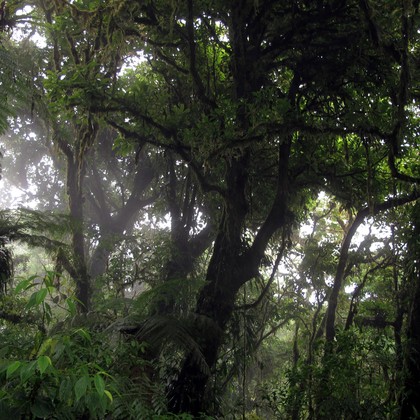
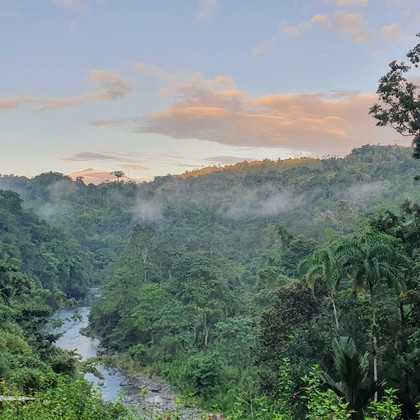
Cloud forest and humid montane forest, especially along streams, ravines and steep, wet slopes with many epiphytes, roughly between 800 and 2300 m. It visits hanging flowers of heaths (Ericaceae) among others and hawks insects over the water.
Where the bird is most at home, classified by the vegetation units of Mexico and Central America.

Range and movements
In the guide area in the mountains of Costa Rica, from the Cordillera de Tilarán through the Cordillera Central to the Talamanca, and in western Panama in Chiriquí, Bocas del Toro, Ngäbe-Buglé and Veraguas; in addition a few records in the mountains of Darién. Outside the guide area in the Andes from Venezuela and Colombia to Bolivia.
- Resident
- dark = core range, pale = thinly spread
How and when to look
Along streams and ravines in cloud forest, where the bird flies regular circuits past flowering epiphytes. A spot overlooking a forest stream with hanging flowers gives the best chance.
Conservation status
Least Concern. The species has a large range, but is scarce and local everywhere. In the guide area it depends on montane forest with intact stream valleys.
Scientific name
Doryfera ludovicae | (Bourcier & Mulsant, 1847)
Bourcier & Mulsant described the species in 1847 as Trochilus ludovicae; because it was later moved to another genus, the author and year stand in brackets. The genus Doryfera was introduced in 1847 by Gould. Doryfera is Greek, from dory 'spear' and -phoros 'bearing': 'spear-bearer', after the long, straight bill. ludovicae honours Louise (Ludovica) Geoffroy Saint-Hilaire, née Blacque-Belair (1810–1855), wife of the French zoologist Isidore Geoffroy Saint-Hilaire. The specimen the first description was based on came from Buena Vista (1,400 m), above Villavicencio, Eastern Andes, Colombia.