All species › Swifts › Hummingbirds › Stripe-throated Hermit
Position in the tree Birds Aves › Birds with a flexible palate Neognathae › All other modern birds Neoaves › Birds of the elements Elementaves › Nightjars and swifts Strisores
Stripe-throated Hermit | Phaethornis striigularis
Kleine streepkeelheremietkolibrie | Ermitaño enano
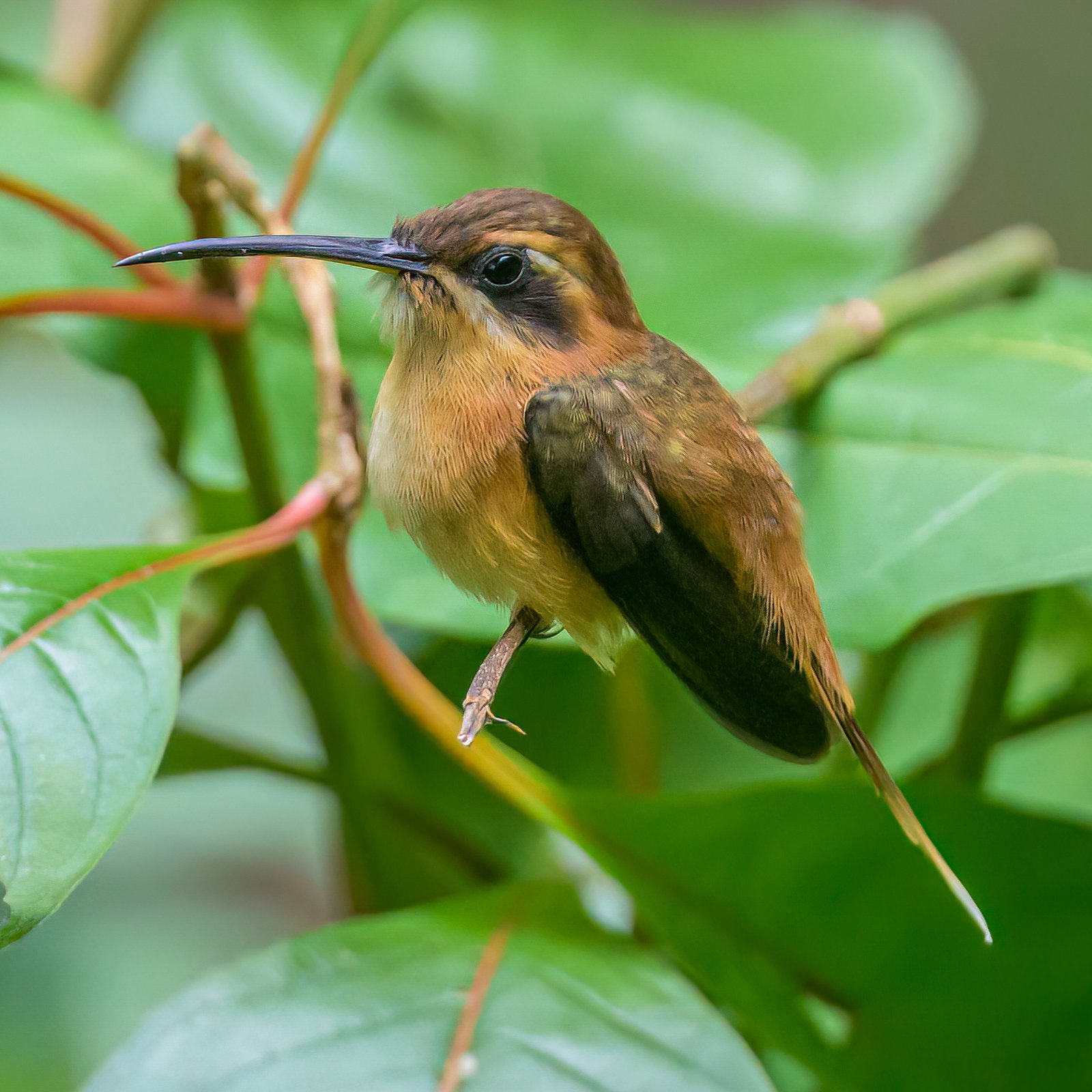
The Stripe-throated Hermit is the smallest hermit of the guide area and one of the commonest hummingbirds of the understorey of humid forest, from southern Mexico to Panama. It was formerly treated as one species with related small hermits from South America. Males sing in small groups at traditional display sites in the undergrowth.
Voice
A thin, high tsip in flight. At the display site males sing a rapid, high, squeaky phrase repeated endlessly from a low branch in the undergrowth.
Recording: Max Noack — CC BY-NC-SA 4.0 · converted to mono · xeno-canto
Identification
8–9 cm, with a slightly decurved bill of about 2 cm. The upperparts are bronzy green, with a rufous rump. The face has a dark mask between a buff supercilium and malar stripe. The underparts are warm cinnamon, the throat finely streaked dusky. The tail is graduated, with buff tips and slightly elongated, pale central feathers. The sexes are almost alike.
Confusion species
Its small size, warm cinnamon colour and short bill make it unlikely to be confused. Larger hermits, such as Long-billed Hermit Phaethornis longirostris, Mexican Hermit Phaethornis mexicanus and Pale-bellied Hermit Phaethornis anthophilus, have a much longer bill and long, white central tail feathers. Rufous-breasted Hermit Glaucis hirsutus and Bronzy Hermit Glaucis aeneus are larger and lack the elongated central tail feathers.
Habitat
The understorey of humid lowland and foothill forest, secondary forest, overgrown forest edges, gallery forest and shady plantations, from sea level to about 1200 m. It visits small understorey flowers, such as those of Heliconia, Cephaelis and gingers, and picks small arthropods from spider webs and leaves.
Where the bird is most at home, classified by the vegetation units of Mexico and Central America.






Range and movements
From southern Veracruz and northern Oaxaca through Tabasco, Chiapas and the southern Yucatán Peninsula, through Belize, Guatemala, Honduras and Nicaragua, mainly on the Caribbean side, to Costa Rica and Panama, where it occurs on both sides of the mountains. Outside the guide area in Colombia, north-western Venezuela and western Ecuador.
- Resident
- dark = core range, pale = thinly spread
How and when to look
Mainly at flowering understorey plants along forest trails. The bird sometimes hovers for a few seconds right in front of an observer before vanishing quickly. The endless squeaking of a display site reveals where males are perched.
Conservation status
Least Concern. The species is widespread and common in most parts of the guide area. It tolerates secondary forest and plantations, but disappears where the understorey is cleared completely.
Scientific name
Phaethornis striigularis | Gould, 1854
Gould described the species in 1854 and placed it straight away in the genus where it still stands. The genus Phaethornis was introduced in 1827 by Swainson. Phaethornis is Greek, from phaethōn 'sun, shining' and ornis 'bird': 'sun-bird'. striigularis is Latin, from striga 'streak' and gularis 'of the throat', after the streaked throat. The specimen the first description was based on came from Bogotá, Colombia.