All species › Swifts › Hummingbirds › Green-fronted Hummingbird
Position in the tree Birds Aves › Birds with a flexible palate Neognathae › All other modern birds Neoaves › Birds of the elements Elementaves › Nightjars and swifts Strisores
Green-fronted Hummingbird | Ramosomyia viridifrons
Groenvoorhoofdamazilia | Colibrí frente verde
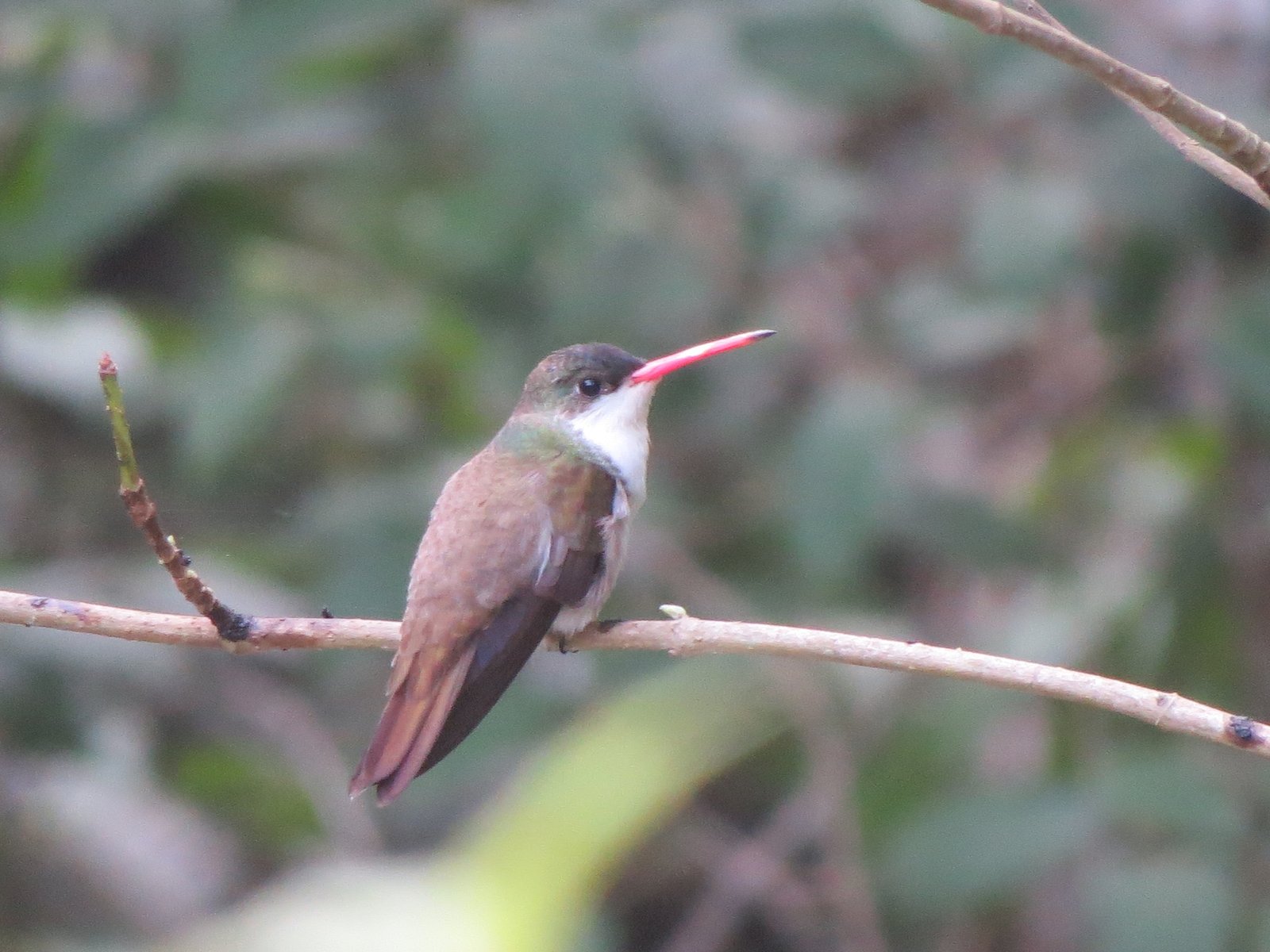
The Green-fronted Hummingbird is a medium-sized hummingbird with a red bill and white underparts that occurs only in dry forest and scrub in southern Mexico and extreme western Guatemala. Birds from Chiapas and Guatemala have cinnamon flanks and are sometimes treated as a separate species.
Voice
A dry, hard tsik and a rolling, twittering rattle in chases.
Recording: Andrew Spencer — CC BY-NC-SA 4.0 · converted to mono · xeno-canto
Identification
10–11 cm, with a straight red bill with a dark tip. The crown and upperparts are green to bronze-green, without blue or violet on the head. The underparts are white; birds from Guerrero and Oaxaca have green-spotted flanks, birds from Chiapas and Guatemala cinnamon to ochre flanks. The tail is dull bronze-green to olive. The sexes are alike; the female is duller.
Confusion species
Violet-crowned Hummingbird Ramosomyia violiceps has a violet-blue to turquoise crown and entirely white flanks. Azure-crowned Hummingbird Saucerottia cyanocephala has a blue crown and a mostly black bill. White-bellied Emerald Chlorestes candida is smaller, has a mostly black bill with only a pale base and lives in humid forest. Cinnamon Hummingbird Amazilia rutila has entirely cinnamon underparts.
Habitat
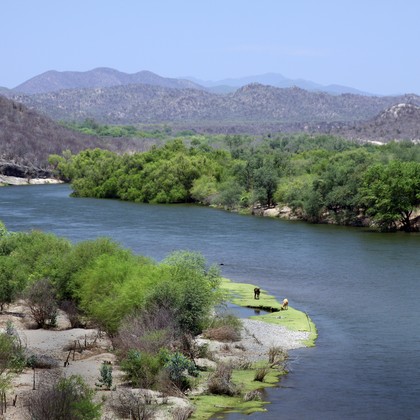
Dry and semi-deciduous forest, thorn scrub, scrubby slopes and ravines, riparian woodland and forest edges in dry valleys, from the lowlands to about 1800 m. It feeds at flowering shrubs and trees, often low above the ground.
Where the bird is most at home, classified by the vegetation units of Mexico and Central America.



Range and movements
Endemic to the guide area. In southern Mexico in Guerrero and Oaxaca, with a few records from Morelos, and in Chiapas, mainly in the dry Central Depression; further in extreme western Guatemala in the dry valley of the Río Selegua in Huehuetenango.
- Resident
- dark = core range, pale = thinly spread
How and when to look
In dry scrub and forest edges in the Sumidero Canyon near Tuxtla Gutiérrez in Chiapas and in the dry interior of Oaxaca. Often at flowering shrubs along dry streambeds.
Conservation status
Not threatened. The range is fairly small, but the species is locally fairly common. Clearing and conversion of dry forest to farmland affect the species locally.
Scientific name
Ramosomyia viridifrons | (Elliot, 1871) (GBIF: Leucolia viridifrons)
Elliot described the species in 1871 as Cyanomyia viridifrons; because it was later moved to another genus, the author and year stand in brackets. The genus Ramosomyia was introduced in 2021 by Stiles & Bruce. Ramosomyia (Bruce & Stiles, 2021) presumably honours the Mexican ornithologist Mario Alberto Ramos, with Greek muia 'fly', a common suffix in hummingbird names. viridifrons is Latin, from viridis 'green' and frons 'forehead', after the green forehead. The specimen the first description was based on came from Putla, Oaxaca, Mexico.