All species › Gannets and cormorants › Frigatebirds › Great Frigatebird
Position in the tree Birds Aves › Birds with a flexible palate Neognathae › All other modern birds Neoaves › Birds of the elements Elementaves › Tropicbirds and waterbirds Phaethoquornithes › Core waterbirds Aequornithes
Great Frigatebird | Fregata minor
Grote fregatvogel | Rabihorcado grande
The Great Frigatebird is the frigatebird of the tropical ocean. In the guide area it breeds only on the remote islands in the Pacific; off the mainland coast it is scarce and often overlooked among the far more numerous Magnificent Frigatebirds. With its large wingspan and low weight it soars over the sea for days without ever landing on the water.
Voice
Silent at sea. At the colony males give a yodelling, gurgling call interspersed with bill-clattering; females give a harsh kwah.
Recording: AUDEVARD Aurélien — CC BY-NC-SA 4.0 · converted to mono · xeno-canto
Identification
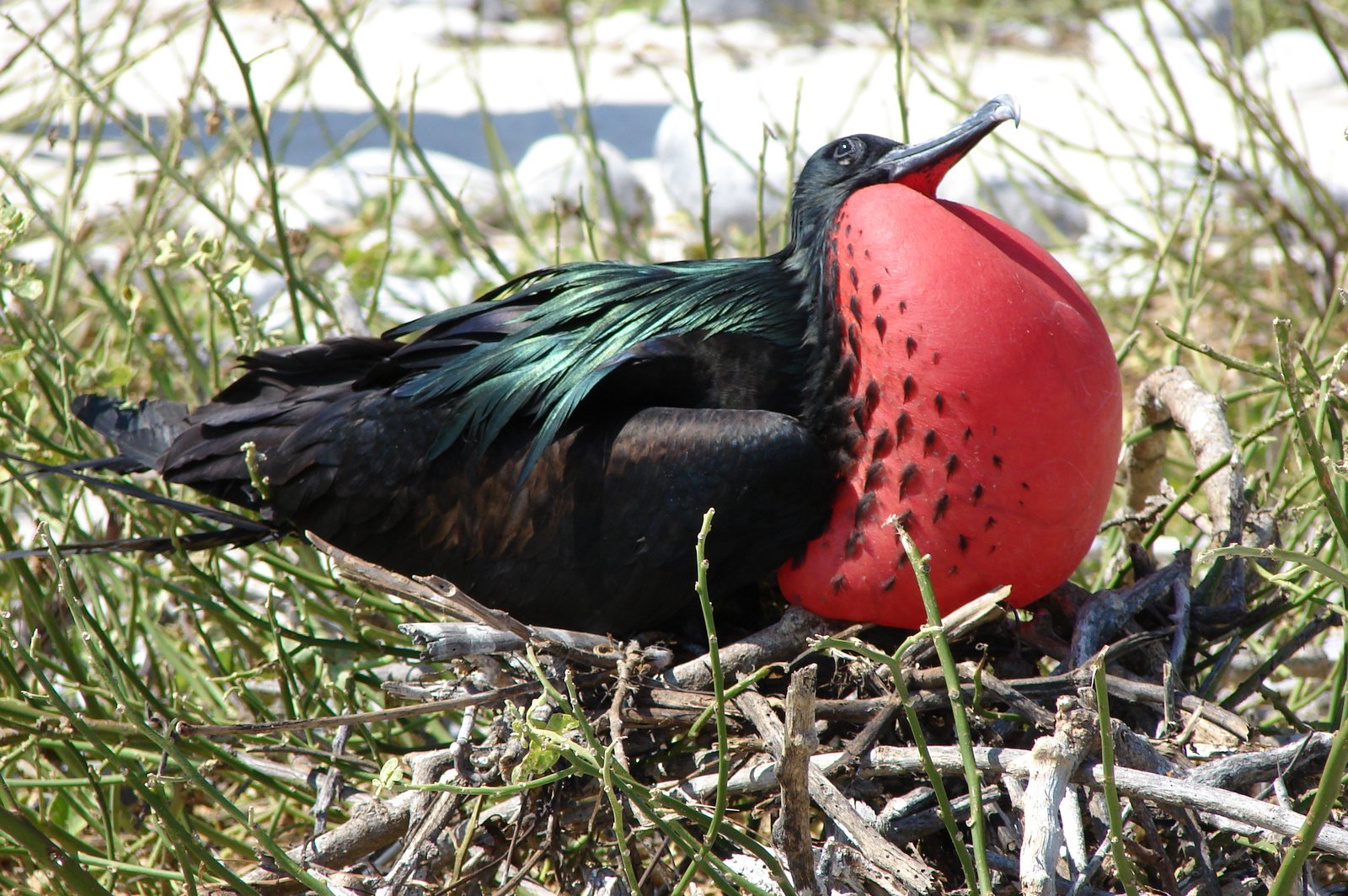
85–105 cm, with a wingspan of well over two metres; much of the length is tail. Built like other frigatebirds: narrow, angled wings, a long, forked tail and a long, hooked bill. The male is all black with a green gloss on the head and mantle, has a pale brown bar across the upperwing, pink to red legs and a bright red gular pouch inflated like a balloon in display. The female has a greyish-white throat, a white breast that does not extend into the armpit, and a pink to red eye-ring. Juveniles have a white, rust-tinged head and a white breast and belly. Females are larger than males.
Confusion species
Magnificent Frigatebird Fregata magnificens is slightly larger. The male has a purple gloss, no pale wing bar and dark legs; the female has a black throat, a blue eye-ring and white that extends to the sides into the armpits; juveniles have a pure white head without a rusty tinge. Certain identification at sea requires a good view of throat, eye-ring and armpit pattern.
Habitat
Open tropical ocean, often far offshore over warm, deep water. It takes flying fish and squid at the surface and robs tropicbirds and boobies of their catch. It breeds in colonies in bushes and low trees on remote oceanic islands.
Where the bird is most at home, classified by the vegetation units of Mexico and Central America.


Range and movements
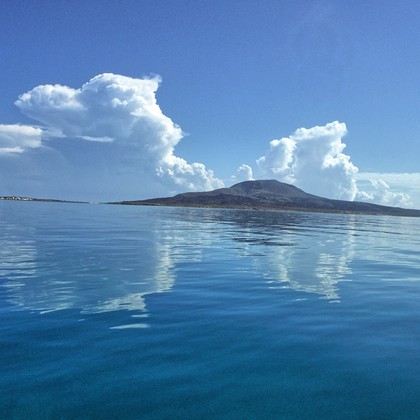
Breeds on the Revillagigedo Islands off western Mexico and on Cocos Island off Costa Rica. Beyond these scarce at sea off the Pacific coast from Mexico to Panama, with an occasional bird over the coast or in a bay, mainly in the south of the guide area. It is virtually absent from the Caribbean side. Birds in the guide area belong to the subspecies F. m. ridgwayi, which also breeds on the Galápagos Islands. Outside the guide area on tropical islands in the Pacific and Indian Oceans and on a few islands in the South Atlantic.
- Resident
- Winter visitor (c. Oct–Mar)
- Passage (Mar–Apr, Oct–Nov)
- dark = core range, pale = thinly spread
How and when to look
Boat trips to the Revillagigedo Islands or Cocos Island, where the species is numerous, offer the best chance. Off the mainland coast it is worth checking flocks of frigatebirds over shoals of fish for females with a pale throat and a red eye-ring.
Conservation status
Not threatened globally, although the population is declining. Threats are predation by introduced rats and cats, disturbance and habitat loss on breeding islands, and the taking of birds for food. The breeding islands in the guide area are protected.
Scientific name
Fregata minor | (Gmelin, 1789)
Gmelin described the species in 1789 as Pelecanus minor; because it was later moved to another genus, the author and year stand in brackets. The genus Fregata was introduced in 1799 by De Lacépède. Fregata derives from the French frégate, 'frigate', a fast warship — for the swift flight and the habit of robbing other seabirds. minor is Latin for 'smaller' — Gmelin used it to distinguish it from a larger frigatebird, although this is in fact one of the larger species. The specimen the first description was based on came from Christmas Island, Indian Ocean (designated later).