All species › Passerines › Thrushes and allies › Gray-cheeked Thrush
Position in the tree Birds Aves › Birds with a flexible palate Neognathae › All other modern birds Neoaves › Landbirds Telluraves › Falcons, parrots and passerines Australaves › Falcons and passerines Eufalconimorphae › Parrots and passerines Psittacopasserae
Gray-cheeked Thrush | Catharus minimus
Grijswangdwerglijster | Zorzalito carigrís
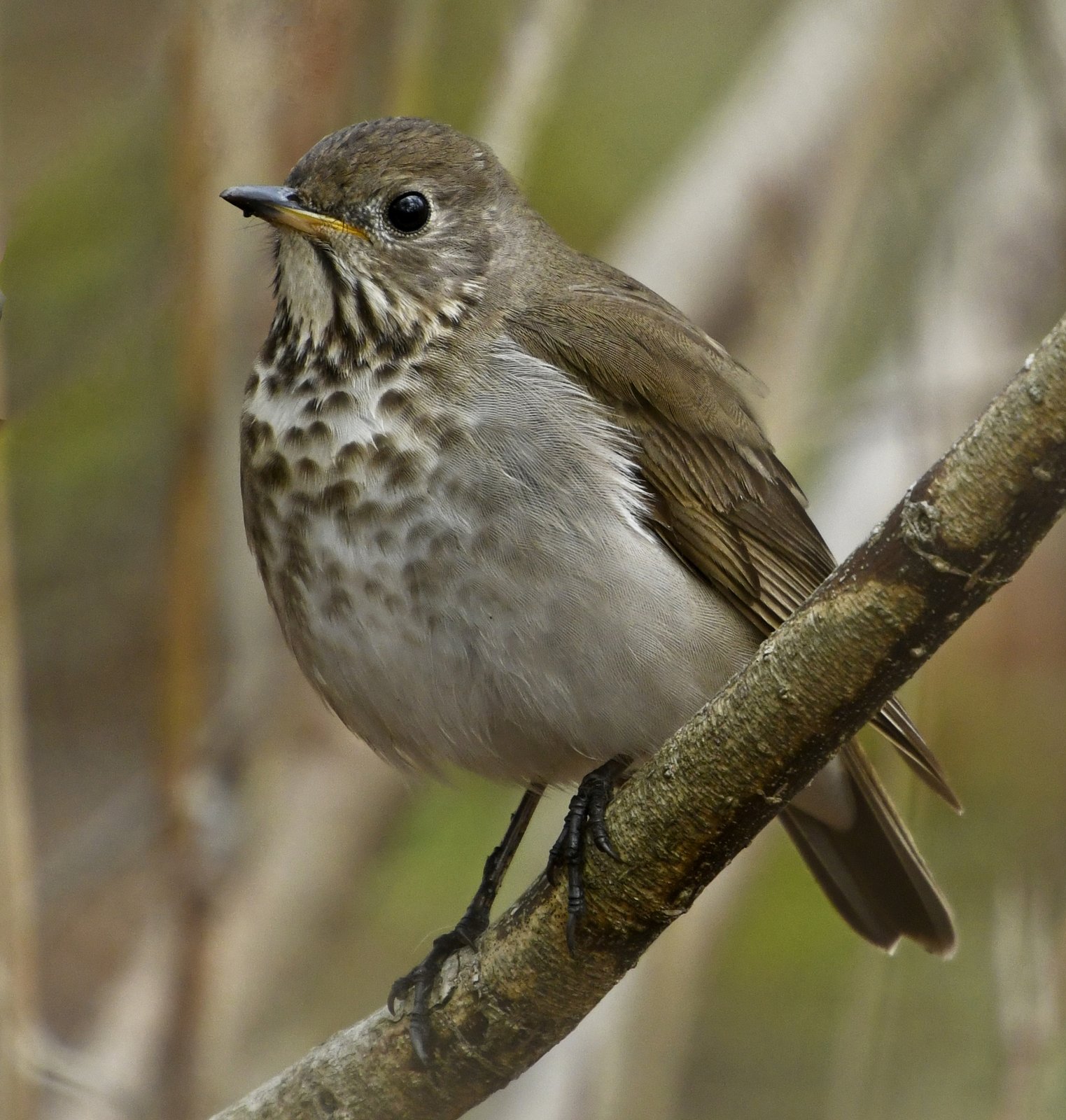
The Gray-cheeked Thrush is a greyish-brown Catharus thrush with a spotted breast that breeds in the northern forests and scrub of North America and extreme north-eastern Siberia. It winters in northern South America and passes through the guide area in spring and autumn, where it is scarce and seen mainly on the Caribbean side.
Voice
Usually silent on migration. The call is a nasal, descending vee-er; at night the flight call of passing birds can be heard, a high, shrill kwee-er. The song, rarely heard in the guide area, is a thin, nasal series of whistled notes that spirals down in pitch.
Recording: Seth Beaudreault (Toolik Field Station) — CC BY-NC-SA 4.0 · converted to mono · xeno-canto
Identification
16–18 cm. Upperparts plain cool olive-grey to greyish-brown, with no rufous tones on wings or tail. Cheeks grey, with at most a faint, narrow greyish eye-ring; there are no buff spectacles. Throat and breast white with a faint yellowish wash and distinct dark, triangular spots, flanks grey, belly white. Bill dark with a pale base to the lower mandible. The sexes are alike.
Confusion species
Swainson's Thrush Catharus ustulatus, which passes through the guide area in much larger numbers, has distinct buff spectacles and a buff wash on the cheeks and breast. Veery Catharus fuscescens is warmer reddish-brown above and has fainter, rusty breast spots. Hermit Thrush Catharus guttatus has a rufous tail that contrasts with the back and a white eye-ring. Wood Thrush Hylocichla mustelina is larger, has a rusty head and large round black spots extending onto the belly.
Habitat
On migration in the understorey and lower levels of humid lowland forest, secondary forest, forest edges and coastal scrub, and in wooded gardens and parks; mainly in the lowlands and foothills. It forages on the ground and low in shrubs for insects and also eats many berries and other fruits on passage.
Where the bird is most at home, classified by the vegetation units of Mexico and Central America.




Range and movements
Breeds from north-eastern Siberia and Alaska across Canada to Newfoundland and the north-eastern United States. Winters in northern South America, mainly in Colombia, Venezuela and north-western Brazil. In the guide area a passage migrant, mainly along the Gulf coast and the Yucatán Peninsula, in Belize and on the Caribbean slope of Central America to Panama; scarce on the Pacific slope and in the interior of Mexico.
- Passage (Mar–Apr, Oct–Nov)
- dark = core range, pale = thinly spread
How and when to look
Best found during migration peaks in coastal forest and scrub on the Caribbean side, early in the morning after a night of heavy migration. Among groups of passing Swainson's Thrushes it pays to check each bird for cheek colour and eye-ring.
Conservation status
Not threatened (LC). Widespread in northern North America; in the guide area a scarce passage migrant. Collisions with buildings during nocturnal migration and forest loss in the wintering range are the main threats.
Scientific name
Catharus minimus | (de Lafresnaye, 1848)
De Lafresnaye described the species in 1848 as Turdus minimus; because it was later moved to another genus, the author and year stand in brackets. The genus Catharus was introduced in 1850 by Bonaparte. Catharus is from Ancient Greek katharos 'pure, clean', a name given for the clean plumage of the orange-billed nightingale-thrush. minimus is Latin for 'smallest'. The specimen the first description was based on came from Bogotá, Colombia.