All species › Passerines › Thrushes and allies › Black-billed Nightingale-Thrush
Position in the tree Birds Aves › Birds with a flexible palate Neognathae › All other modern birds Neoaves › Landbirds Telluraves › Falcons, parrots and passerines Australaves › Falcons and passerines Eufalconimorphae › Parrots and passerines Psittacopasserae
Black-billed Nightingale-Thrush | Catharus gracilirostris
Grijskeeldwerglijster | Zorzalito piquinegro
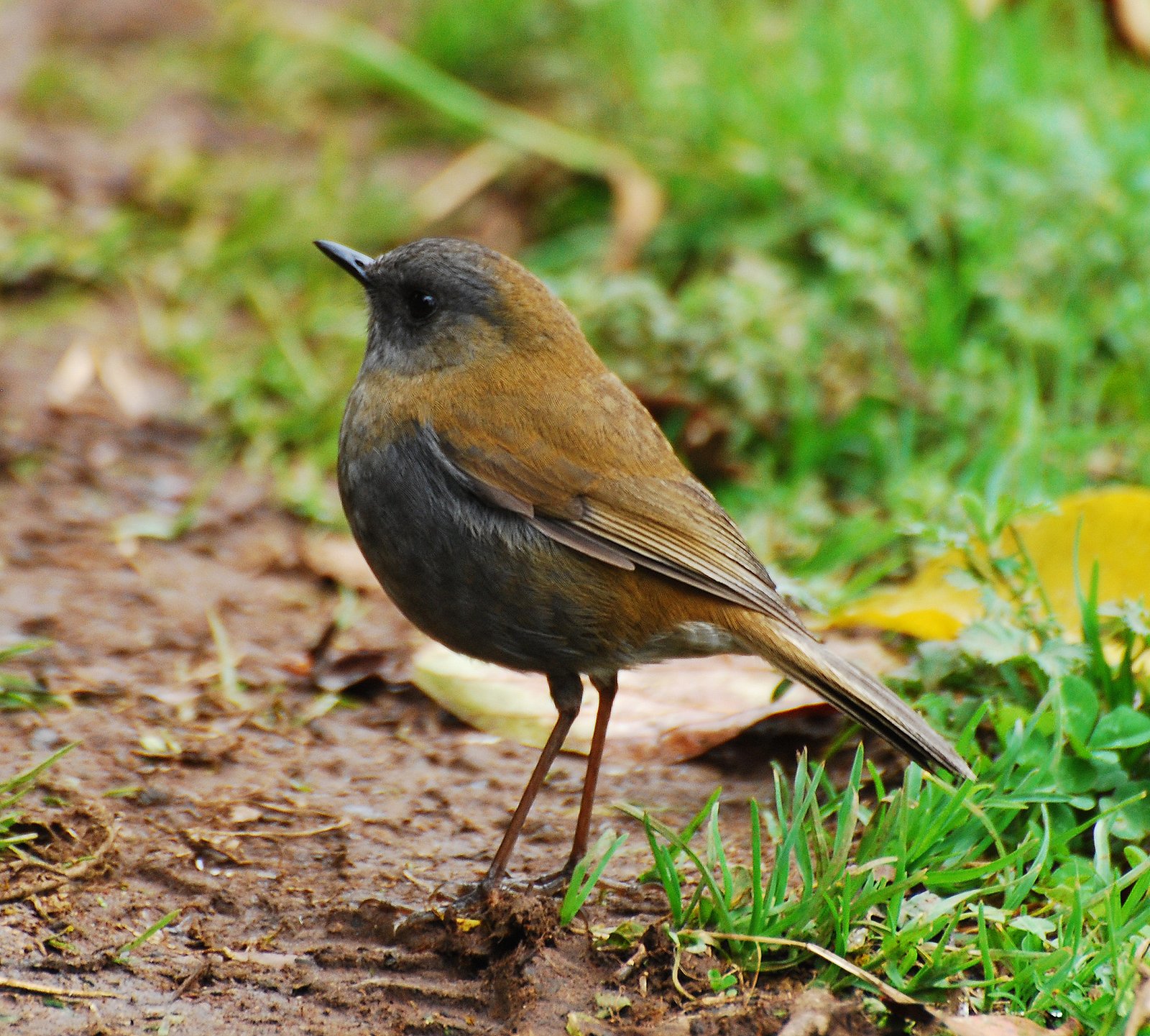
The Black-billed Nightingale-Thrush is the smallest nightingale-thrush: a dark, grey and olive-brown Catharus with an all-black, thin bill. It lives only in the high mountains of Costa Rica and western Panama, in montane forest and scrub up to above the treeline. It is fairly tame and often walks in the open on trails and forest edges.
Voice
The song consists of short, high, rather thin whistled phrases of a few notes, repeated after pauses and varying between birds. Calls include a thin, high see and a soft, nasal mewing note.
Recording: Odirlei Vieira da Fonseca — CC BY-NC-SA 4.0 · shortened to the first 60 s, mono · xeno-canto
Identification
14–16 cm. Upperparts dark olive-brown, head greyer with a darker crown. Throat, cheeks and breast grey, the breast often with a faint olive-brown band; centre of belly whitish, flanks greyish-brown. Bill thin and all black; legs dark greyish-brown; no conspicuous eye-ring. Eyes dark. The sexes are alike; juveniles are darker with pale spots.
Confusion species
Ruddy-capped Nightingale-Thrush Catharus frantzii usually lives lower, has a warm rufous crown and an orange lower mandible. Orange-billed Nightingale-Thrush Catharus aurantiirostris has an orange bill, orange eye-ring and orange legs and lives in lower, drier regions. Slaty-backed Nightingale-Thrush Catharus fuscater has a dark slate-grey back, a pale iris, an orange bill and an orange eye-ring.
Habitat
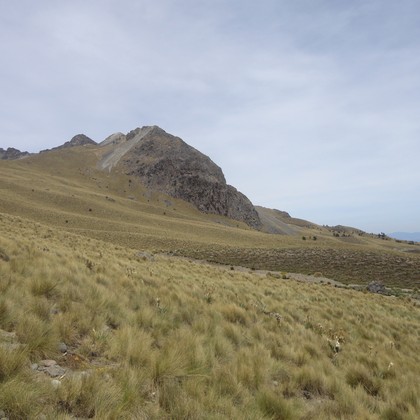
Understorey and edges of montane forest with oaks and bamboo, higher up elfin forest, scrub and the transition to páramo above the treeline; mostly above 2200 m and up to the highest summits, locally lower. It forages on the ground and low in shrubs for insects, worms and small fruits. It builds a cup-shaped nest of moss low in a shrub or bamboo.
Where the bird is most at home, classified by the vegetation units of Mexico and Central America.

Range and movements
Only in the guide area: the high mountains of Costa Rica (the Cordillera Central and the Cordillera de Talamanca) and western Panama, in Chiriquí province.
- Resident
- dark = core range, pale = thinly spread
How and when to look
Regularly seen on Cerro de la Muerte in the Cordillera de Talamanca and on Volcán Irazú in Costa Rica, and on Volcán Barú in Panama. It often feeds on footpaths, road verges and open patches between shrubs, where it is fairly tame.
Conservation status
Not threatened (LC). Small range, but locally common and largely within protected areas. Warming that shrinks high-elevation habitats may become a threat in the long term.
Scientific name
Catharus gracilirostris | Salvin, 1865
Salvin described the species in 1865 and placed it straight away in the genus where it still stands. The genus Catharus was introduced in 1850 by Bonaparte. Catharus is from Ancient Greek katharos 'pure, clean', a name given for the clean plumage of the orange-billed nightingale-thrush. gracilirostris is Latin, from gracilis 'slender' and -rostris '-billed', after the thin bill. The specimen the first description was based on came from Volcán de Cartago (Irazú), Costa Rica.