All species › Passerines › New World warblers › Golden-winged Warbler
Position in the tree Birds Aves › Birds with a flexible palate Neognathae › All other modern birds Neoaves › Landbirds Telluraves › Falcons, parrots and passerines Australaves › Falcons and passerines Eufalconimorphae › Parrots and passerines Psittacopasserae
Golden-winged Warbler | Vermivora chrysoptera
Geelvleugelzanger | Chipe ala dorada
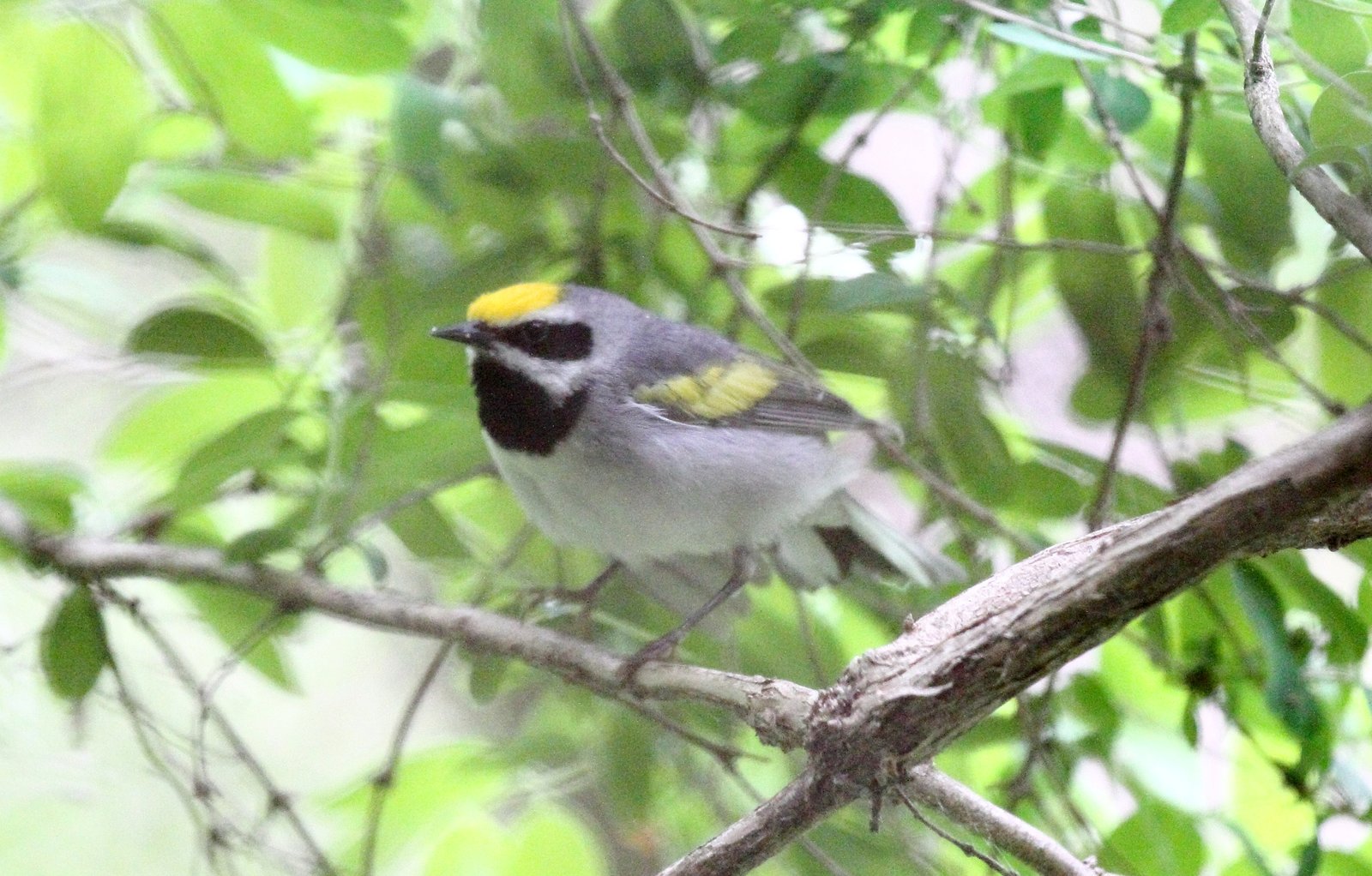
The Golden-winged Warbler is a grey-and-white warbler with a golden-yellow crown and wing patch and, in the male, a black throat and black eye mask. It breeds in young regrowth and forest edges around the Great Lakes and in the Appalachians. In the guide area it is a winter visitor to the canopy of foothill and montane forest, mainly from Guatemala to Panama. It hybridises regularly with Blue-winged Warbler.
Voice
The song is a high, buzzy bee-bzz-bzz-bzz, the first note higher than the rest. The call is a dry chip; in flight a thin zee. In winter mainly the call.
Recording: Valerie Heemstra — CC BY-NC-SA 4.0 · shortened to the first 60 s, mono · xeno-canto
Identification
11–13 cm. Male: crown golden yellow and a large golden-yellow patch on the wing; black throat and a black mask through the eye, separated by a white supercilium and a white malar stripe. Upperparts blue-grey, underparts white to pale grey. The female has a grey throat and grey mask, and a duller yellow crown and wing patch. White spots in the tail.
Confusion species
Blue-winged Warbler Vermivora cyanoptera has yellow underparts, a narrow black eye-stripe and two white wing bars. Hybrids between the two species occur regularly: the 'Brewster's' type resembles Golden-winged but lacks the black throat and mask and often shows some yellow on the breast; the 'Lawrence's' type is yellow with the black throat and eye mask of Golden-winged.
Habitat
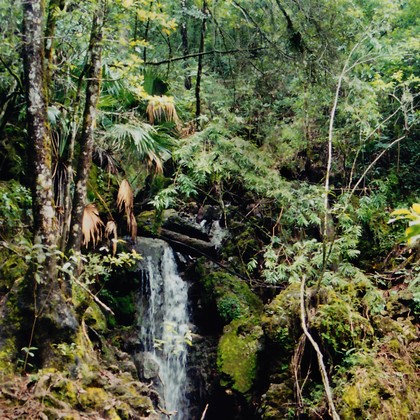
In winter the canopy and edges of humid foothill forest and cloud forest, mostly between about 600 and 2000 m, also mature secondary forest and shade coffee with tall trees. It travels with mixed flocks and often hangs upside down from dead, curled leaves to extract caterpillars and spiders.
Where the bird is most at home, classified by the vegetation units of Mexico and Central America.




Range and movements
Breeds from south-eastern Canada and the Great Lakes region to the Appalachians. Winters from southern Mexico through Central America to Colombia and north-western Venezuela. In the guide area mainly in the mountains and foothills of Guatemala, Honduras, Nicaragua, Costa Rica and Panama; scarce in Chiapas. On passage along the Gulf Coast of Mexico and across the Yucatán Peninsula.
- Winter visitor (c. Oct–Mar)
- dark = core range, pale = thinly spread
How and when to look
In winter best sought in mixed flocks in the canopy of montane forest in Costa Rica and Panama, where it hangs from dead leaves among the other warblers.
Conservation status
Near Threatened (NT). Has declined strongly through the loss of young regrowth on the breeding grounds, through displacement by and hybridisation with Blue-winged Warbler, and through clearance of montane forest in the wintering area.
Scientific name
Vermivora chrysoptera | (Linnaeus, 1766)
Linnaeus described the species in 1766 as Motacilla chrysoptera; because it was later moved to another genus, the author and year stand in brackets. The genus Vermivora was introduced in 1827 by Swainson. Vermivora is Latin, from vermis 'worm' and -vorus '-eating': 'worm-eater'. chrysoptera is Greek, from khrusos 'gold' and -pteros '-winged', after the yellow wing patch. The specimen the first description was based on came from near Philadelphia, Pennsylvania (USA).