All species › Passerines › New World warblers › Blue-winged Warbler
Position in the tree Birds Aves › Birds with a flexible palate Neognathae › All other modern birds Neoaves › Landbirds Telluraves › Falcons, parrots and passerines Australaves › Falcons and passerines Eufalconimorphae › Parrots and passerines Psittacopasserae
Blue-winged Warbler | Vermivora cyanoptera
Blauwvleugelzanger | Chipe ala azul
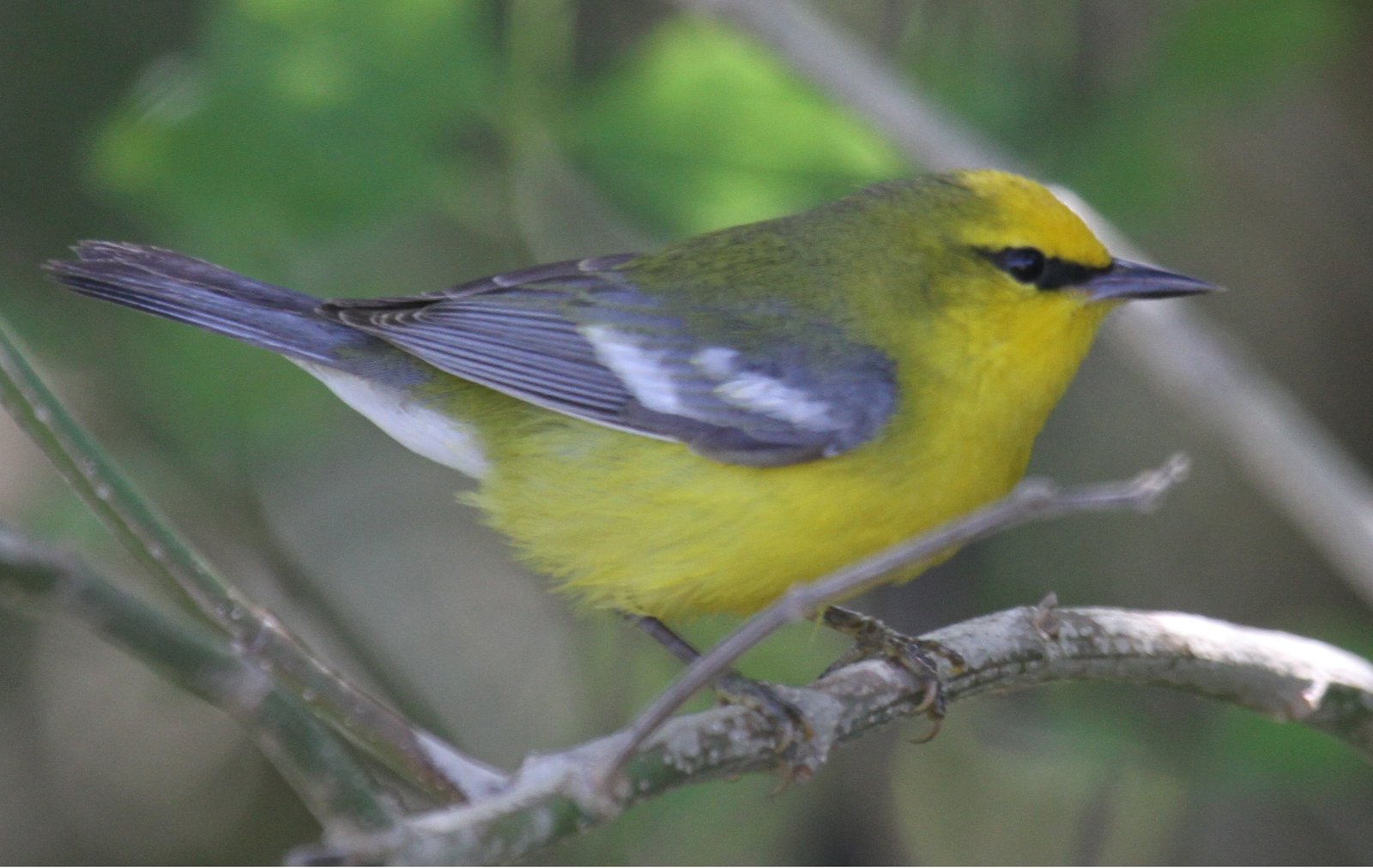
The Blue-winged Warbler is a small, bright yellow warbler with blue-grey wings and a narrow black line through the eye. It breeds in eastern North America and winters in the guide area, from south-eastern Mexico to Panama. There it searches forest edges and scrub for insects, often in mixed flocks with other warblers.
Voice
The song is a buzzy, two-part bee-bzzz, the second part lower and rasping. In winter mainly a short, high tsip and a dry chip; it rarely sings in the guide area.
Recording: Stephen Tyndel — CC BY-NC-SA 4.0 · shortened to the first 60 s, mono · xeno-canto
Identification
11–12 cm. Head and underparts bright yellow, back olive-green. Wings blue-grey with two white wingbars; tail blue-grey with white spots on the underside. A narrow black eyeline runs from the bill to just behind the eye. Bill pointed and dark. The male has a yellow crown; the female is duller, with an olive-tinged crown and greyer wingbars. Young birds resemble the female.
Confusion species
Prothonotary Warbler Protonotaria citrea is also yellow with blue-grey wings but lacks the white wingbars and the black eyeline and lives mainly in mangrove and swamp forest. Golden-winged Warbler Vermivora chrysoptera has grey upperparts, a yellow wing patch and a black or grey eye mask and throat. The two Vermivora species hybridise regularly; hybrids show mixtures of both plumages and also occur in the guide area.
Habitat
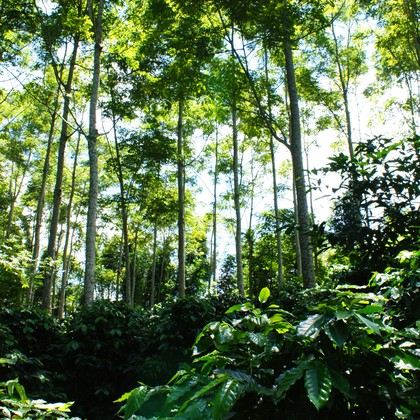
In winter the edges and clearings of humid lowland and foothill forest, secondary forest, scrub and shade coffee, mostly below 1500 m. It searches dead leaf clusters and fine twigs for insects and spiders, often hanging from branches.
Where the bird is most at home, classified by the vegetation units of Mexico and Central America.



Range and movements
Breeds in the eastern United States and extreme southern Ontario. Migrates along the Gulf coast of Mexico and across the Yucatán Peninsula. Winters from south-eastern Mexico (mainly southern Veracruz, Oaxaca, Chiapas and Yucatán) through Belize, Guatemala, Honduras, Nicaragua and Costa Rica to Panama, scarcer in eastern Panama. Outside the guide area in small numbers in the Caribbean.
- Winter visitor (c. Oct–Mar)
- dark = core range, pale = thinly spread
How and when to look
Most often found in mixed flocks of warblers and vireos along forest edges in the Caribbean lowlands and foothills, for example in Belize and northern Guatemala. It often forages in dead leaves.
Conservation status
Not threatened (LC). Fairly common; the breeding population is slowly declining through loss of open, shrubby land.
Scientific name
Vermivora cyanoptera | Olson & Reveal, 2009
Olson & Reveal described the species in 2009 and placed it straight away in the genus where it still stands. The genus Vermivora was introduced in 1827 by Swainson. Vermivora is Latin, from vermis 'worm' and -vorus '-eating': 'worm-eater'. cyanoptera is Greek, from kuanos 'dark blue' and -pteros '-winged', after the blue-grey wings. The specimen the first description was based on came from North America (not specified).