All species › Passerines › Manakins › Golden-headed Manakin
Position in the tree Birds Aves › Birds with a flexible palate Neognathae › All other modern birds Neoaves › Landbirds Telluraves › Falcons, parrots and passerines Australaves › Falcons and passerines Eufalconimorphae › Parrots and passerines Psittacopasserae
Golden-headed Manakin | Ceratopipra erythrocephala
Goudkopmanakin | Saltarín cabecidorado
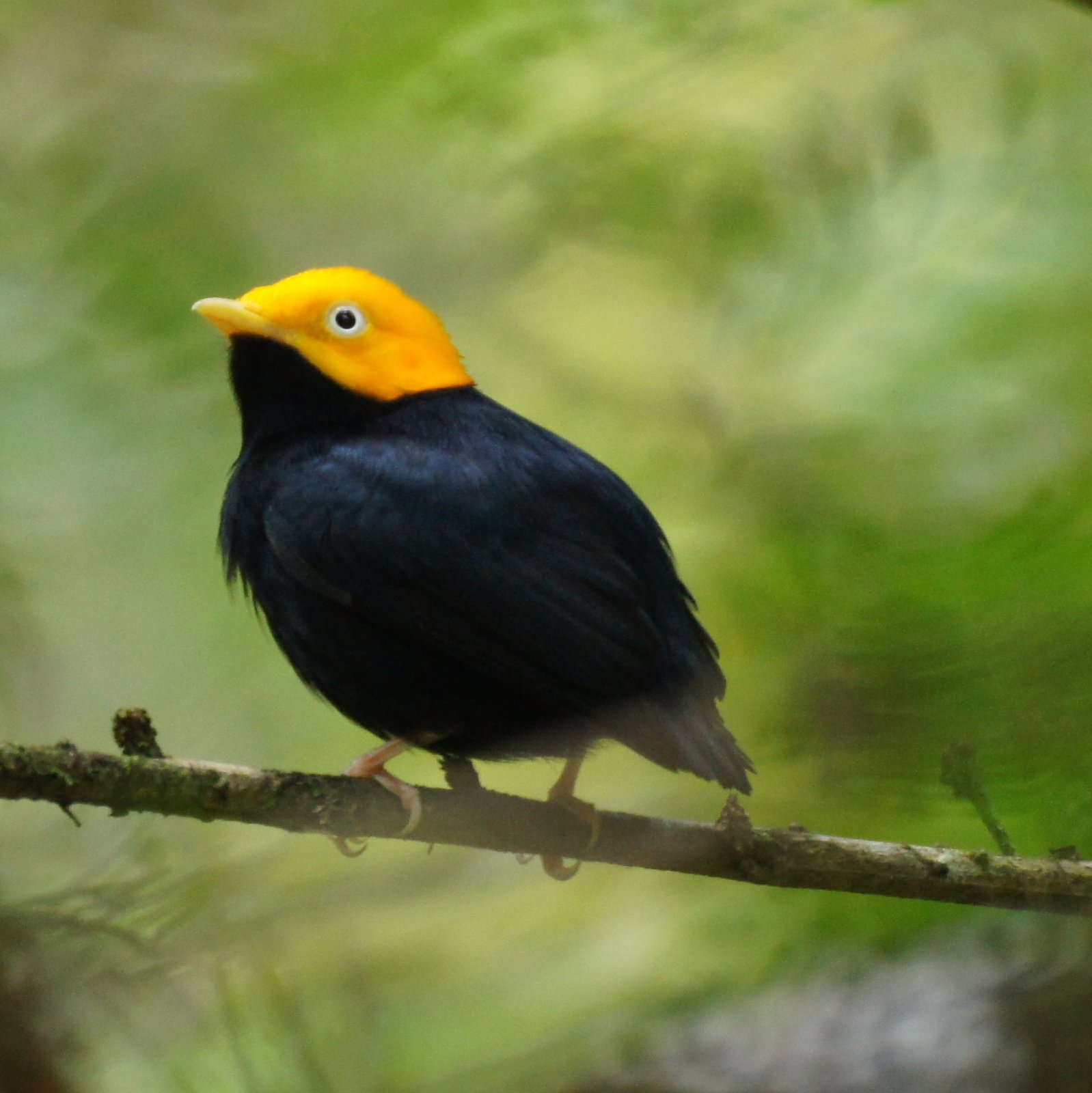
The Golden-headed Manakin is a small black manakin with a golden-yellow head that in the guide area occurs only in eastern Panama. There it is locally common in Darién. Males display in groups at mid-levels in the forest with rapid flights and sideways steps along a branch.
Voice
High, buzzy notes and a rapid series like pur-pir-prrrt. Males at the display ground also produce snapping sounds with the wings.
Recording: Juan Freile — CC BY-NC-SA 4.0 · shortened to the first 60 s, mono · xeno-canto
Identification
9 cm. Male: body glossy black, head and neck golden-yellow, thighs red; iris white, bill pale. Female olive-green, slightly paler below, with a pale bill. Young males resemble the female.
Confusion species
Red-capped Manakin Ceratopipra mentalis, which occurs alongside it in eastern Panama, has a red head and yellow thighs. Females of the two species are barely separable in the field. Other black manakins in the guide area lack a golden-yellow head.
Habitat
Understorey and mid-levels of humid lowland and foothill forest, also mature secondary forest and forest edge, mostly below 1000 m. It eats mainly small fruits and some insects.
Where the bird is most at home, classified by the vegetation units of Mexico and Central America.



Range and movements
Eastern Panama: Darién, Emberá, Guna Yala and the east of Panamá province. Outside the guide area in northern South America, from Colombia and Venezuela to the Guianas, northern Brazil and eastern Ecuador and Peru.
- Resident
- dark = core range, pale = thinly spread
How and when to look
Best looked for in the forests of Darién. Males give themselves away at the display ground by their buzzy calls and snapping wings.
Conservation status
Not threatened. Widespread in South America; in the guide area restricted to eastern Panama, where forest is under pressure from deforestation.
Scientific name
Ceratopipra erythrocephala | (Linnaeus, 1758) (GBIF: Pipra erythrocephala)
Linnaeus described the species in 1758 as [Parus] erythrocephalus; because it was later moved to another genus, the author and year stand in brackets. The genus Ceratopipra was introduced in 1854 by Bonaparte. Ceratopipra combines Greek keras 'horn' with the genus Pipra, after the horn-like crest feathers of the type species, the Scarlet-horned Manakin. erythrocephala is Greek for 'red-headed', from eruthros 'red' and kephalē 'head', after the male's golden-red head. The specimen the first description was based on came from Suriname.