All species › Passerines › Cotingas › Purple-throated Fruitcrow
Position in the tree Birds Aves › Birds with a flexible palate Neognathae › All other modern birds Neoaves › Landbirds Telluraves › Falcons, parrots and passerines Australaves › Falcons and passerines Eufalconimorphae › Parrots and passerines Psittacopasserae
Purple-throated Fruitcrow | Querula purpurata
Purperkeelvruchtenkraai | Cotinga quérula
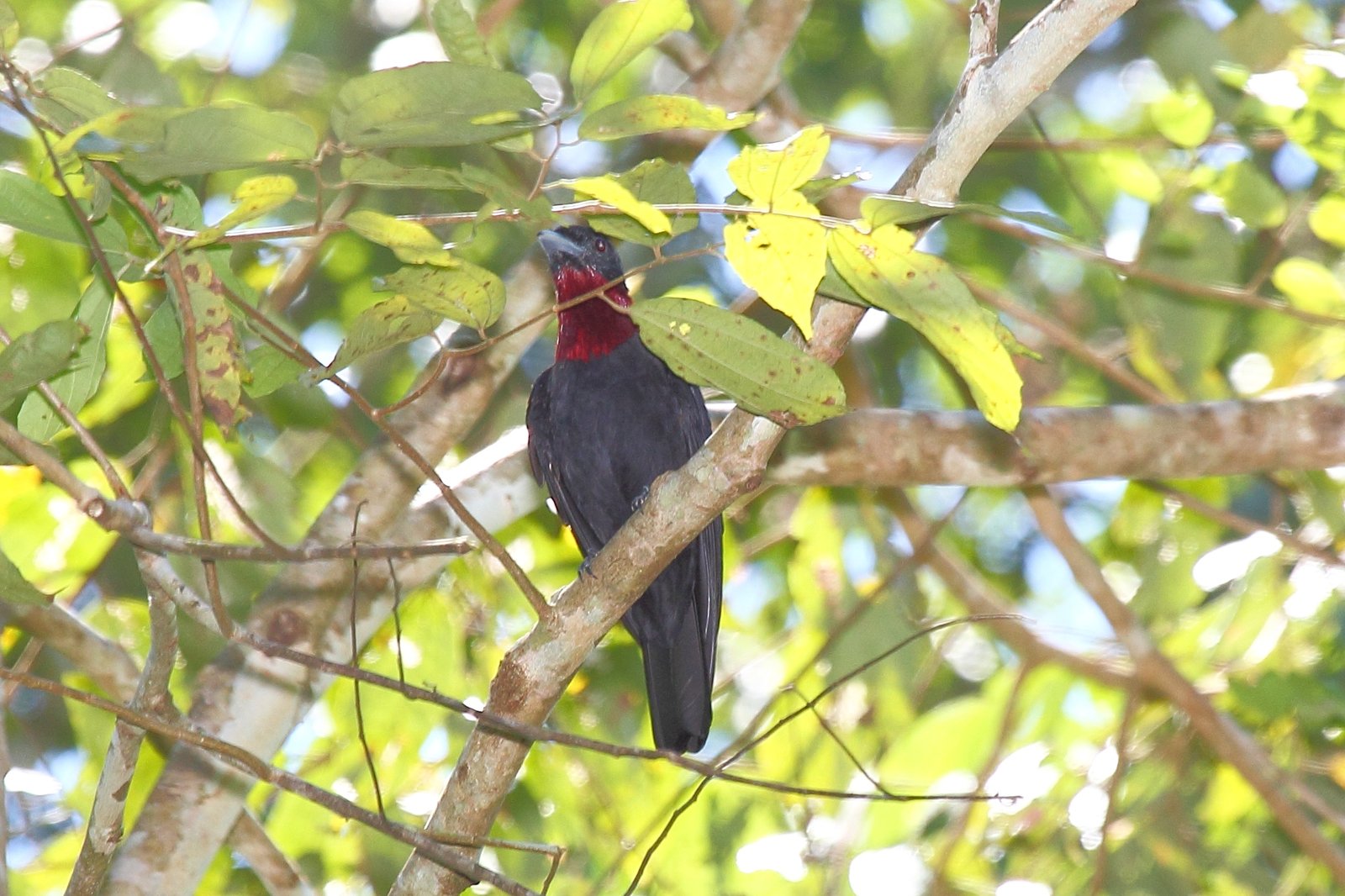
The Purple-throated Fruitcrow is an all-black cotinga of the canopy of humid lowland forest. It lives in noisy groups of three to six birds that defend the territory together and jointly raise a single brood. In the guide area it occurs from Nicaragua to Panama.
Voice
Very noisy. A loud, ringing and rather plaintive oo-waa-oo or kwa-wa-oo, often given by several birds in turn, as well as harsh wak calls.
Recording: Jacob Wijpkema — CC BY-NC-SA 4.0 · converted to mono · xeno-canto
Identification
25–30 cm. Stocky, with broad wings, a fairly short tail and a broad, blue-grey bill with a dark tip. The male is dull black with a glossy purplish-red throat patch that it spreads into a fan when excited; female and juvenile are entirely black without a throat patch. In flight the broad, rounded wings stand out.
Confusion species
The female Bare-necked Umbrellabird Cephalopterus glabricollis is larger, with a small crest and a black bill, and lives mainly higher on the slopes. Black icterids and the Greater Ani Crotophaga major have a different bill shape and do not live in groups in the canopy.
Habitat
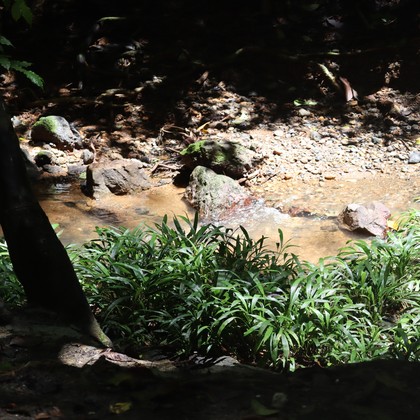
Canopy and middle levels of humid evergreen lowland and foothill forest, mostly below 600 m, also tall secondary forest and forest edges. It eats fruit and large insects, including larvae taken from wasp nests. The group moves through the forest together and defends a large territory.
Where the bird is most at home, classified by the vegetation units of Mexico and Central America.



Range and movements
Caribbean slope of south-eastern Nicaragua and Costa Rica; in Panama on the Caribbean slope and in the centre and east also on the Pacific slope. Outside the guide area in western Colombia and Ecuador and across much of the Amazon basin and the Guianas.
- Resident
- dark = core range, pale = thinly spread
How and when to look
Regularly heard and seen along Pipeline Road (Camino del Oleoducto) in Panama and at La Selva in Costa Rica. Groups usually give themselves away first by their loud calls.
Conservation status
Not threatened. Fairly common in continuous lowland forest; disappears where the forest becomes fragmented.
Scientific name
Querula purpurata | (Müller, 1776)
Müller described the species in 1776 as Muscicapa purpurata; because it was later moved to another genus, the author and year stand in brackets. The genus Querula was introduced in 1816 by Vieillot. Querula is Latin, from querulus 'plaintive, noisy' (queri 'to complain'), after the loud, plaintive calls. purpurata is Latin for 'clad in purple', after the male's purple-red throat. The specimen the first description was based on came from Cayenne, French Guiana.