All species › Owls › Owls › Eastern Screech Owl
Position in the tree Birds Aves › Birds with a flexible palate Neognathae › All other modern birds Neoaves › Landbirds Telluraves › Raptors, owls, kingfishers and woodpeckers Afroaves › Hawks and owls Hieraves
Eastern Screech Owl | Megascops asio
Oostelijke schreeuwuil | Tecolote oriental
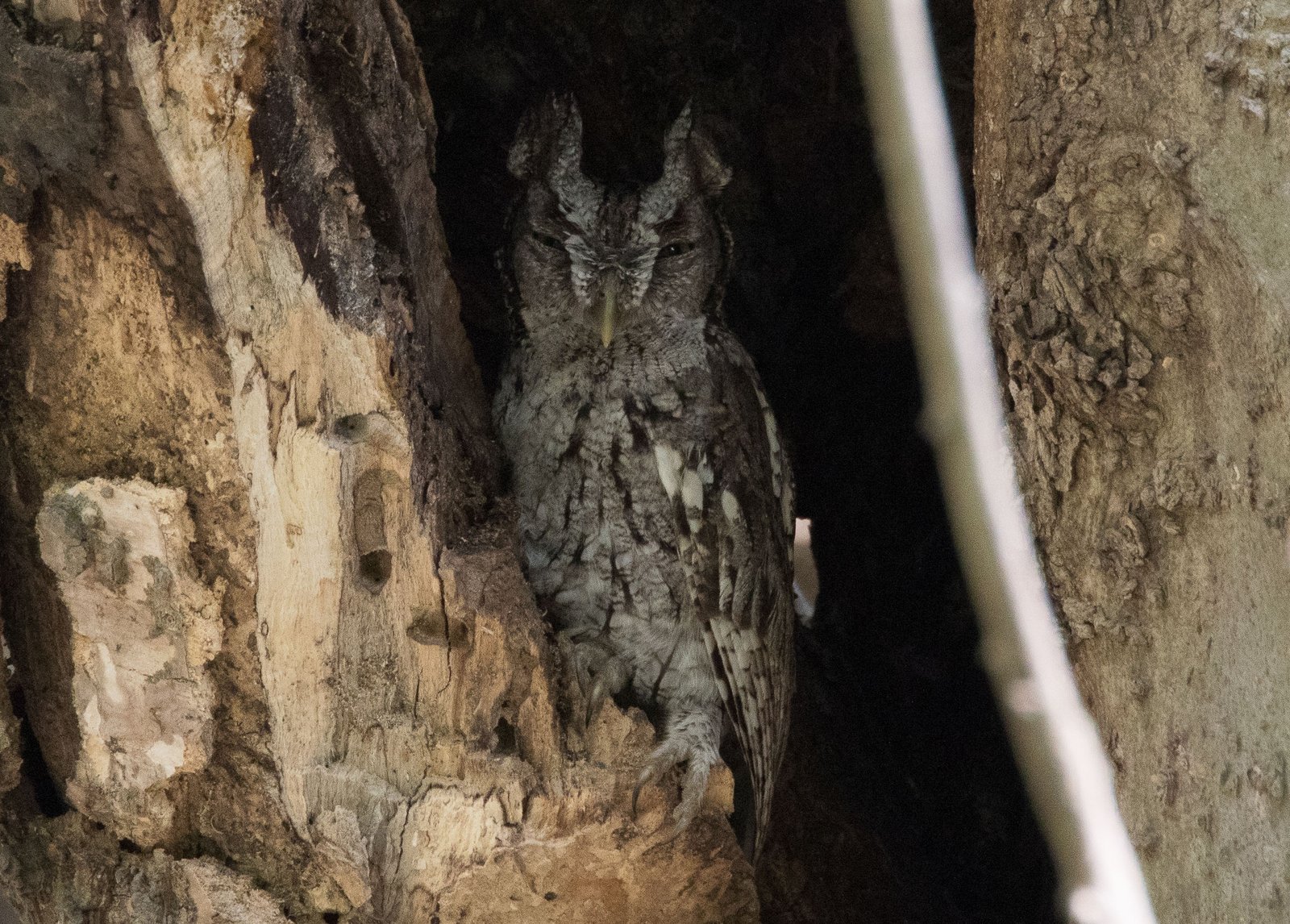
The Eastern Screech Owl is the small ear-tufted owl of eastern North America. Within the guide area it occurs only in northeastern Mexico, at the southern edge of its range. It lives in riparian woodland, thorn scrub and forest edges, and also in villages and parks. It is active only at night and is mostly detected by its whinnying song.
Voice
Two songs: a descending, wavering whinny of just over a second, like a small horse neighing in the distance, and an even, purring trill on one pitch lasting three to five seconds, used between partners. The male sings lower than the female. When disturbed it gives barks and bill-snaps.
Recording: Noah Khanti Steinberg — CC BY-NC-SA 4.0 · converted to mono · xeno-canto
Identification
16–25 cm, stocky, with a large, broad head, short ear tufts and a short tail. The plumage is grey with heavy black streaks and fine cross-bars on the underparts; elsewhere in its range a rufous morph also occurs, but among birds of southern Texas and northeastern Mexico it is rare. The eyes are yellow and the bill is pale yellowish green. Male and female are alike; the female is heavier.
Confusion species
The Western Screech Owl Megascops kennicottii is very similar but has a dark grey to blackish bill and sings a series of whistles that follow each other ever faster; in Mexico it lives mainly farther west, on the plateau and in the deserts. The Middle American Screech Owl Megascops guatemalae, in southern Tamaulipas, is browner, finely vermiculated below and sings a long trill. The Great Horned Owl Bubo virginianus has the same shape but is many times larger.
Habitat
Riparian woodland along rivers and streams, thorn scrub with larger trees, forest edges and the lower parts of oak and cloud forest in the Sierra Madre Oriental, also wooded pasture, villages, farmyards and parks. It nests in tree cavities, old woodpecker holes and nest boxes. It hunts at night from a perch for large insects, crayfish, mice, small birds and frogs.
Where the bird is most at home, classified by the vegetation units of Mexico and Central America.






Range and movements
A local resident in northeastern Mexico: in eastern Coahuila, Nuevo León and Tamaulipas, south to the area of Gómez Farías and the El Cielo Biosphere Reserve in southern Tamaulipas. Reports farther south, from San Luis Potosí and Veracruz, are old and uncertain. Outside the guide area in eastern North America, from southern Canada to Florida and Texas.
- Resident
- dark = core range, pale = thinly spread
How and when to look
Around Monterrey in Nuevo León and Gómez Farías in Tamaulipas the whinny can be heard in the evening in riparian woodland and villages with large trees. By day it roosts in a cavity or against a trunk, where small songbirds sometimes mob it noisily.
Conservation status
Not threatened. The species is common in North America and adapts well to villages and parks with old trees; in northeastern Mexico it is locally common and depends on riparian woodland and cavities in old trees.
Scientific name
Megascops asio | (Linnaeus, 1758)
Linnaeus described the species in 1758 as Strix Asio; because it was later moved to another genus, the author and year stand in brackets. The genus Megascops was introduced in 1848 by Kaup. Megascops combines the Greek megas 'great' with Scops, the old genus name of the scops owls. asio is Latin for a kind of horned owl, already mentioned by Pliny, after the ear tufts. The specimen the first description was based on came from South Carolina.