All species › Owls › Owls › Crested Owl
Position in the tree Birds Aves › Birds with a flexible palate Neognathae › All other modern birds Neoaves › Landbirds Telluraves › Raptors, owls, kingfishers and woodpeckers Afroaves › Hawks and owls Hieraves
Crested Owl | Lophostrix cristata
Kuifuil | Búho corniblanco
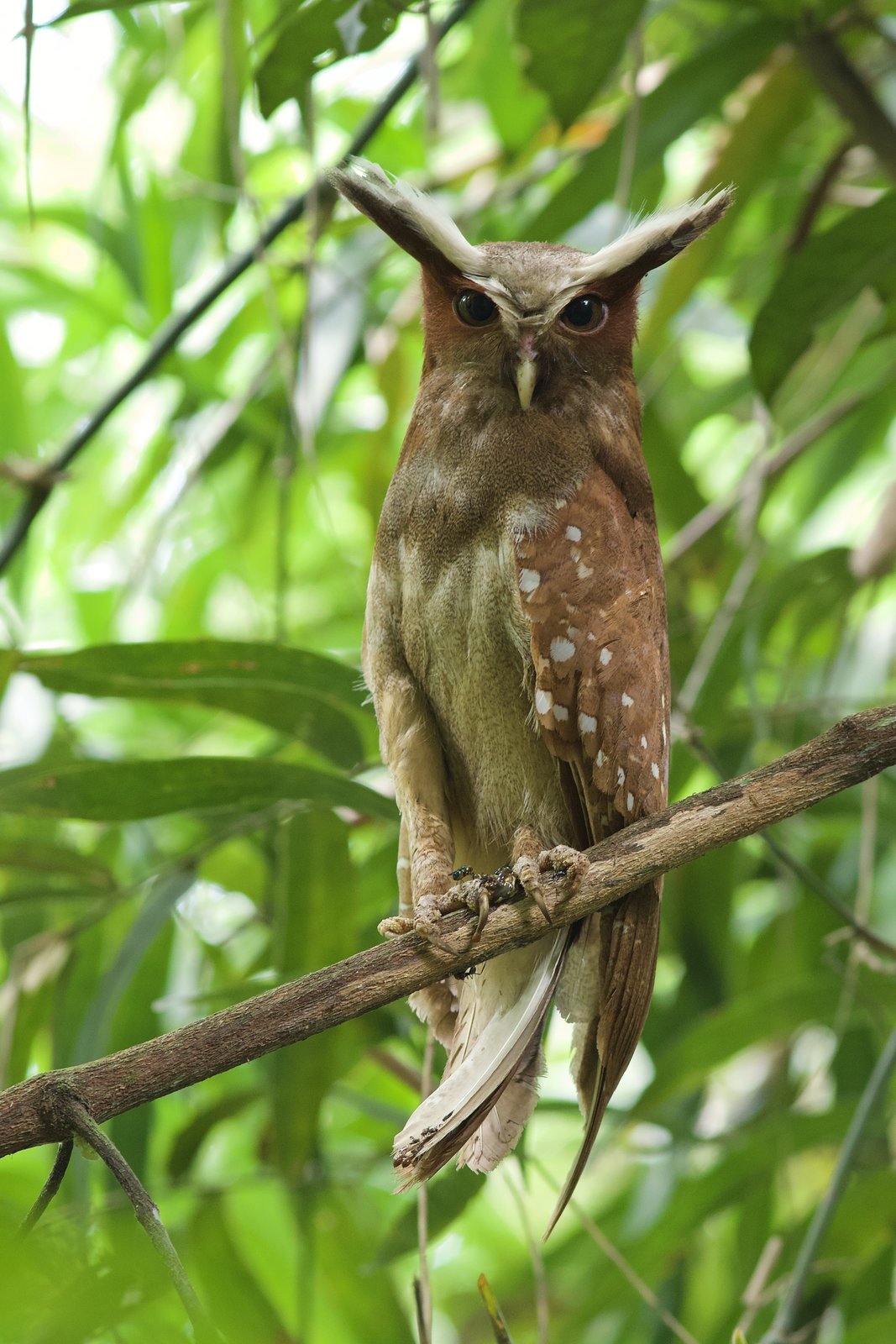
The Crested Owl is a medium-sized forest owl of humid lowland forest, recognisable by the long white ear tufts that continue into white eyebrows. It occurs from southern Mexico to Bolivia and Amazonia. In the guide area it lives in undisturbed forest, often along streams and rivers. It is active only at night and by day roosts, often in pairs, low in dense foliage.
Voice
The song is a low, far-carrying, growling grrrrrow, introduced by a short, stuttering rattle, k-k-kkkk, that accelerates into a deep, rough, guttural note. The sound is more reminiscent of a frog or a mammal than of an owl. Heard mainly in the first part of the night.
Recording: Juan Freile — CC BY-NC-SA 4.0 · shortened to the first 60 s, mono · xeno-canto
Identification
38–43 cm, with very long, white to buff ear tufts that stand out and up at an angle and merge at their base into a white eyebrow. The facial disc is rufous to dark brown with a dark rim. The upperparts are dark chocolate brown with small white spots on the wing; the underparts are paler brown to buff with fine dark vermiculation. Besides a dark morph there is a paler, more rufous morph. In Central America the eyes are yellow. Male and female are alike.
Confusion species
The Spectacled Owl Pulsatrix perspicillata lives in the same forest but is larger and lacks ear tufts; it has white spectacles around the eyes, a dark breast band and a plain buff belly. The Stygian Owl Asio stygius has closely set, dark ear tufts and heavily streaked underparts and lives mainly in highland pine forest. The Black-and-white Owl Strix nigrolineata and the Mottled Owl Strix virgata lack ear tufts.
Habitat
Humid lowland rainforest, flooded forest and gallery forest, especially old forest with undergrowth and snags near water; also hill forest up to about 1000 m and locally older secondary forest. It nests in large tree cavities. It hunts at night mainly for large insects such as beetles and grasshoppers, and also for small mammals.
Where the bird is most at home, classified by the vegetation units of Mexico and Central America.





Range and movements
Resident in southern Mexico, in southern Veracruz, Tabasco, Oaxaca and Chiapas, and on through Belize, Guatemala, Honduras, Nicaragua, Costa Rica and Panama, mainly on the Caribbean side but in Costa Rica and Panama also on the Pacific side. Rare in El Salvador. A second subspecies (wedeli) lives in eastern Panama. Outside the guide area in northern and central South America, to Bolivia and Brazilian Amazonia.
- Resident
- dark = core range, pale = thinly spread
How and when to look
Day roosts are often known to local guides, for example in lowland forest in Costa Rica such as La Selva and Carara. At night the low, growling call reveals its presence along streams in undisturbed forest.
Conservation status
Not threatened, but dependent on large tracts of undisturbed lowland forest; numbers are probably declining through deforestation in much of Central America.
Scientific name
Lophostrix cristata | (Daudin, 1800)
Daudin described the species in 1800 as Strix cristata; because it was later moved to another genus, the author and year stand in brackets. The genus Lophostrix was introduced in 1836 by Lesson. Lophostrix is Greek, from lophos 'crest' and strix 'owl', after the long white ear tufts. cristata is Latin for 'crested', after the long white ear tufts. The specimen the first description was based on came from the Guianas (not specified).