All species › Passerines › Tanagers and allies › Swallow Tanager
Position in the tree Birds Aves › Birds with a flexible palate Neognathae › All other modern birds Neoaves › Landbirds Telluraves › Falcons, parrots and passerines Australaves › Falcons and passerines Eufalconimorphae › Parrots and passerines Psittacopasserae
Swallow Tanager | Tersina viridis
Zwaluwtangare | Tangara golondrina
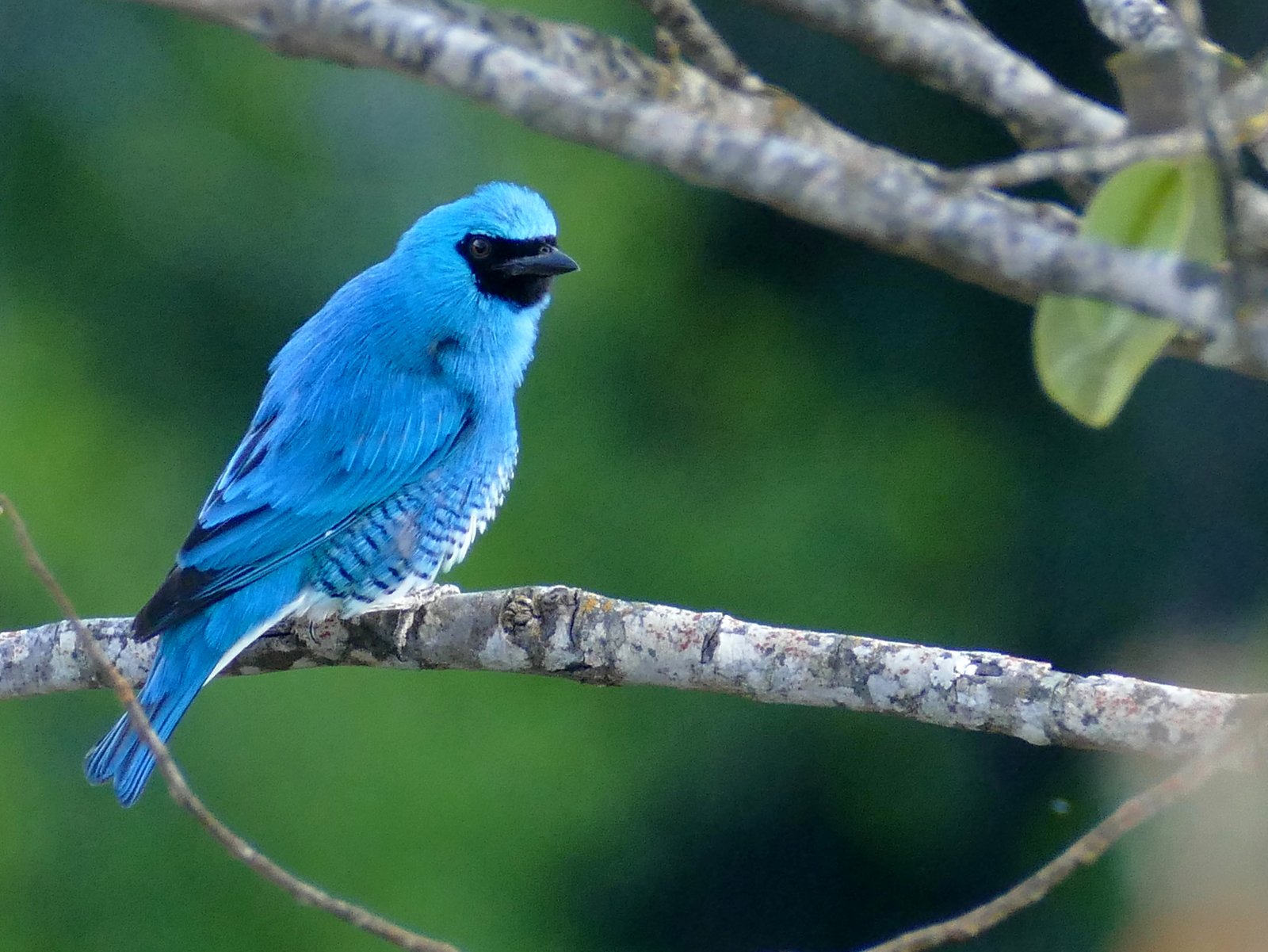
The Swallow Tanager is a tanager with long, pointed wings and a broad, flat bill that catches insects in the air from a bare branch, like a swallow. It also eats much fruit. It nests in holes in banks and walls. In the guide area it occurs only in eastern Panama.
Voice
A sharp, metallic tseep, often repeated, and a dry twitter. Displaying males bob their heads and call repeatedly.
Recording: Jacob Wijpkema — CC BY-NC-SA 4.0 · converted to mono · xeno-canto
Identification
14–15 cm. A compact tanager with a short, broad bill with a slightly hooked tip and long wings. The male is glossy turquoise-blue with a black mask and black throat; the belly is white with black bars on the flanks. The female is bright grass-green with a greyish throat, a yellow belly and green bars on the flanks. Young males are green with blue patches.
Confusion species
The male Blue Dacnis Dacnis cayana is smaller, has a pointed bill, a black back and no white belly. The female Green Honeycreeper Chlorophanes spiza has a slightly curved bill and no bars on the flanks. Female honeycreepers Cyanerpes are smaller and have a long, curved bill.
Habitat
Edges of humid lowland forest, clearings with tall bare trees, riverbanks and semi-open country with scattered trees, in the guide area mainly in the lowlands and foothills. Breeds in a hole in a steep bank or a wall.
Where the bird is most at home, classified by the vegetation units of Mexico and Central America.




Range and movements
Eastern Panama, mainly in Darién and eastern Panamá province; scarce and local, further west only as a vagrant. Outside the guide area across much of South America to northern Argentina; southern birds migrate.
- Resident
- dark = core range, pale = thinly spread
How and when to look
Best found by searching forest edges and riverbanks in Darién for bare branches high in the trees, where the species perches upright and makes short sallies after insects.
Conservation status
Not threatened (LC). Widespread and fairly common in South America; scarce and irregular in Panama.
Scientific name
Tersina viridis | (Illiger, 1811)
Illiger described the species in 1811 as Hirundo viridis; because it was later moved to another genus, the author and year stand in brackets. The genus Tersina was introduced in 1819 by Vieillot. Tersina comes from the French Tersine, an unidentified bird described by Buffon. viridis is Latin for 'green'. The specimen the first description was based on came from eastern Brazil.