All species › Passerines › Antbirds › Chestnut-backed Antbird
Position in the tree Birds Aves › Birds with a flexible palate Neognathae › All other modern birds Neoaves › Landbirds Telluraves › Falcons, parrots and passerines Australaves › Falcons and passerines Eufalconimorphae › Parrots and passerines Psittacopasserae
Chestnut-backed Antbird | Poliocrania exsul
Bruinrugmiervogel | Hormiguero dorsicastaño
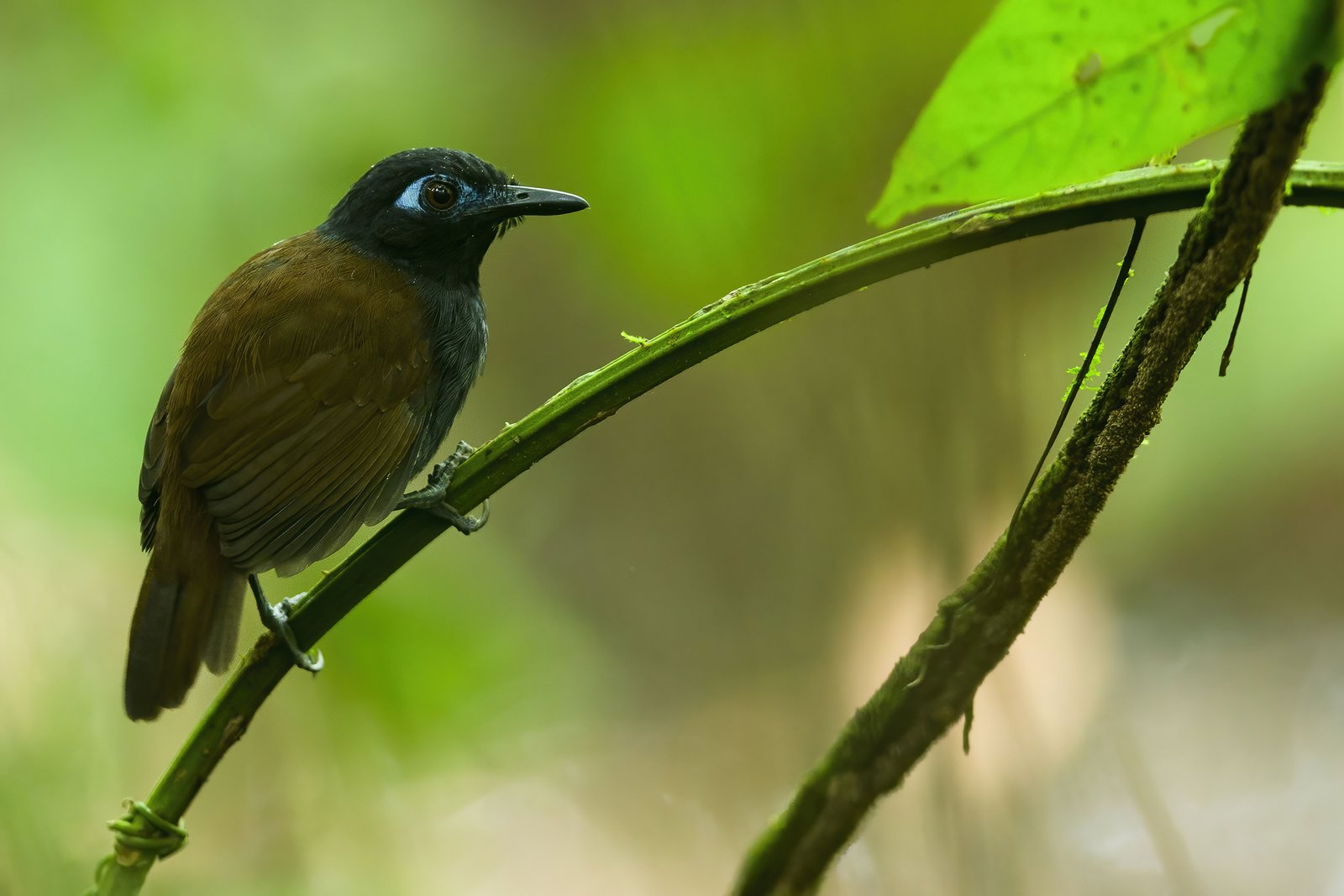
The Chestnut-backed Antbird is a stocky, short-tailed antbird with a dark head and a chestnut back. Pairs keep low in the dense undergrowth of humid forest and are heard more often than seen. In the guide area it lives from Honduras to Panama.
Voice
A clear, whistled song of two or three notes, the last usually lower. Both partners sing. Also short, harsh calls.
Recording: Juan Freile — CC BY-NC-SA 4.0 · shortened to the first 60 s, mono · xeno-canto
Identification
14 cm. Bare pale blue skin around the eye. The male has a dark slate-grey to blackish head, neck and underparts; back, wings and tail are chestnut. The female has the same dark head and chestnut upperparts but rufous-brown underparts. Birds in eastern Panama have a blacker head and small white spots on the wing coverts. Tail short.
Confusion species
Dull-mantled Antbird Sipia laemosticta is slightly smaller, with a red eye and white spots on the blackish wing coverts, and lives mainly in the foothills. Female Bare-crowned Antbird Gymnocichla nudiceps is larger, with an olive-brown head and more rufous underparts. Zeledon's Antbird Hafferia zeledoni is clearly larger and longer-tailed; the male is all black.
Habitat
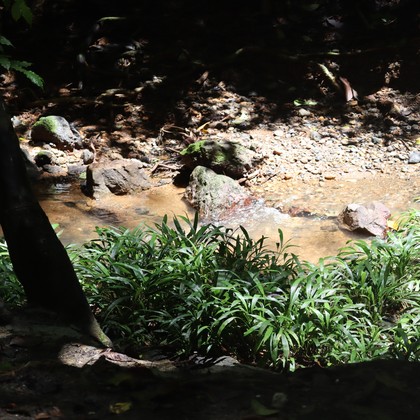
Undergrowth of humid lowland and foothill forest, especially dense growth at treefall gaps, along streams and in mature secondary forest; from sea level to about 900 m. It searches for insects and other invertebrates on or just above the ground, sometimes at army-ant swarms.
Where the bird is most at home, classified by the vegetation units of Mexico and Central America.



Range and movements
Caribbean slope of Honduras and Nicaragua to Costa Rica, where it also occurs on the southern Pacific slope; in Panama on both slopes. Outside the guide area in western Colombia and Ecuador.
- Resident
- dark = core range, pale = thinly spread
How and when to look
Common along Pipeline Road (Camino del Oleoducto) in Panama and at La Selva in Costa Rica. The whistled song usually gives the bird away before it is seen.
Conservation status
Not threatened. Fairly common in humid forest with dense undergrowth, including older secondary forest; disappears where the forest is cleared entirely.
Scientific name
Poliocrania exsul | (Sclater, 1859) (GBIF: Myrmeciza exsul)
Sclater described the species in 1859 as Myrmeciza exsul; because it was later moved to another genus, the author and year stand in brackets. The genus Poliocrania was introduced in 2013 by Bravo, Isler & Brumfield. Poliocrania is Greek, from polios 'grey' and kranion 'skull, head', after the grey head. exsul is Latin for 'exile', in the sense of remote or isolated; why Sclater chose the name is not recorded. The specimen the first description was based on came from Panama and Nicaragua.