All species › Waders, gulls and terns › Thick-knees and stone-curlews › Double-striped Thick-knee
Position in the tree Birds Aves › Birds with a flexible palate Neognathae › All other modern birds Neoaves › Birds of the elements Elementaves › Cranes and waders Gruimorphae
Double-striped Thick-knee | Hesperoburhinus bistriatus
Caribische griel | Alcaraván americano
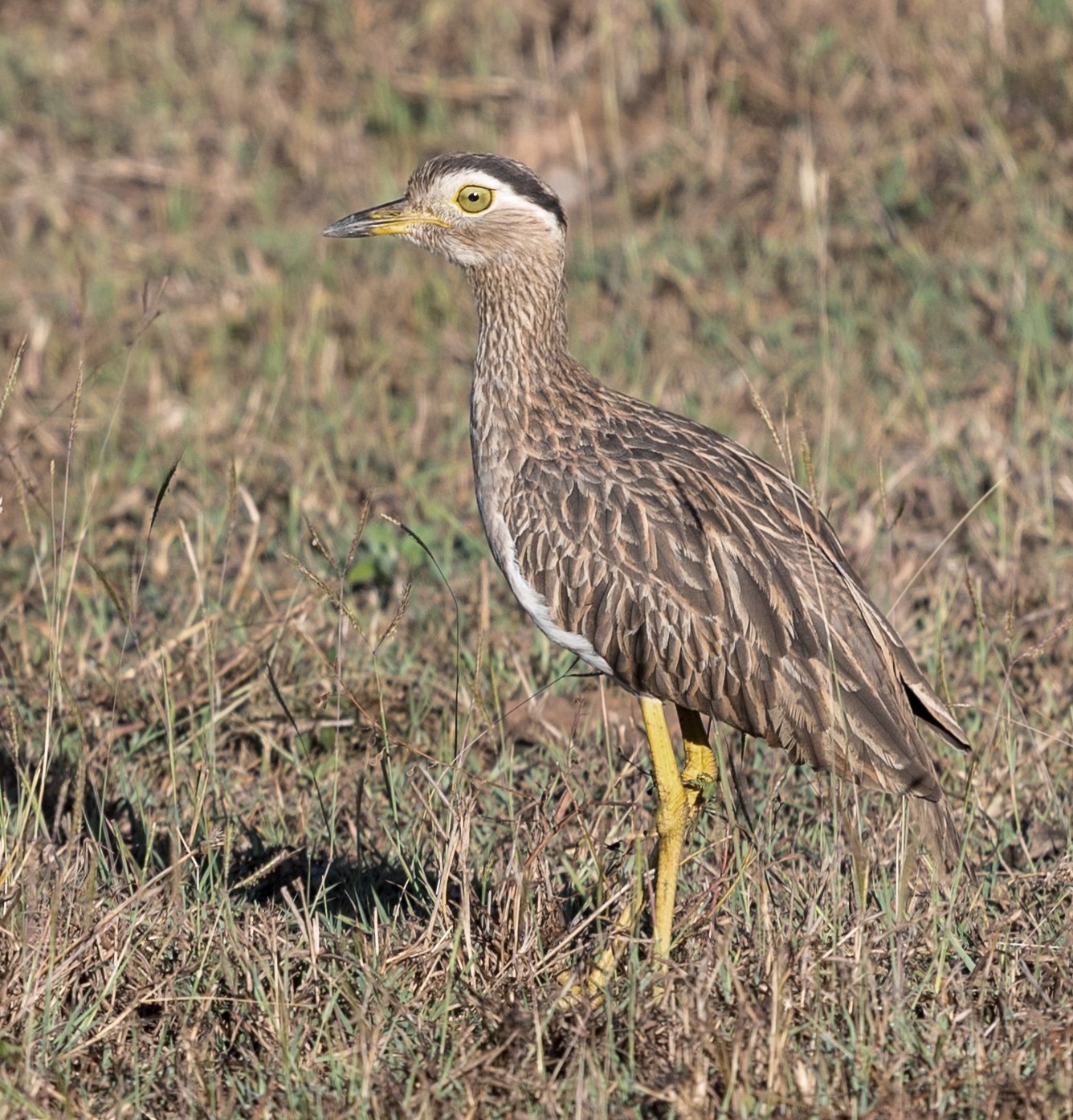
The Double-striped Thick-knee is a large, cryptically patterned shorebird with long legs, a heavy head and strikingly large yellow eyes, the only thick-knee in the guide area. It is active mainly at dusk and at night, spending the day standing motionless or crouched in open, dry country. In the guide area it is resident in savannas, pastures and dry open country, from southern Mexico to northwestern Costa Rica.
Voice
Heard mainly at night and at dusk: a loud, rapid series of shrill notes, like kee-kee-kee-kee, swelling and fading again and often given by several birds together. Disturbed birds give a short, sharp keek.
Recording: Alfonso Auerbach — CC BY-NC-SA 4.0 · converted to mono · xeno-canto
Identification
43–48 cm, standing upright on long, greenish-grey legs. The upperparts are grey-brown with fine dark streaks, the neck and breast pale brown and finely streaked, the belly white. A broad white supercilium is bordered above by a black stripe; this double stripe gives the species its English name. The large eye is yellow, the short, stout bill black with yellow at the base. In flight the dark wings show a white patch on the primaries. The sexes are alike; juveniles are slightly darker and less crisply marked.
Confusion species
There is no other thick-knee in the guide area. Killdeer Charadrius vociferus is much smaller, with two black breast bands and an orange rump. Southern Lapwing Vanellus chilensis, which is spreading in southern Central America, has a black breast, a thin crest and a pink bill base, and is active by day. At night its call differs from that of the Pauraque Nyctidromus albicollis, a whistled pu-weeeeur rather than a series of shrill notes.
Habitat
Dry, open country with low vegetation: savanna, closely grazed pasture with scattered trees, thorn scrub, dry field edges and clearings in dry forest, mainly in the lowlands. By day it rests in the shade of bushes and relies on its camouflage rather than flight; it prefers to walk away rather than fly. At night it hunts on the ground for insects, worms and other invertebrates, sometimes also taking lizards and small rodents. It lays two eggs in a bare scrape on the ground.
Where the bird is most at home, classified by the vegetation units of Mexico and Central America.




Range and movements
In southern Mexico, on the Pacific side mainly in Oaxaca and Chiapas, including the plains of the Isthmus of Tehuantepec, and on the Gulf side locally from central Veracruz southwards. Further in the Pacific lowlands and dry interior valleys of Guatemala, El Salvador, Honduras and Nicaragua, to northwestern Costa Rica (Guanacaste). It is absent from Panama. Birds in the guide area belong to the nominate subspecies H. b. bistriatus. Outside the guide area in northern Colombia, Venezuela, the Guianas and northern Brazil, and on Hispaniola.
- Resident
- dark = core range, pale = thinly spread
How and when to look
Good places are the pastures and dry savannas of Guanacaste in Costa Rica, including around Palo Verde, and the open plains of the Isthmus of Tehuantepec. The birds are best found at nightfall, when they start calling and come out into the open; at night the large eyes reflect the light of a lamp. By day a resting bird may stand motionless close to a track or yard.
Conservation status
Not threatened. In the guide area locally fairly common, especially in northwestern Costa Rica, and the species also occurs in pasture created by deforestation. Little has been documented about numbers and trends in Mexico and northern Central America.
Scientific name
Hesperoburhinus bistriatus | (Wagler, 1829)
Wagler described the species in 1829 as Charadrius bistriatus; because it was later moved to another genus, the author and year stand in brackets. The genus Hesperoburhinus was introduced in 2023 by Černý, van Els, Natale & Gregory. Hesperoburhinus combines Greek hesperos 'western' with Burhinus: the only thick-knee genus of the Western Hemisphere. bistriatus is Latin, from bi- 'two-' and striatus 'striped', after the double (white and black) stripe above the eye. The specimen the first description was based on came from Mexico.