All species › Passerines › Cardinals and allies › Dickcissel
Position in the tree Birds Aves › Birds with a flexible palate Neognathae › All other modern birds Neoaves › Landbirds Telluraves › Falcons, parrots and passerines Australaves › Falcons and passerines Eufalconimorphae › Parrots and passerines Psittacopasserae
Dickcissel | Spiza americana
Dickcissel | Arrocero americano
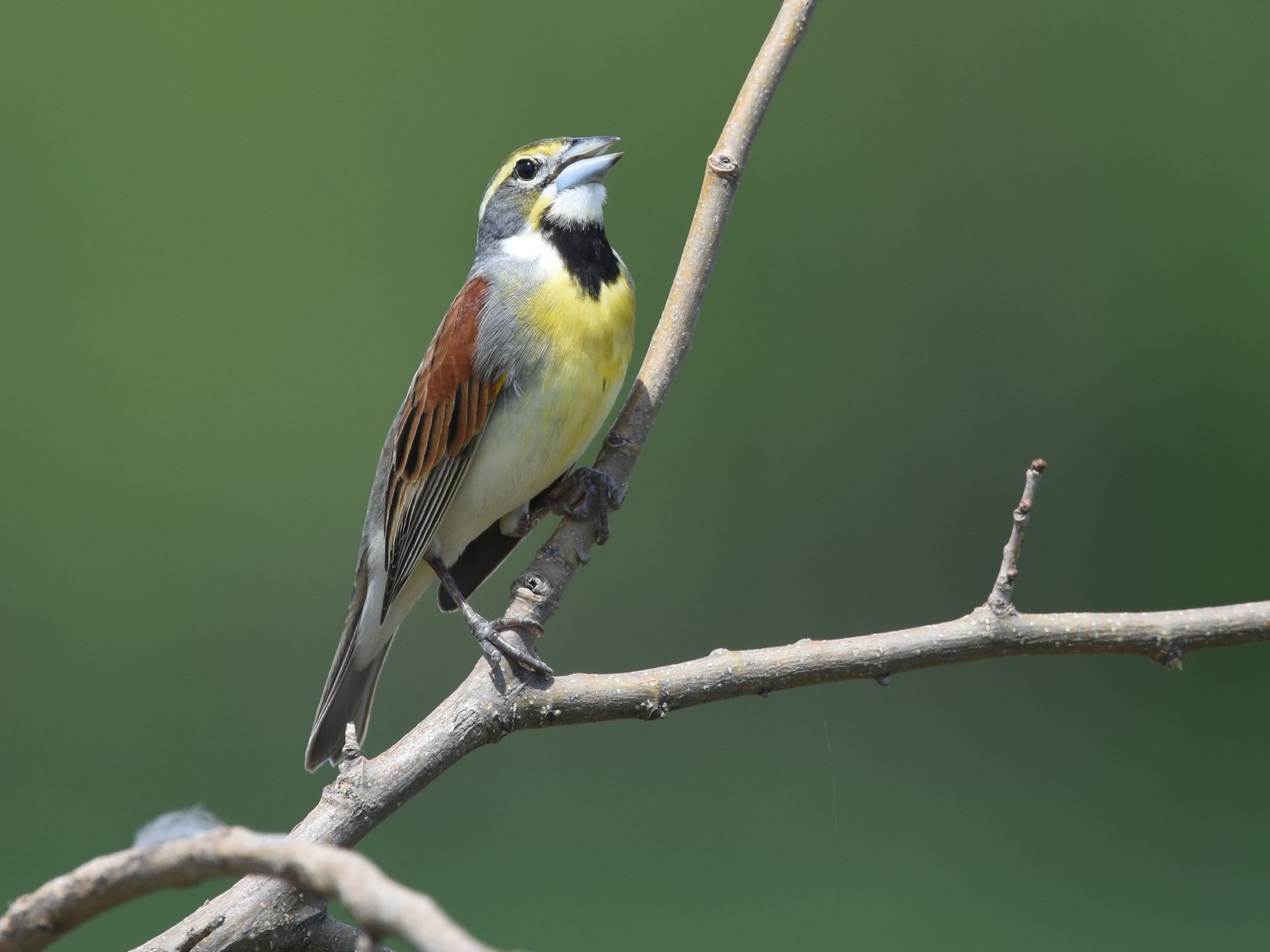
The Dickcissel is a sparrow-like songbird of grassland with a yellow breast, a chestnut shoulder patch and, in the male, a black bib. It breeds on the prairies of North America and winters mainly in northern South America. In the guide area it passes through in large flocks, mainly in the lowlands.
Voice
The song, sometimes heard on spring migration, is a dry dick-dick-ciss-ciss-ciss, which gives the species its name. The flight call is a low, buzzy brrt, also heard at night from passing flocks.
Recording: Anne McCormack — CC BY-NC-SA 4.0 · shortened to the first 60 s, mono · xeno-canto
Identification
14–16 cm. Bill heavy, conical and blue-grey. The breeding male has a grey head with a yellow eyebrow and yellow moustachial stripe, a white chin, a black V-shaped bib, a yellow breast, a chestnut shoulder patch and a brown back streaked black. The female is duller, with little yellow on the eyebrow and breast, little or no bib and a smaller chestnut shoulder patch. In winter plumage and in young birds it resembles a sparrow: buffy brown, with a pale eyebrow, fine streaks on the flanks and often a wash of yellow on the breast.
Confusion species
Female House Sparrow Passer domesticus lacks the yellow on the breast and the chestnut shoulder patch and has no flank streaks. Eastern Meadowlark Sturnella magna also has a yellow breast with a black V, but is much larger, with a long, pointed bill. Grassland Yellow Finch Sicalis luteola is streaked yellowish green, without a grey head or shoulder patch.
Habitat
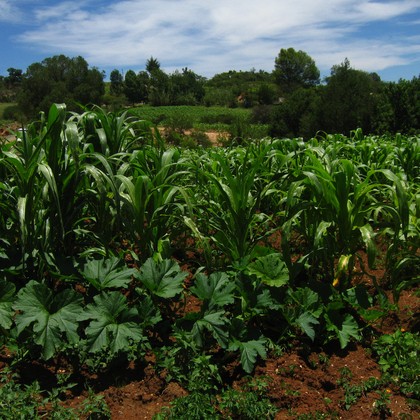
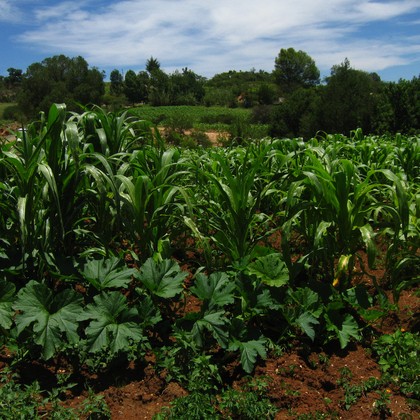
Open grassland, savanna, rice fields, fields of grain and sorghum, rank weedy areas and wet grasslands, mainly in the lowlands. It searches for seeds on the ground and in tall grasses, on migration often in flocks of hundreds or thousands of birds, and roosts in reedbeds or sugarcane.
Where the bird is most at home, classified by the vegetation units of Mexico and Central America.



Range and movements
Breeds in the central and eastern United States, with the largest numbers on the prairies, and in southern Canada. Migrates through eastern and southern Mexico and through Central America, mainly through the lowlands of the Pacific slope. Winters mainly in the llanos of Venezuela and adjacent Colombia; in smaller numbers also in the lowlands of Mexico and Central America.
- Passage (Mar–Apr, Oct–Nov)
- dark = core range, pale = thinly spread
How and when to look
On migration in September and October and in April regularly found in large flocks in rice fields and weedy areas in the Pacific lowlands, for example in Guanacaste in Costa Rica and in southern Mexico. The buzzy flight call is often the first sign of a passing flock.
Conservation status
Not threatened (LC). Common, but numbers fluctuate strongly from year to year. In the wintering area it is controlled as a pest in rice fields.
Scientific name
Spiza americana | (Gmelin, 1789)
Gmelin described the species in 1789 as Emberiza americana; because it was later moved to another genus, the author and year stand in brackets. The genus Spiza was introduced in 1824 by Bonaparte. Spiza is the Ancient Greek word for a finch, probably the chaffinch. americana is Latin for 'American'. The specimen the first description was based on came from New York.