All species › Passerines › Cardinals and allies › Grey-throated Chat
Position in the tree Birds Aves › Birds with a flexible palate Neognathae › All other modern birds Neoaves › Landbirds Telluraves › Falcons, parrots and passerines Australaves › Falcons and passerines Eufalconimorphae › Parrots and passerines Psittacopasserae
Grey-throated Chat | Granatellus sallaei
Grijskeelgranaatzanger | Granatelo yucateco
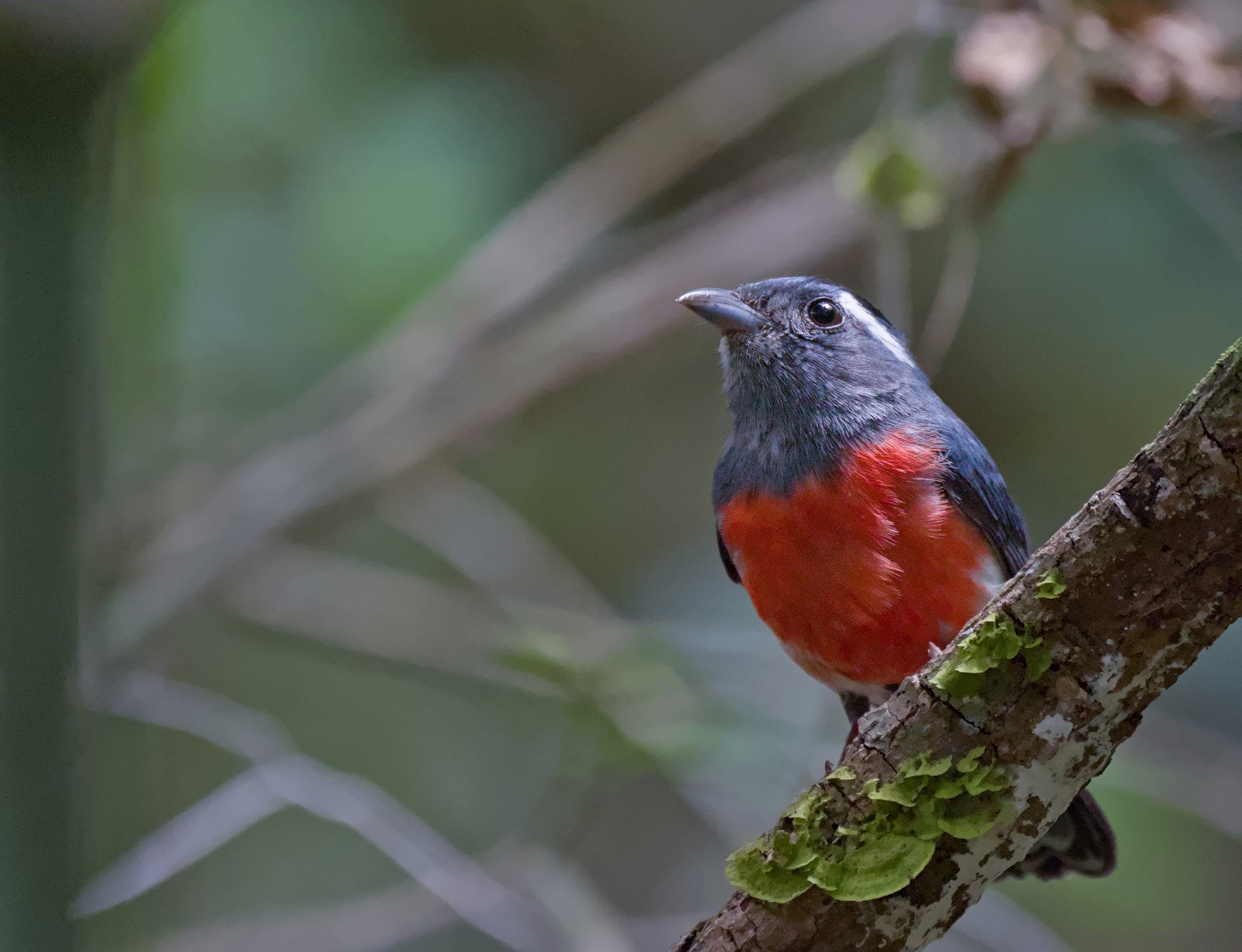
The Grey-throated Chat is a small, long-tailed songbird of lowland forest in south-eastern Mexico, Belize and northern Guatemala. The male is grey with a red breast and belly; the female grey and buff. Like Red-breasted Chat it belongs to the cardinal family.
Voice
The song is a short series of clear, whistled notes, roughly chuweet chuweet chuweet. The call is a nasal, rasping chet.
Recording: Bill Pyle — CC BY-NC-SA 4.0 · converted to mono · xeno-canto
Identification
12–13 cm. The male has a blue-grey head and upperparts, a short white stripe behind the eye, a grey throat and a red central breast, belly and undertail, with whitish flanks. The tail is grey to blackish, without broad white corners. The female has grey upperparts, a buff face with a pale stripe behind the eye, buff underparts and a pink-tinged undertail. Bill short and grey. It often flicks its tail.
Confusion species
Red-breasted Chat Granatellus venustus lives only on the Pacific slope of Mexico; the male has a white throat and broad white tail corners. Females of antwrens and other small grey understorey birds lack the pink undertail.
Habitat
Humid and semi-humid lowland forest, seasonal forest of the Yucatán Peninsula, mature secondary forest and dense forest edges; from sea level to about 500 m. It searches for insects in the dense lower and middle levels, often among vines, and sometimes joins mixed flocks.
Where the bird is most at home, classified by the vegetation units of Mexico and Central America.



Range and movements
Only in the guide area: the Caribbean lowlands of south-eastern Mexico, from southern Veracruz and northern Oaxaca through Tabasco and northern Chiapas to the Yucatán Peninsula, and on into Belize and northern Guatemala.
- Resident
- dark = core range, pale = thinly spread
How and when to look
In the forest of Calakmul in Campeche and around Tikal in Guatemala. The nasal call from vines and dense foliage is often the first sign.
Conservation status
Not threatened (LC). Fairly common in suitable forest, but sensitive to deforestation in the lowlands of south-eastern Mexico.
Scientific name
Granatellus sallaei | (Bonaparte, 1856)
Bonaparte described the species in 1856 as Setophaga sallaei; because it was later moved to another genus, the author and year stand in brackets. The genus Granatellus was introduced in 1850 by Bonaparte. Granatellus is a diminutive of New Latin granatus 'garnet-red', after the red on breast and belly. sallaei honours the French naturalist and collector Auguste Sallé (1820–1896), who collected in Mexico. The specimen the first description was based on came from Córdoba, Veracruz, Mexico.