All species › Passerines › Cardinals and allies › Blue-black Grosbeak
Position in the tree Birds Aves › Birds with a flexible palate Neognathae › All other modern birds Neoaves › Landbirds Telluraves › Falcons, parrots and passerines Australaves › Falcons and passerines Eufalconimorphae › Parrots and passerines Psittacopasserae
Blue-black Grosbeak | Cyanoloxia cyanoides
Blauwrugbisschop | Picogrueso negriazulado
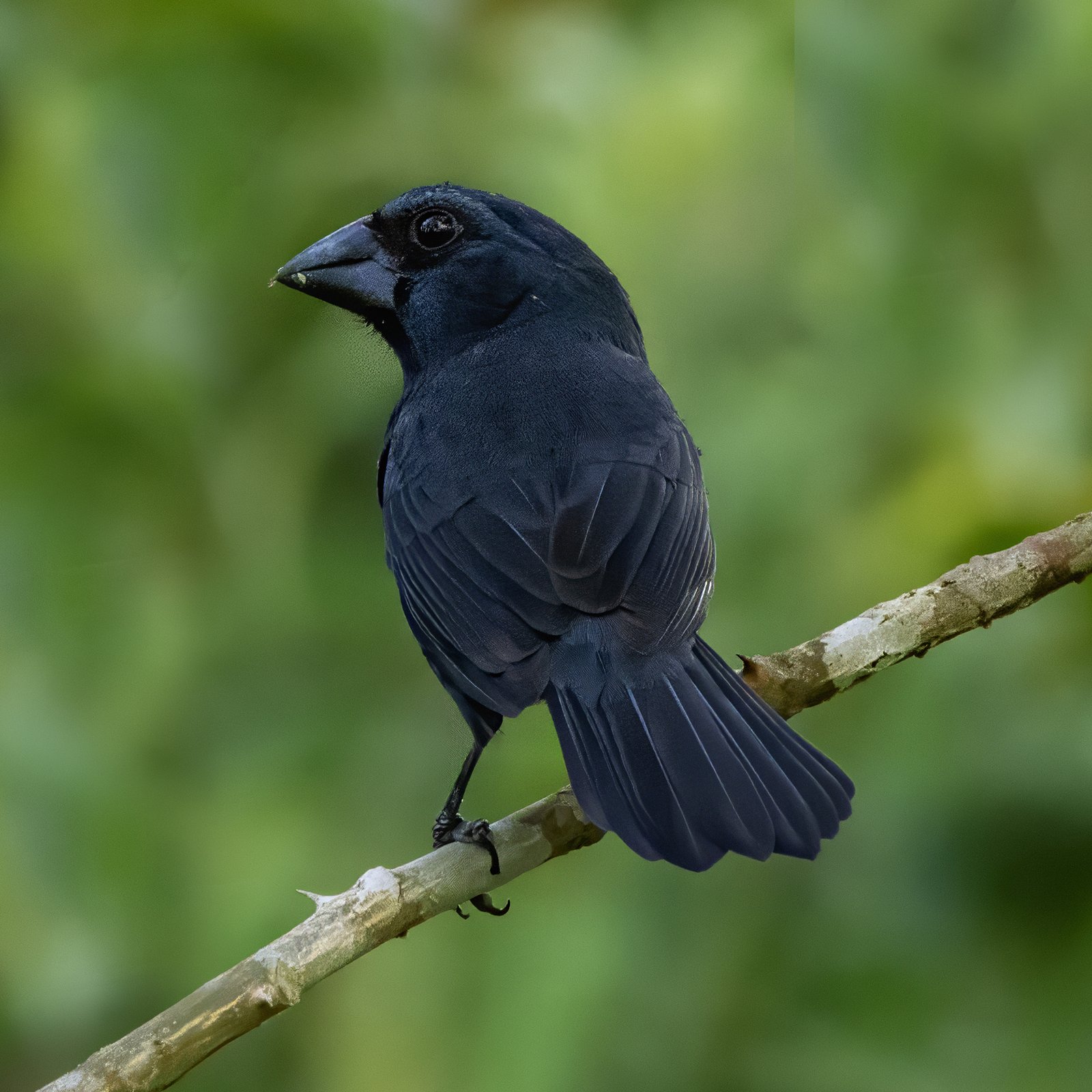
The Blue-black Grosbeak is a large, dark grosbeak with a heavy black bill. The male is almost entirely dark blue-black, the female uniform dark brown. It lives in the undergrowth of humid lowland and foothill forest and usually stays hidden in dense vegetation, where it is heard more often than seen.
Voice
The song is a series of clear, full whistles that begins slowly and speeds up and falls towards the end. The call is a sharp, metallic chink, often the first sign of its presence.
Recording: Juan Freile — CC BY-NC-SA 4.0 · converted to mono · xeno-canto
Identification
15–16 cm. Heavy, conical black bill. The male is dark blue-black, with brighter blue on the forehead, in a narrow eyebrow and on the lesser wing coverts; in poor light the whole bird looks black. The female is uniform warm chocolate brown, slightly paler below, without streaks or wing bars. Young birds resemble the female; young males gradually acquire blue-black patches.
Confusion species
Blue Bunting Cyanocompsa parellina is smaller, with a smaller bill; the male has more bright pale blue on the head, shoulder and rump, and the species lives mainly in drier forest. Blue Grosbeak Passerina caerulea has two rufous wing bars and lives in open country. Slate-colored Grosbeak Saltator grossus, from Honduras to Panama, is slate grey with a red bill. Blue-black Grassquit Volatinia jacarina is much smaller, glossy blue-black with a pointed bill, and lives in grassland.
Habitat
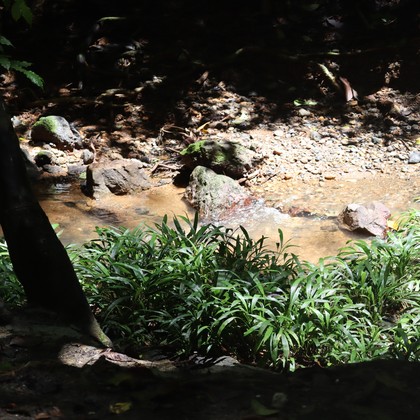
Undergrowth of humid lowland and foothill forest, especially forest edges, clearings, secondary forest, dense thickets along streams and overgrown clearings; mostly below 1200 m. Lives in pairs close to the ground and eats seeds, fruit and insects.
Where the bird is most at home, classified by the vegetation units of Mexico and Central America.




Range and movements
From southern Mexico (southern Veracruz, northern Oaxaca and Chiapas, Tabasco and the southern Yucatán Peninsula) along the Caribbean slope through Central America to Panama; in Costa Rica and Panama also on the Pacific slope. Further in northern and western South America; the birds of the Amazon basin are sometimes treated as a separate species.
- Resident
- dark = core range, pale = thinly spread
How and when to look
Usually located by the metallic chink and the whistled song from dense undergrowth along forest edges; waiting quietly at a clearing often brings the bird briefly into view.
Conservation status
Not threatened (LC). Fairly common and tolerates secondary forest; locally declining through deforestation.
Scientific name
Cyanoloxia cyanoides | (de Lafresnaye, 1847) (GBIF: Cyanocompsa cyanoides)
De Lafresnaye described the species in 1847 as Coccoborus cyanoides; because it was later moved to another genus, the author and year stand in brackets. The genus Cyanoloxia was introduced in 1850 by Bonaparte. Cyanoloxia is Greek, from kuanos 'dark blue' and Loxia (crossbill, a thick-billed finch): 'blue grosbeak'. cyanoides is Greek, from kuanos 'dark blue' and -oidēs 'resembling': 'bluish', after the male's blue plumage. The specimen the first description was based on came from Panama (unspecified).