All species › Gamebirds › Guans, curassows and chachalacas › Black Guan
Position in the tree Birds Aves › Birds with a flexible palate Neognathae › Fowl Galloanserae
Black Guan | Chamaepetes unicolor
Zwarte goean | Pava negra
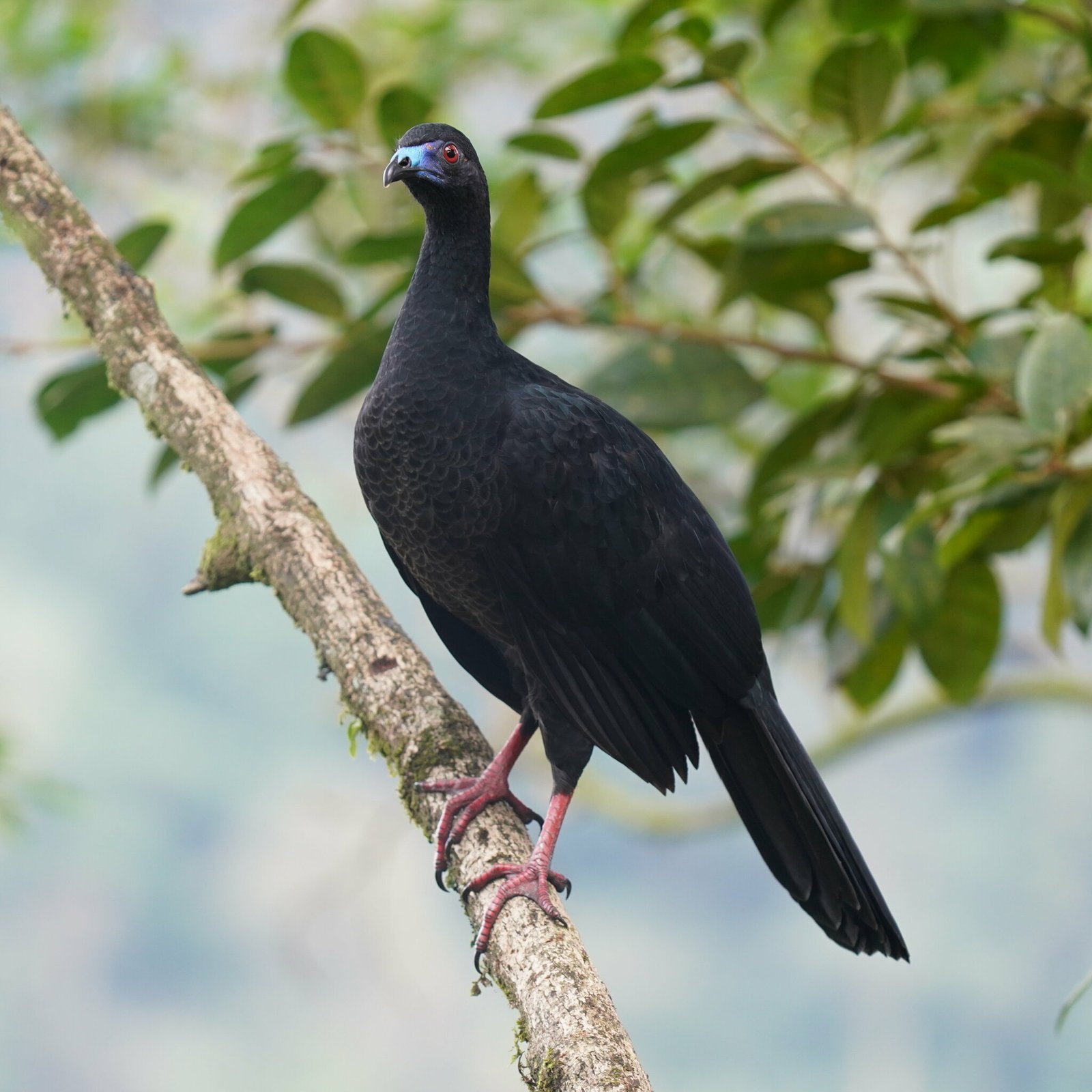
The Black Guan is a medium-sized, plain black guan of the montane rainforest of Costa Rica and western Panama. The bare blue face and red eyes stand out against the dark plumage. In protected areas the bird is often quite tame. The species does not occur outside the guide area.
Voice
Usually silent. In the breeding season the bird makes a crackling, rattling sound with its wings at dawn, during a short glide from tree to tree. Also soft, plaintive whistles and a low growl when alarmed.
Recording: Paul Driver — CC BY-NC-SA 3.0 · converted to mono · xeno-canto
Identification
62–67 cm; a fairly slender guan with a small head, a long, rounded tail and no crest or dewlap. The plumage is plain black with a blue gloss on the upperparts; the belly is slightly browner. The face around the eye is bare and bright blue, the eye red, the bill dark with a blue base and the legs pink to red. Male and female are alike.
Confusion species
Crested Guan Penelope purpurascens occurs together with Black Guan on the lower slopes, but is much larger, olive-brown with white streaks on the neck and breast, and has a bushy crest and a red dewlap. Male Great Curassows Crax rubra are also black, but much larger, with a curly crest, a yellow knob on the bill and a white belly, and live mainly lower down on the forest floor.
Habitat
Wet montane forest and cloud forest from about 1000 to 3000 m, mainly between 1200 and 2500 m, also forest edges and old clearings in the forest. It lives alone, in pairs or in small family groups, mainly in the mid-storey and canopy, but also comes to the ground. It eats mainly fruit, as well as leaves and flowers.
Where the bird is most at home, classified by the vegetation units of Mexico and Central America.

Range and movements
Highlands of Costa Rica, from the Cordillera de Guanacaste and Cordillera de Tilarán through the Cordillera Central to the Talamanca range, and western Panama in Chiriquí, Bocas del Toro, Veraguas and Coclé. The species does not occur outside the guide area.
- Resident
- dark = core range, pale = thinly spread
How and when to look
At Monteverde, Tapantí, the Talamanca range at San Gerardo de Dota and on the slopes of Barú in Chiriquí the bird is regularly seen, often in fruiting trees along trails. Where it is not hunted, it allows people to approach closely.
Conservation status
Not threatened. Common in large protected forests; outside them vulnerable to hunting and the loss of montane forest.
Scientific name
Chamaepetes unicolor | Salvin, 1867
Salvin described the species in 1867 and placed it straight away in the genus where it still stands. The genus Chamaepetes was introduced in 1832 by Wagler. Chamaepetes is Greek, from khamaipetēs 'falling to the ground', from khamai 'on the ground' and piptō 'to fall', as these guans come to the ground more often than Penelope. unicolor is Latin for 'of one colour', after the plain black plumage. The specimen the first description was based on came from Veraguas, Panama.