All species › Passerines › Tanagers and allies › Cinnamon-bellied Saltator
Position in the tree Birds Aves › Birds with a flexible palate Neognathae › All other modern birds Neoaves › Landbirds Telluraves › Falcons, parrots and passerines Australaves › Falcons and passerines Eufalconimorphae › Parrots and passerines Psittacopasserae
Cinnamon-bellied Saltator | Saltator grandis
Noordelijke grijze saltator | Saltador gris
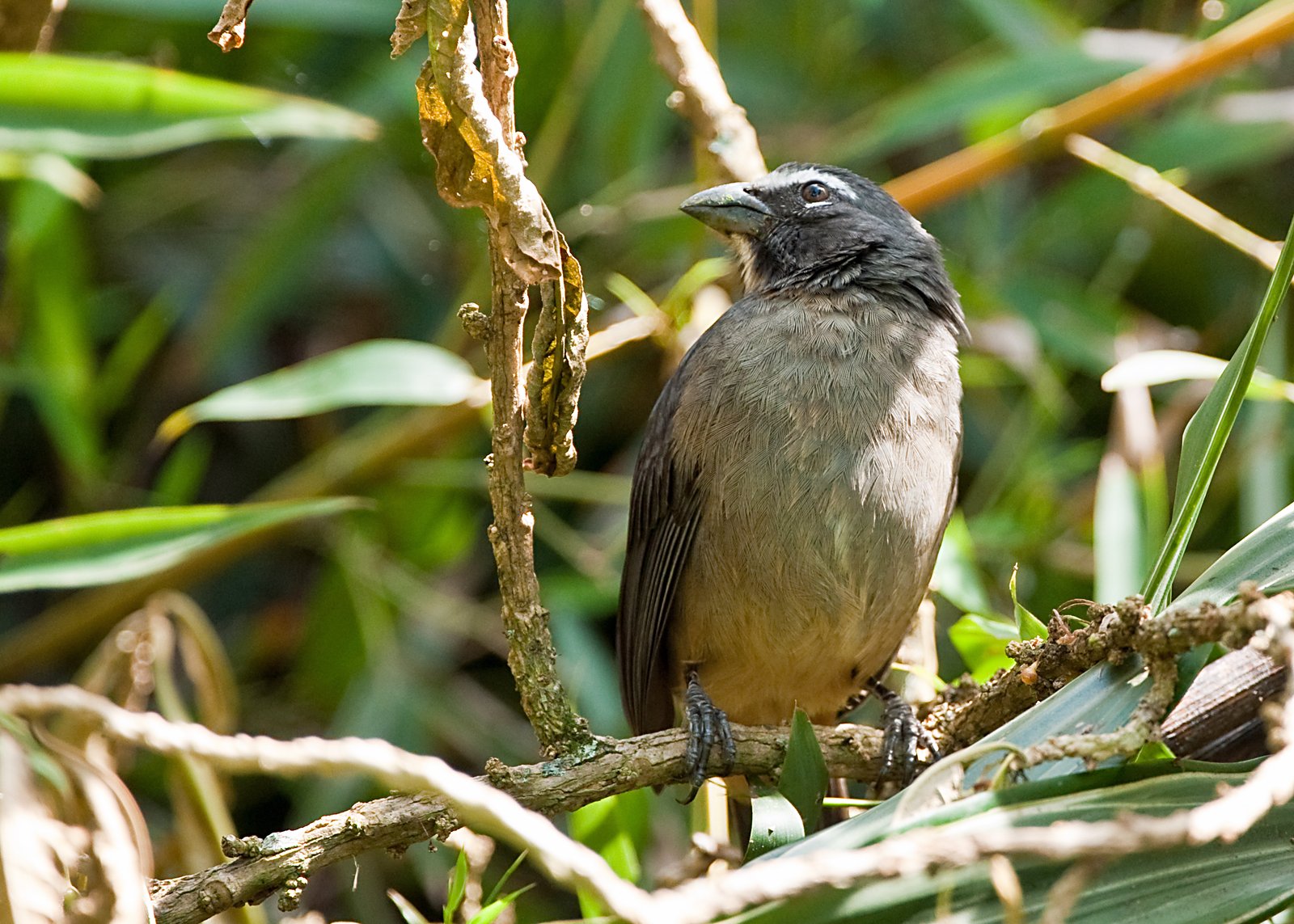
The Cinnamon-bellied Saltator is a large, grey tanager with a heavy black bill, a white supercilium, a white throat and a cinnamon belly. It lives in open and semi-open country, from dry scrub to gardens, and is one of the commonest saltators in the region. It occurs only in the guide area, from Mexico to western Panama.
Voice
Song a loud, clear series of whistled notes, often in the pattern chuweet chuweet chuweeeer, with a longer, falling final note; it sings a lot, even in the middle of the day. Call a sharp, metallic chink.
Recording: Manuel Grosselet — CC BY-NC-SA 4.0 · converted to mono · xeno-canto
Identification
20–22 cm. Upperparts plain grey, sometimes with a faint olive tinge. White supercilium extending behind the eye. Throat white, bordered by a narrow black malar stripe. Breast grey, merging into warm cinnamon to buff on the belly; undertail coverts cinnamon. Bill heavy and black. Male and female alike; young birds are more olive, with a yellowish supercilium and a yellowish, mottled throat.
Confusion species
Olive-grey Saltator Saltator olivascens (in the guide area only in Darién in eastern Panama) has more olive-grey upperparts and a paler belly. Buff-throated Saltator Saltator maximus has olive-green upperparts and a buff lower throat. Black-headed Saltator Saltator atriceps is larger, with a black or blackish-grey head and an olive-green back. Streaked Saltator Saltator striatipectus has a streaked breast.
Habitat
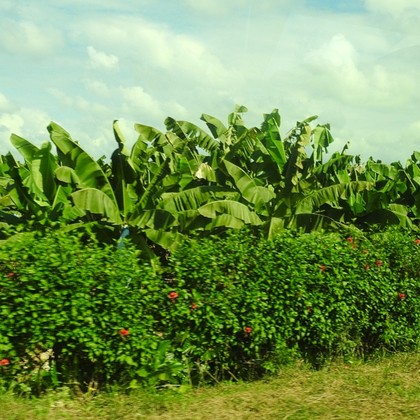
Open and semi-open country with shrubs and trees: scrub, hedgerows, forest edges, secondary forest, pasture with trees, plantations, farmyards, gardens and parks, in both humid and dry regions, from sea level to about 1800 m. It eats fruit, flowers, buds, leaves and insects. It lives in pairs or small family groups.
Where the bird is most at home, classified by the vegetation units of Mexico and Central America.






Range and movements
Mexico, on the Pacific slope from southern Sinaloa and on the Gulf slope from southern Tamaulipas, through southern Mexico and the Yucatán Peninsula, Belize, Guatemala, El Salvador, Honduras, Nicaragua and Costa Rica to western Panama, where it occurs in Bocas del Toro and Chiriquí. It does not occur outside the guide area.
- Resident
- dark = core range, pale = thinly spread
How and when to look
Common in gardens, farmyards and along hedged roads in much of Mexico and Central America; its loud song often gives it away before the bird is seen. It also visits fruit feeders.
Conservation status
Not threatened (LC). Common and widespread; it benefits from deforestation and semi-open farmland.
Scientific name
Saltator grandis | (Deppe, 1830)
Deppe described the species in 1830 as Tanagra grandis; because it was later moved to another genus, the author and year stand in brackets. The genus Saltator was introduced in 1816 by Vieillot. Saltator is Latin for 'dancer, leaper', after the birds' hopping movements. grandis is Latin for 'large', after its hefty size for a tanager. The specimen the first description was based on came from Xalapa, Veracruz, Mexico.