All species › Passerines › New World sparrows › Chipping Sparrow
Position in the tree Birds Aves › Birds with a flexible palate Neognathae › All other modern birds Neoaves › Landbirds Telluraves › Falcons, parrots and passerines Australaves › Falcons and passerines Eufalconimorphae › Parrots and passerines Psittacopasserae
Chipping Sparrow | Spizella passerina
Musgors | Gorrión ceja blanca
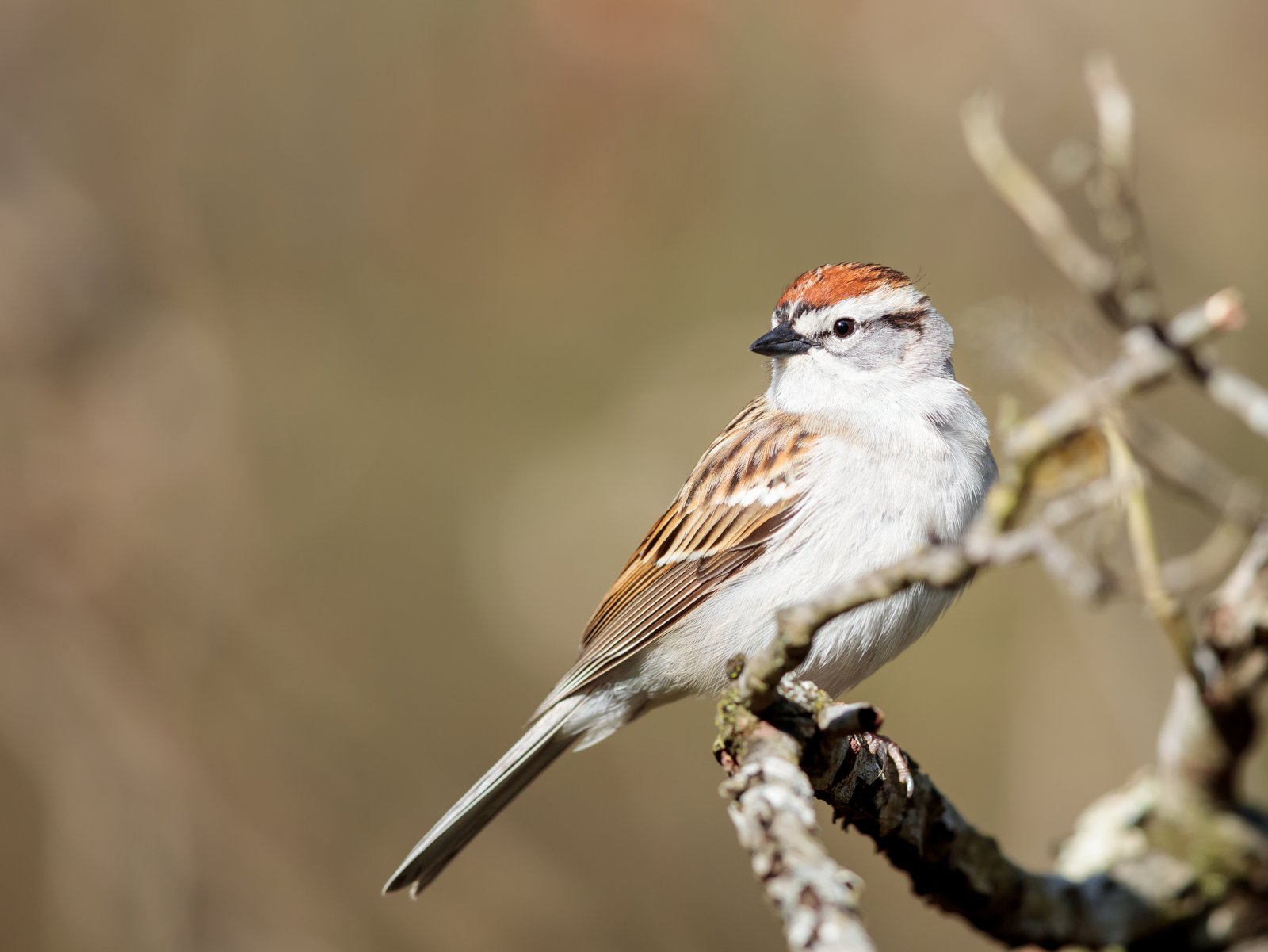
The Chipping Sparrow is a small, slim sparrow with a rufous crown. In North America it is a common breeding bird of parks and gardens; in the guide area there are also resident birds in the pine forests of the highlands, from northern Mexico to Nicaragua. In winter large numbers of migrants from the north join them.
Voice
The song is a dry, mechanical trill on one pitch, such as chipipipipipipi, lasting a few seconds. The call is a short, sharp tsip; in flight a thin tseet.
Recording: Richard E. Webster — CC BY-NC-SA 4.0 · converted to mono · xeno-canto
Identification
12–15 cm. Small and slim, with a fairly long, slightly notched tail and a small bill. In breeding plumage a plain rufous crown, a white supercilium and a black eye-stripe that reaches the bill. Cheek, nape and underparts plain grey, back brown with black streaks, rump grey. Bill dark in the breeding season. In non-breeding plumage and in juveniles the crown is streaked brown, the supercilium buff and the bill paler, but the dark eye-stripe reaching the bill and the grey rump remain. The sexes are alike.
Confusion species
Clay-colored Sparrow Spizella pallida has a buff-brown cheek with a dark outline, a pale median crown stripe, no dark lores and a brown rump. Brewer's Sparrow Spizella breweri is more finely streaked on head and nape, lacks a clear median crown stripe and has a white eye-ring. Field Sparrow Spizella pusilla has a pink bill, a grey face with a white eye-ring and no black eye-stripe.
Habitat
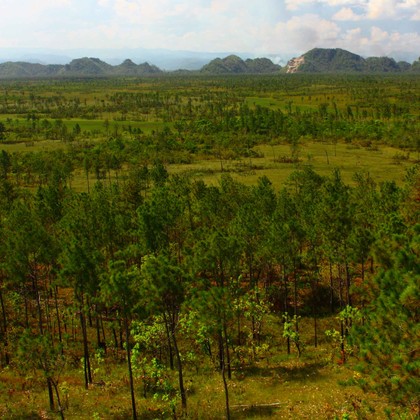
Open pine and pine-oak forest with a grassy understorey, forest edges and pasture with scattered trees in the highlands; in Belize, Honduras and Nicaragua also lowland pine savanna. In winter additionally parks, gardens, field edges and other semi-open country. It forages on the ground for seeds, often in flocks, and flies up into a tree when disturbed.
Where the bird is most at home, classified by the vegetation units of Mexico and Central America.




Range and movements
Breeds from Canada across much of the United States to Mexico and Central America. In the guide area resident in the highlands of Mexico, from the Sierra Madre Occidental and Oriental to the Trans-Mexican Volcanic Belt and Chiapas, and further in the highlands of Guatemala, El Salvador, Honduras and northern Nicaragua; also in the pine savannas of Belize, eastern Honduras and north-eastern Nicaragua. North American migrants winter over much of Mexico, especially in the north and on the central plateau.
- Resident
- dark = core range, pale = thinly spread
How and when to look
In pine forest the dry trill is often the first sign; in winter flocks sit on the ground along forest edges and fly up together into a tree.
Conservation status
Not threatened (LC). One of the most numerous sparrows of North America and locally common in the highlands of the guide area. The isolated populations in the pine savannas of Central America depend on open pine forest and are sensitive to deforestation and changes in fire regime.
Scientific name
Spizella passerina | (Bechstein, 1798)
Bechstein described the species in 1798 as Fringilla passerina; because it was later moved to another genus, the author and year stand in brackets. The genus Spizella was introduced in 1831 by Bonaparte. Spizella is a diminutive of the Greek spiza 'finch': 'little finch'. passerina is Latin for 'sparrow-like', from passer 'sparrow'. The specimen the first description was based on came from Quebec City, Canada.