All species › Passerines › New World blackbirds, troupials and allies › Chihuahuan Meadowlark
Position in the tree Birds Aves › Birds with a flexible palate Neognathae › All other modern birds Neoaves › Landbirds Telluraves › Falcons, parrots and passerines Australaves › Falcons and passerines Eufalconimorphae › Parrots and passerines Psittacopasserae
Chihuahuan Meadowlark | Sturnella lilianae
Lilians weidespreeuw | Pradero chihuahuense
The Chihuahuan Meadowlark is a meadowlark of the semi-desert grasslands of the south-western United States and north-western and western Mexico. It was long treated as a subspecies of Eastern Meadowlark, but differs in plumage and genetics and is now recognised as a separate species.
Voice
The song consists of a few clear, drawn-out whistles and closely resembles that of Eastern Meadowlark. The call is a buzzy dzzrt; also a dry rattle.
Recording: Oohlookitsarabbit — CC BY-NC 4.0 · converted to mono · iNaturalist
Identification
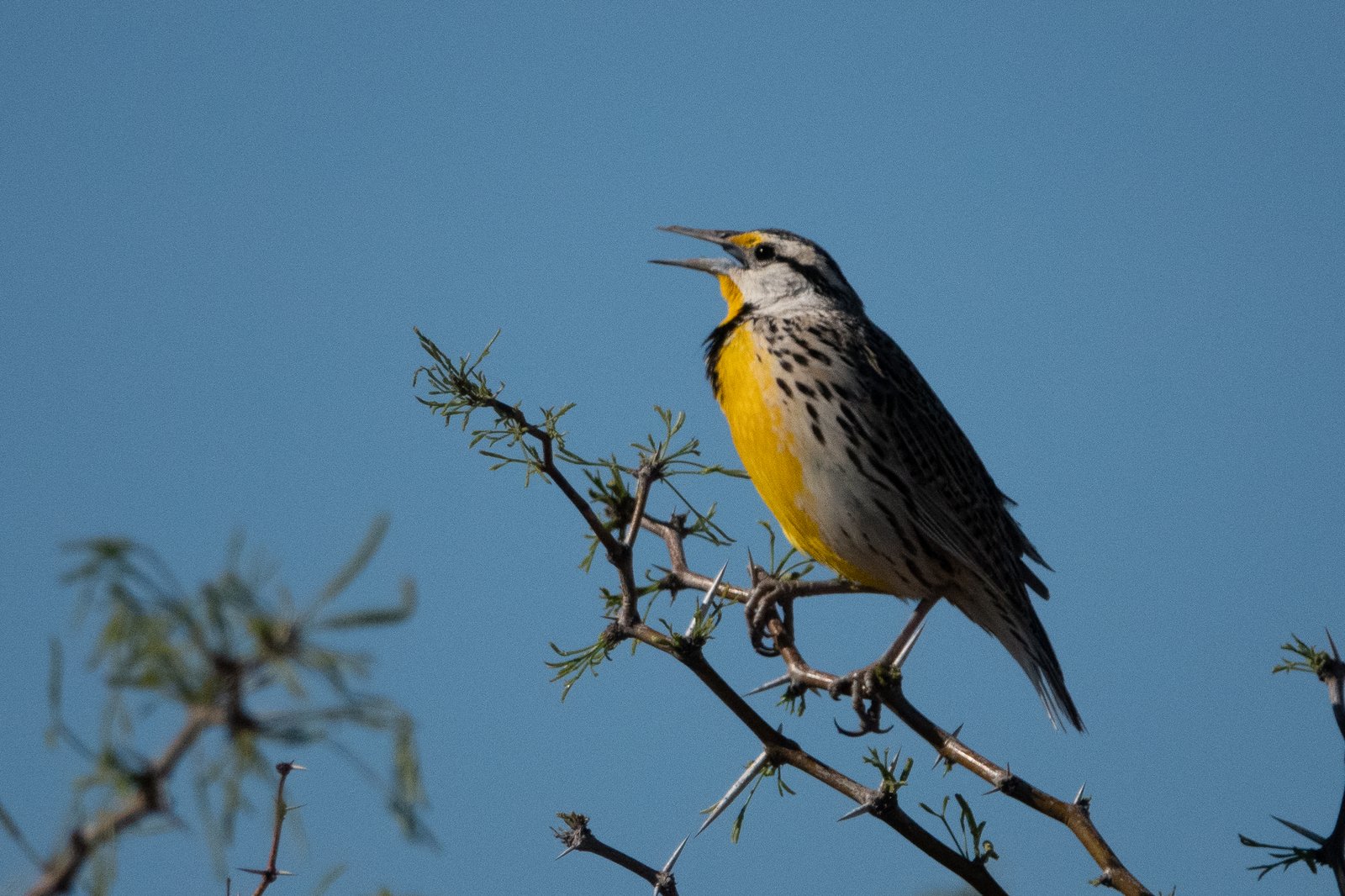
20–24 cm. Built like the other meadowlarks: stocky, with a long, pointed bill, a flat head and a short tail. Upperparts pale greyish-brown with black streaks, crown with black-and-white stripes, face fairly white with a narrow dark eyestripe. Throat and breast yellow with a black V; the malar area below the cheek is white. Flanks pale with fine dark streaks. The tail shows much white: the outer three feathers are almost entirely white and the fourth is largely white. The sexes are alike.
Confusion species
Eastern Meadowlark Sturnella magna is darker above and has less white in the tail; both species sing in a similar way. Western Meadowlark Sturnella neglecta, which occurs in winter in the same area, has yellow in the malar area, less white in the tail, a bubbling song and a low chuck call. For birds in winter, the combination of face, tail pattern and call is needed for a certain identification.
Habitat
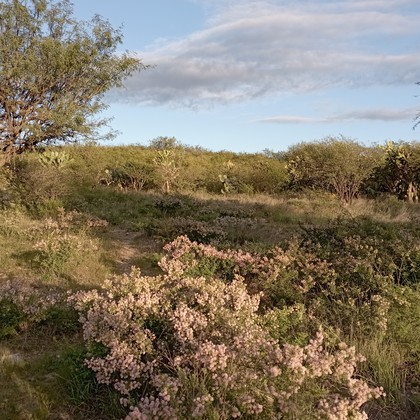
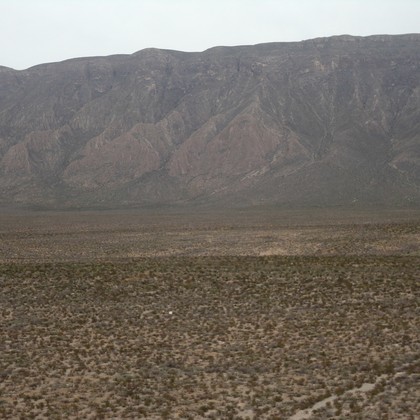
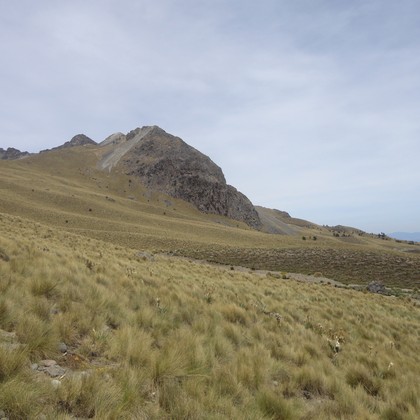
Semi-desert grassland with scattered shrubs and yuccas, open highland grassland and grazed grassland. Avoids dense scrub. It forages walking on the ground for insects and seeds.
Where the bird is most at home, classified by the vegetation units of Mexico and Central America.

Range and movements
Occurs in south-eastern Arizona, New Mexico and western Texas, and in Mexico in Sonora, Chihuahua, Durango and northern Coahuila. A darker subspecies lives in the grasslands of western and central Mexico, from Sinaloa and Durango to Jalisco, Michoacán and Guanajuato. The boundaries with Eastern Meadowlark in north-eastern and central Mexico are not yet precisely known.
- Resident
- dark = core range, pale = thinly spread
How and when to look
In open semi-desert grassland best found by its song from a post or yucca. In a bird in flight the large white tail sides are clearly visible.
Conservation status
Near Threatened (NT). The species has not yet been assessed separately at global level; the assessment of Eastern Meadowlark in the broad sense, in which it was formerly included, is used here. Overgrazing, shrub encroachment and the conversion of grassland to cropland are the main threats.
Scientific name
Sturnella lilianae | Oberholser, 1930
Oberholser described the species in 1930 and placed it straight away in the genus where it still stands. The genus Sturnella was introduced in 1816 by Vieillot. Sturnella is a Latin diminutive of sturnus 'starling': 'little starling'. lilianae honours Lilian Hanna Baldwin, wife of the American ornithologist Samuel Prentiss Baldwin, who gave the bird collection containing the type to the Cleveland Museum of Natural History. The specimen the first description was based on came from Huachuca Mountains, Arizona (USA).